
Most of what a company does to prepare for a public issue can be done in the year it decides to file. Fixed asset and inventory records are the exception. By the time the decision is taken, the years that will be examined have already happened.
This page sets out why those two areas cause difficulty at IPO stage more often than their apparent simplicity suggests, and links to a 22-page checklist you can work through against your own records.
The records were built for a different purpose
In a growing company the fixed asset register exists to compute depreciation. It holds cost, capitalisation date, rate and written down value, and it agrees with the ledger because it was built from the ledger. What it often does not hold is a unique identifier for each asset, where that asset physically sits today, who is responsible for it, or any record that a person has laid eyes on it since the invoice was booked.
Inventory records develop the same way. Counts happen to arrive at a closing valuation. They are not usually designed to demonstrate that a control operated — that a defined population was counted, by named people, against a written method, with differences chased down rather than absorbed.
None of this is negligent. It is a reasonable allocation of effort for a private company. It simply produces records that answer one question, and a public issue asks a different one.
What changes when you file
Three financial years and a stub period are restated and re-audited. The same records are then examined by a peer reviewed auditor, by the book running lead managers, and by legal counsel conducting due diligence.
The question shifts. It is no longer whether the register agrees with the ledger. It is whether the register agrees with what physically exists, and whether you can show that somebody checked. Every remark made on those years carries forward into the restated accounts and, where material, into the offer document.
Fixed asset verification before IPO: the part that cannot be fixed later
A process can be corrected today. Fixed asset verification before IPO can be delayed, but it cannot be performed retrospectively for a financial year that has already closed.
If a year inside the restated period passed without a documented verification of fixed assets, or without a properly evidenced inventory count, that gap is permanent. It can be disclosed, explained and put in context. It cannot be filled in afterwards. This is the single reason the work belongs well before a filing rather than during one.
A misreading worth correcting
CARO 2020, notified by the Ministry of Corporate Affairs, is frequently described as requiring companies to verify their assets. It does not. It is a reporting order directed at the statutory auditor, requiring the auditor to state whether management maintained proper records, whether management verified at reasonable intervals, and whether discrepancies were properly dealt with in the books.
The distinction matters in practice. The burden of producing evidence sits entirely with management. Where a company cannot demonstrate that a verification took place, the auditor has nothing to report favourably — and says so, in a document that will be read closely.
Why it has to start early
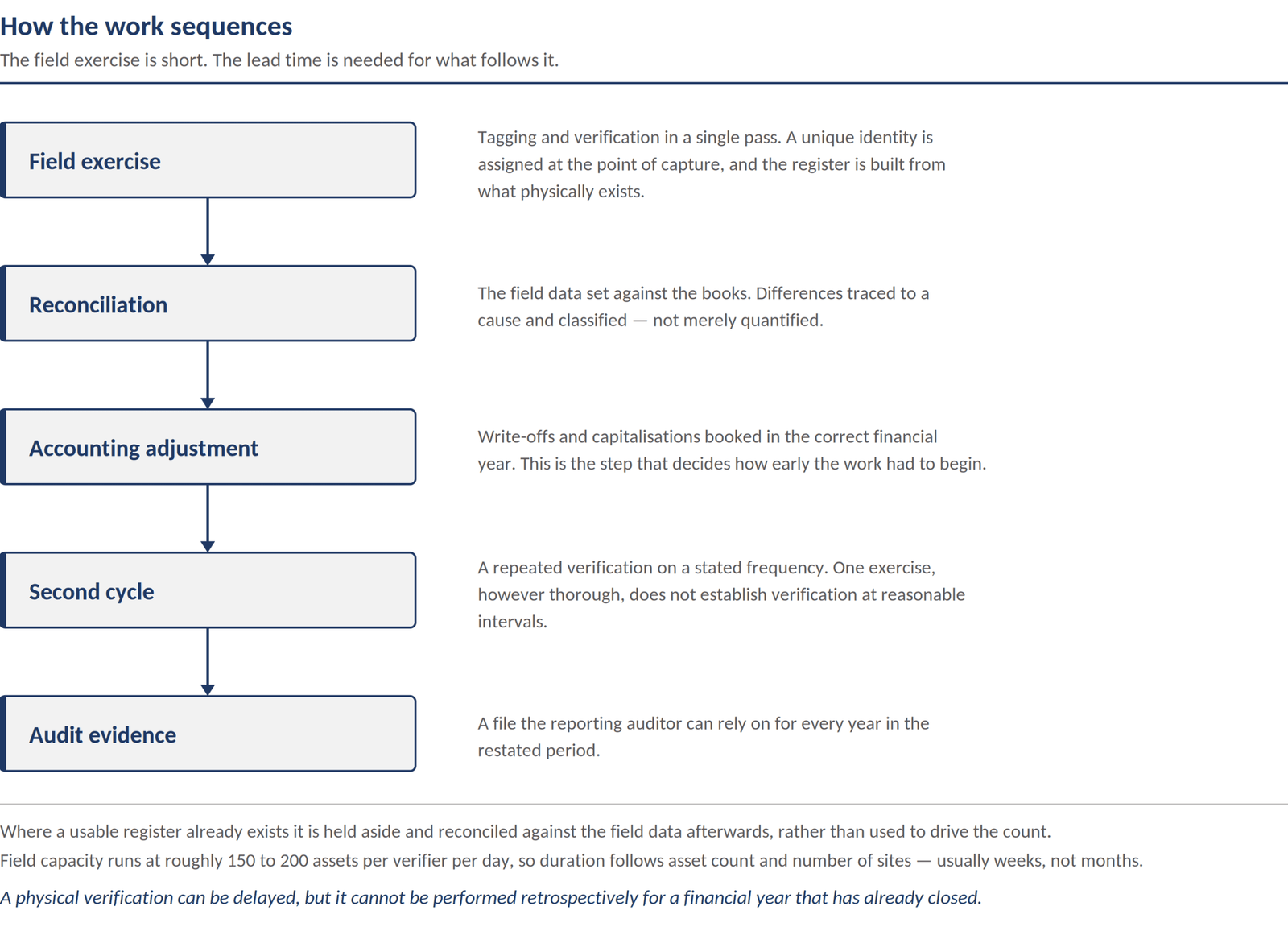
Tagging and verification are one field pass, not two stages. In most companies there is no usable register to verify against, so a unique identity is assigned to each asset at the point of capture and the register is built from what the field team records. What follows is reconciliation against the books, then the accounting adjustments, then a second cycle.
Download the checklist — 22 pages, PDF, no registration.
The field work itself is shorter than most people expect. A verifier covers roughly 150 to 200 assets a day in office environments, and 80 to 100 a day for plant and machinery, where each item takes longer to identify and access. Duration therefore follows asset count, asset type and number of sites — for most companies that is weeks rather than months.
The reason to begin early is not the tagging. It is that the write-offs and capitalisations arising from the exercise have to be booked in the correct financial year, and those years are the ones that will be restated. And CARO speaks of verification at reasonable intervals, in the plural: one exercise conducted shortly before a filing does not establish a programme. A second cycle does.
What the checklist covers
Twenty-two pages, in tick-box form, across two parts.
Part A, fixed assets: the register itself; identification and tagging; the physical verification programme; reconciliation and treatment of differences; capital work in progress and intangible assets under development; title, revaluation and encumbrance; depreciation, componentisation and useful life; disposals and assets that no longer exist; leased assets and assets not owned.
Part B, inventory: the count programme; the ten per cent threshold and why it is tested class by class; cut-off; stock held at job workers and third party locations; agreement between quarterly stock statements filed with lenders and the books; valuation, obsolescence and slow movement.
Three further sections deal with what can still be done about financial years that have already closed, the internal financial controls documentation that sits alongside the verification itself, and an indicative sequence of stages.
A few of the checks
- Does every asset in the register carry a unique identification number distinct from the invoice, voucher or ledger code?
- Have bulk capitalisations been broken into individual assets, so that one line does not represent forty workstations?
- Is capital work in progress analysed project by project, with the ageing bands Schedule III requires?
- Are inventory discrepancies reviewed class by class rather than in aggregate — stores and spares being the class that most often breaches the threshold unnoticed?
- Do the quarterly stock statements filed with your bankers agree with the books for every quarter in the restated period, and is there a reconciliation on file where they do not?
- Are the last goods receipt and last delivery challan numbers recorded before each count begins?
A first pass takes about half an hour. Closing what it opens takes considerably longer, and that gap is the point.
Download the checklist
Fixed Assets and Inventory: An IPO Readiness Checklist. 22 pages, PDF. Free, no registration.
Download the checklist (PDF, 22 pages)
Reviewed by Pooja Aggarwal, FCA, DISA. References should be verified against the statute in force at the relevant date.
Where we fit
TagMyAssets is a field services firm. We tag fixed assets, carry out fixed asset verification and inventory verification, and reconcile fixed asset registers against what our teams find on the floor. We work across India, and we operate our own verification applications — our field teams run on them, with audit progress visible during the exercise and variance analysis available in Excel.
We do not supply a fixed asset management system for a company to run its register on, and the checklist is not written to sell one. If you work through it and find the gaps are in identification and verification rather than in documentation, that is the point at which a field exercise becomes useful.
Common questions
Does CARO 2020 require a company to physically verify its fixed assets?
Not directly. CARO is a reporting order addressed to the statutory auditor, who must report on whether management verified property, plant and equipment at reasonable intervals and whether material discrepancies were properly dealt with in the books. The obligation to produce the evidence therefore rests with management, and an absence of documented verification becomes a remark in the auditor’s report.
Is asset tagging mandatory before an IPO?
Tagging is not a statutory requirement. It is the mechanism by which an asset acquires an identity that can be checked again later. Without it, a verification exercise becomes an approximate walk-through rather than an item-by-item reconciliation, which is difficult to evidence and difficult for an auditor to rely on.
How long does the field exercise take?
It follows asset count and number of locations rather than the calendar. A verifier covers roughly 150 to 200 assets a day in office environments and 80 to 100 a day for plant and machinery, so a mid-sized exercise across several sites is usually a matter of weeks. The lead time a company needs is not for the field work itself, but for the reconciliation and accounting adjustments that follow it, and for a second verification cycle.
What if earlier years were never verified?
That gap cannot be closed retrospectively, but it can be managed. Alternative evidence — insurance schedules, maintenance records, statutory inspection certificates, movement registers, capital expenditure approvals — narrows it and supports a reasoned position. The position is best discussed with the reporting auditor early rather than discovered during the audit.
Why is the ten per cent inventory threshold tested by class?
Because CARO applies it to each class of inventory rather than to inventory as a whole. A company with a comfortable overall variance can still breach the threshold within a single class. Stores and spares is a frequent instance, being high in item count, low in value, and rarely counted with the same rigour as finished goods.
Does the checklist apply to companies that are not going public?
The verification and reconciliation content applies to any company reporting under CARO. The sections dealing with the restated period, due diligence enquiries and the sequence of stages are specific to a public issue.