
A fixed asset register may show one machine.
This is the core question behind component capitalisation vs physical verification: one is an accounting decision, the other is a field check of what actually exists.
But when you reach the factory floor, that “one machine” may actually consist of a main unit, motor, control panel and other major components.
Sometimes the opposite happens. The FAR shows several separate assets, but when you physically inspect them, you find that they are all parts of one larger machine or installation.
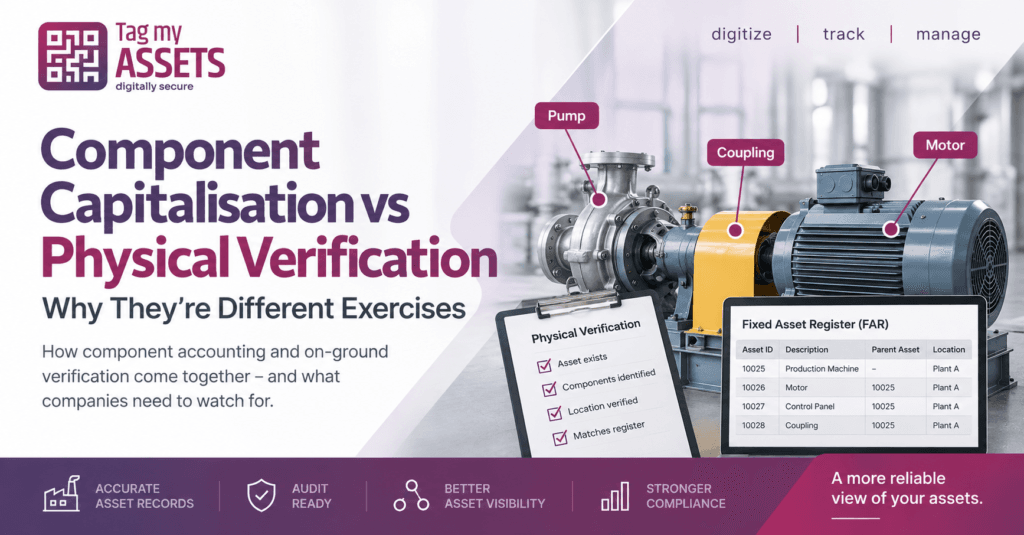
This is where component capitalisation and physical verification meet.
They are related, but they are not the same thing.
Component capitalisation is an accounting decision. Physical verification is about checking what actually exists on the ground.
And in practice, physical verification is often where differences between the way an asset is recorded and the way it physically exists first become visible.
What Is Component Capitalisation?
Some assets are made up of major parts that may have different useful lives.
Take a large production machine. It may include:
- the main machine;
- a motor;
- a control system; and
- other major replaceable parts.
For the production team, this may simply be one machine.
From an accounting point of view, however, some significant components may need to be accounted for and depreciated separately.
This is the basic idea behind component capitalisation, or component accounting.
Ind AS 16 requires significant parts of an item of property, plant and equipment to be depreciated separately where applicable. Similar component-accounting principles are also reflected in Schedule II to the Companies Act, 2013.
So component capitalisation is mainly concerned with:
How should an asset and its significant components be recorded and depreciated in the books?
Physical verification starts from a different question.
What Does Physical Verification Look At?
Physical verification asks:
What is actually there?
If the FAR says there is a machine at Plant A, the verification exercise checks whether that machine exists and whether the available information matches the records.
Depending on the scope of the exercise, the team may check details such as:
- asset description;
- asset or tag number;
- serial number;
- location;
- department;
- custodian;
- condition; and
- verification status.
The broader physical verification of assets process is therefore about connecting the fixed asset register with what can actually be identified at the location.
But while doing this, the team also sees something that may not be obvious from an Excel-based FAR:
how the asset is physically put together.
And that is where parent-child asset issues start appearing.
The Real Overlap: Parent-Child Asset Mapping
One of the practical issues that can arise during fixed asset verification is parent-child asset mapping.
Suppose the FAR contains this:
Asset 10025 – Production Machine
One asset. One line in the register.
But at the site, the verification team finds that the machine consists of a main unit, a separately identifiable motor and a control panel.
That does not automatically mean that three separate assets should be created.
But it does raise an important question:
Does the FAR correctly represent the asset and its significant components?
The reverse can happen as well.
The FAR may show:
Asset 10025 – Main Machine
Asset 10026 – Motor
Asset 10027 – Control Panel
When the team reaches the location, it becomes clear that all three belong to the same production installation.
The individual asset records may be perfectly valid. The issue is that the FAR may not show the relationship between them.
That is a parent-child mapping issue.
The machine is the parent. The separately recorded components are linked to it as child assets.
A structured parent-child asset mapping approach can help document these relationships without assuming that the accounting treatment itself needs to change.
Why You May Not Find This Problem by Reviewing the FAR
This is where physical verification adds information that a desk review may not provide.
Imagine seeing this line in Excel:
| Asset ID | Description | Location | Gross Block |
|---|---|---|---|
| 10025 | Production Machine | Plant A | ₹25,00,000 |
Nothing necessarily looks wrong.
The description exists. The location exists. The value exists.
But Excel cannot tell you that the machine standing at Plant A has three major identifiable components.
Someone has to see the asset.
The same applies in reverse.
Three different rows in the FAR may look like three independent assets. Once you physically inspect them, you may discover that they are all parts of the same installation.
This is why fixed asset verification should not become just a tick-mark exercise against the FAR.
What Can Physical Verification Actually Find?
One asset in the FAR, several components on the floor
The FAR may record a complete machine under one asset code, while the verification team finds several identifiable components.
This can be documented and sent to the finance team for review.
Several assets in the FAR, one installation on the floor
Different components may have separate asset codes but physically form part of one machine or system.
In such cases, the FAR may need a clear parent-child relationship rather than simply a list of unrelated asset IDs.
An old component is still in the FAR
This is another practical issue.
A motor may have been replaced two years ago, but the old motor may still be sitting in the FAR while the new motor is now installed in the machine.
Physical verification can bring this situation to attention.
The accounting treatment — including whether anything needs to be derecognised or adjusted — is a separate decision.
A component has moved but the parent asset has not
Sometimes a component is shifted from one machine to another or from one department to another.
The FAR may still show it against its original location or parent asset.
This is where proper parent-child records and an asset movement register become useful.
The FAR description is too broad
Descriptions such as:
Plant & Machinery
Electrical Installation
Production Line
Machinery
Furniture & Fixtures
may be correct from a broad accounting perspective, but they do not always tell you exactly what is physically present.
During verification, the actual asset and its components can be identified in more detail and then considered during FAR reconciliation.
Physical Verification Does Not Decide the Accounting Treatment
This is an important distinction.
If the verification team finds four components inside a machine, it does not mean the company should immediately create four asset codes.
Similarly, finding three separately capitalised components attached to one machine does not mean those records should automatically be merged.
The field team identifies the physical situation. The finance team decides the accounting treatment.
In simple terms:
| Physical Verification | Component Capitalisation |
|---|---|
| What actually exists? | How should it be accounted for? |
| Where is the asset? | Should components be accounted for separately? |
| Which components belong together? | What useful life should apply? |
| Does the physical asset match the FAR? | Is an accounting adjustment required? |
| Has a component been replaced or moved? | What should happen to the existing accounting record? |
One provides the physical evidence.
The other determines what that evidence means for accounting.
How Parent-Child Mapping Can Help
Suppose a production line has ten separately recorded components.
Each component may have its own asset ID, value and useful life.
But if the FAR does not show that all ten belong to the same production line, understanding the register becomes difficult.
A practical FAR can therefore include fields such as:
- Asset ID
- Parent Asset ID
- Asset Description
- Component Description
- Location
- Department
- Serial Number
- Tag Number
- Verification Status
- Remarks
This does not change the accounting treatment by itself.
It simply makes the relationship clear.
Someone reviewing the FAR can see not only what the assets are, but also how they are connected.
What Should You Do When Verification Finds a Component Issue?
The first reaction should not be to immediately change the FAR.
First, document what has been found.
Then compare the physical asset with the existing records.
For example, check:
- What is the main or parent asset?
- What components are physically attached to it?
- Which of those components already have separate FAR records?
- What do the original invoices and capitalisation documents say?
- Has any major component been replaced?
- Is the old component still appearing in the FAR?
- Does the company’s capitalisation policy require separate accounting treatment?
- Should a parent-child relationship be added to the asset master?
Once this review is complete, the finance team can decide whether any change is required in the FAR or books.
The important point is:
A verification finding is not automatically an accounting adjustment.
It is a finding that needs to be understood and resolved.
Why This Matters Before an Audit
These issues become particularly important when a company is preparing its fixed asset records for statutory audit.
If physical verification identifies a difference between what is recorded and what actually exists, there should be a clear trail showing what happened to that exception.
For example:
Found during verification → Checked against FAR → Supporting documents reviewed → Parent-child relationship identified → Accounting review completed → FAR updated, if required
That trail is more useful than simply marking an asset as “verified”.
It explains what was found and how it was dealt with.
Component Capitalisation vs Physical Verification: The Difference in One Sentence
The distinction is actually quite simple:
Component capitalisation decides how significant parts of an asset should be accounted for. Physical verification checks what assets and components actually exist on the ground.
The two meet when what you see physically does not match how the asset is represented in the FAR.
And one of the clearest examples of that is a parent-child asset mapping issue.
Physical verification does not make the accounting decision.
But sometimes it is the first exercise that shows that an accounting question needs to be asked.
Frequently Asked Questions
What is component capitalisation?
Component capitalisation means accounting separately for significant parts of an asset where required under the applicable accounting framework. This may be relevant where major components have different useful lives.
Is component capitalisation the same as physical verification?
No. Component capitalisation is an accounting exercise. Physical verification is a field exercise that checks what assets actually exist and compares them with the fixed asset register.
What is parent-child asset mapping?
Parent-child mapping connects individual components with the larger asset or installation they belong to.
For example, a motor and control panel may have separate asset IDs but both may belong to the same production machine.
Does every component need a separate asset code?
No. Just because a component can be physically identified does not mean it automatically needs a separate asset code.
The accounting treatment depends on factors such as significance, useful life, the company’s accounting policy and the applicable accounting requirements.
Can physical verification identify component accounting problems?
It can identify situations that may require accounting review.
For example, the team may find one FAR asset represented by several significant physical components, several FAR assets forming one installation, or a replaced component that still appears in the register.
Should we immediately change the FAR if we find a mismatch?
Not necessarily.
First document the finding and check it against the FAR, invoices, capitalisation records and other available information. The FAR should be changed only after the appropriate review and approval.
How should parent-child assets be shown in the FAR?
There is no single format that works for every company.
A practical approach is to maintain fields such as Asset ID, Parent Asset ID, Component Description, Location, Tag Number and Verification Status so that individual components can still be traced back to the main asset.