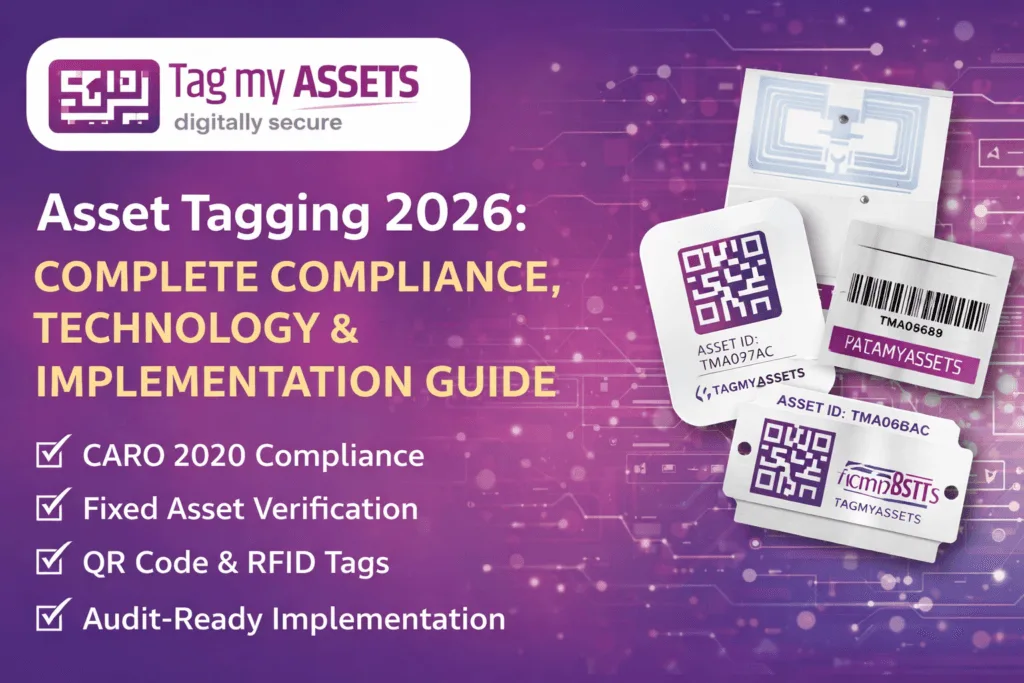
Compliance and Implementation Guide for CFOs, Auditors, Facility Managers and IT Heads
This guide covers asset tagging from the compliance side: what CARO 2020 asks for, how verification and reconciliation work, and what to plan before a project starts.
Whether you are a CFO preparing for statutory audit, a plant head managing thousands of machines, a retail chain struggling with inventory mismatches, or an auditor reporting under CARO 2020 — this guide covers:
- What is Asset Tagging?
- Why it is critical in 2026
- Compliance requirements in India
- QR vs RFID vs Barcode comparison
- Step-by-step implementation process
- FAR reconciliation methodology
- Verification methodology
- Cost structure
- Where the financial benefit comes from
- Industry use cases
- Common mistakes to avoid
- Frequently asked questions
For the service overview, see our guide to asset tagging in India.
1. What is Asset Tagging?
Asset Tagging is the process of assigning a unique identification code (QR code, barcode or RFID tag) to every physical asset of an organization for tracking, verification, audit, and lifecycle management.
Each tag links the physical asset to:
- Fixed Asset Register (FAR)
- ERP system
- Accounting records
- Department mapping
- Location
- Maintenance history
Without tagging, assets remain disconnected from records.
With tagging, physical assets become digitally traceable.
2. Why Asset Tagging is Critical in 2026
For companies with large or spread-out asset bases, several pressures make tagging a practical necessity.
Key Drivers in 2026:
- CARO 2020 compliance
- Increasing statutory audit scrutiny
- Internal Financial Controls (IFC) requirements
- Fraud detection and prevention
- Insurance claim validation
- ESG & sustainability reporting
- ERP integration
- Multi-location business complexity
Asset value is lost each year through:
- Ghost assets (exist in books, not physically)
- Missing assets
- Duplicate capitalization
- Improper location mapping
- Unrecorded scrap
Asset tagging transforms asset control from reactive to structured governance.
3. Regulatory & Compliance Framework (India Focus)
Under CARO 2020, clause 3(i), the auditor reports whether:
- The company maintains proper records showing full particulars of Property, Plant & Equipment (PPE)
- Management has physically verified PPE at reasonable intervals
- Material discrepancies found on verification were properly dealt with in the books
The verification itself is management’s responsibility; the auditor reports on it.
Without structured tagging:
- Verification becomes manual
- Serial number validation becomes difficult
- Audit risk increases
- Qualifications may arise
Asset tagging supports:
- Companies Act compliance
- Ind AS reporting
- Internal Financial Controls
- Insurance audit validation
- Bank stock audits
- Due diligence in mergers & acquisitions
For CFOs, this reduces reporting risk.
For auditors, this strengthens evidence.
4. Types of Asset Tags (Complete Comparison Guide)
Choosing the right tag is critical.
4.1 QR Code Labels
Best suited for:
- Offices
- IT equipment
- Manufacturing plants
- Educational institutions
Advantages:
- Low cost
- Easily scannable via mobile app
- High data capacity
- Easy implementation
- Works offline
Limitation:
- Requires line-of-sight scanning
Most organizations prefer QR codes due to cost-effectiveness and flexibility.
4.2 Barcode Labels
Used primarily for:
- Retail inventory
- Warehousing
- High-volume SKU management
Advantages:
- Fast scanning
- Widely compatible with scanners
Limitation:
- Limited data storage
- Line-of-sight required
- Less durable than industrial QR
4.3 RFID Tags
Best for:
- Large warehouses
- High-speed inventory environments
- Logistics hubs
- Manufacturing tool tracking
Advantages:
- No line-of-sight needed
- Bulk scanning capability
- Faster stock-taking
Limitations:
- Higher cost
- Requires RFID readers
- Infrastructure investment
5. Asset Tagging vs Manual Asset Registers
| Manual Excel Tracking | Structured Asset Tagging |
|---|---|
| Human error prone | Scan-based accuracy |
| No physical linking | Physical-digital mapping |
| Difficult audit trail | Traceable to a FAR line |
| High duplication risk | Unique ID system |
| Time-consuming verification | Scan-based verification |
Manual registers become hard to control when:
- Assets run into thousands
- Multiple departments exist
- Multi-location operations begin
- Auditors demand serial number verification
Excel is a record.
Asset tagging is control.
6. Step-by-Step Asset Tagging Implementation Framework
Phase 1: Pre-Implementation Planning
- Collect Fixed Asset Register (FAR)
- Clean duplicate asset codes
- Categorize asset types
- Freeze tagging scope
- Define tag material
- Define unique coding logic
This stage avoids chaos during fieldwork.
Phase 2: Tag Design & Material Selection
Tag materials vary:
- Polyester labels, printed on site (indoor use)
- Laser-marked 316L stainless steel tags (harsh environments)
Artwork includes:
- Company logo
- Unique asset ID
- QR code
- Year
- Department
Proper design increases durability.
Phase 3: Physical Verification & Tagging
Field team responsibilities:
- Locate asset
- Validate serial number
- Capture condition
- Capture department
- Fix tag properly
- Scan and record on the verification application
Professional tagging is systematic, not random sticking of labels.
Phase 4: FAR Reconciliation
Reconciliation identifies:
- Missing assets
- Surplus assets
- Scrap items
- Location mismatches
- Capitalization errors
- Wrong asset classification
This is where the register is corrected.
Phase 5: Reporting
Deliverables include:
- Updated asset master
- Variance report
- Department summary
- Condition analysis
- Scrap list for management review
- Management summary
This final report strengthens audit documentation.
7. Fixed Asset Verification Methodology (Professional Approach)
Verification must include:
- Physical existence
- Serial number matching
- Asset condition
- Department mapping
- Photo evidence (if required)
- Functional status
Handheld scanners often create issues:
- Data stored locally
- Compilation required later
- Device lag in congested areas
- Laptop dependency during audit
A mobile verification application avoids these problems:
- Scan data captured on the phone with photo and location
- Works offline in low-network areas
- Data consolidated for reconciliation
8. Inventory Verification for Retail & Warehouses
Retail and warehouses face unique challenges:
- SKU mismatch
- Expired stock
- ERP vs physical difference
- Misplaced inventory
- Batch confusion
Professional inventory verification captures:
- SKU code
- Product name
- Batch
- Expiry
- Quantity
- Storage condition
Inventory verification productivity depends on how the stock is held and whether items are barcoded. Where stock is scannable, counts run far faster than fixed asset verification, because the exercise is counting rather than identifying each item individually.
9. Common Asset Tagging Mistakes to Avoid
- Using low-quality labels
- No pre-cleaning of FAR
- Not freezing scope
- Ignoring serial numbers
- No reconciliation report
- No department mapping
- Tagging scrap assets
- Not defining tagging policy
- Over-reliance on Excel
- No management summary of findings
Mistakes lead to rework and cost escalation.
10. Where the Financial Benefit Comes From
Return on Investment areas:
- Ghost assets identified and written off
- Scrap identification
- Accurate depreciation
- Reduced audit time
- Insurance claim support
The recovery period depends on the size of the asset base and what the exercise surfaces.
Indirect benefits:
- Stronger internal controls
- Improved asset visibility
- Faster audits
- Reduced compliance stress
11. Industry-Wise Asset Tagging Use Cases
Manufacturing
- Plant & machinery
- Tools & dies
- Molds
- Electrical panels
- Production equipment
Corporate Offices
- Laptops
- Desktops
- Printers
- Furniture
- Conference systems
Retail Chains
- POS devices
- Display racks
- Storage units
- Store equipment
Educational Institutions
- Lab equipment
- Classroom assets
- IT labs
- Library systems
12. Data Structure & FAR Reconciliation Explained
A strong data structure includes:
- Asset Code
- Asset Description
- Category
- Location
- Department
- Serial Number
- Purchase Date
- Gross Block
- Accumulated Depreciation
- Net Book Value
- Condition
Reconciliation process:
- Import FAR
- Capture physical data
- Match on asset code or serial number
- Flag unmatched items
- Manual review
- Generate variance report
This strengthens financial accuracy.
13. Asset Lifecycle Management
Asset lifecycle includes:
- Procurement
- Capitalization
- Tagging
- Deployment
- Transfer
- Maintenance
- Impairment
- Disposal
Tagging integrates into entire lifecycle.
Without tagging, lifecycle tracking becomes weak.
14. Cost Structure of Asset Tagging Projects
Cost depends on:
- Number of assets
- Number of locations
- Tag material type
- Reporting complexity
- Travel & logistics
Pricing models:
- Per asset rate
- Per man-day basis
- Lump-sum project cost
Always define scope before finalizing cost.
15. Why Professional Asset Tagging Matters
Professional execution supports:
- Structured planning
- Accurate reconciliation
- Compliance alignment
- Proper reporting
- Long-term durability
- Audit readiness
Tagging is not sticker pasting.
It is asset governance.
16. Asset Tagging Policy
A written policy sets which assets are tagged, how often they are verified, and who is responsible for custody and reconciliation. Having a policy strengthens Internal Financial Controls (IFC). What the policy should cover is set out in our guide to the asset tagging policy.
17. Asset Tagging Project Timeline
Duration depends on asset count, the number of locations and the state of the Fixed Asset Register. As a guide:
- A single site with 500–2,000 assets: typically 3–7 working days on site
- Multi-location projects with 10,000+ assets: typically 3–8 weeks, sequenced site by site
- Reconciled report: about a week after findings are agreed
The work runs in four stages: planning (FAR review, scope freeze, tag material), field execution (verification, tagging, photographs), reconciliation against the FAR, and reporting.
18. Advanced Technical Comparison: QR vs RFID (Deep Dive)
| Feature | QR Code | RFID |
|---|---|---|
| Cost per tag | Low | Moderate to High |
| Reader requirement | Mobile camera | RFID reader |
| Line of sight | Required | Not required |
| Bulk scanning | No | Yes |
| Infrastructure cost | Minimal | High |
| Best suited for | Offices, plants | Warehouses, logistics |
19. Common Auditor Observations in Fixed Asset Verification
Auditors frequently report:
- Incomplete FAR details
- Serial numbers not recorded
- No evidence of physical verification
- Department mismatch
- Fully depreciated assets still in use without reassessment
- Scrap assets not removed from books
- No policy for transfer documentation
Asset tagging addresses these audit risks.
20. Handling Special Asset Categories
20.1 Fully Depreciated Assets
Even if fully depreciated, if physically in use, they must be tagged and tracked.
20.2 Capital Work-in-Progress (CWIP)
CWIP typically not tagged until capitalization, but physical tracking during project stage is advisable.
20.3 Leased Assets
Should be separately identified and tagged for control purposes.
20.4 Embedded Plant & Machinery
For heavy embedded equipment:
- Laser-marked 316L stainless steel tags
- Nearby tag fixing
20.5 Land & Buildings
Land cannot be tagged physically.
Buildings may have master identification codes.
21. Asset Tagging & Insurance Benefits
Insurance companies rely on declared asset value.
Without accurate physical verification:
- Over-insurance increases premium
- Under-insurance increases claim risk
Tagged assets provide:
- Clear identification
- Claim support documentation
- Theft investigation support
- Fire damage traceability
22. ESG & Sustainability Reporting Support
Environmental reporting increasingly requires:
- Asset age profiling
- Energy-intensive equipment tracking
- Scrap documentation
- Responsible disposal proof
Tagged assets support sustainability transparency.
23. Internal Control Testing & IFC Strengthening
Under Internal Financial Controls:
- Asset existence assertion
- Completeness assertion
- Accuracy assertion
- Valuation assertion
Asset tagging strengthens:
✔ Existence
✔ Completeness
✔ Ownership
✔ Location control
This reduces risk during statutory audit.
24. How to Evaluate an Asset Tagging Vendor
Before selecting a vendor, ask:
- Do they conduct reconciliation or only tagging?
- Do they provide audit-ready reports?
- What tag material quality do they use?
- Do they verify on their own application?
- Is data backup ensured?
- Do they provide policy drafting support?
- What is post-implementation support?
Choose on method and reporting, not tag price alone.
25. Final Implementation Checklist
Before starting asset tagging:
✔ FAR cleaned and verified
✔ Scope defined
✔ Tag material approved
✔ Department coordinators assigned
✔ Site access arranged
✔ Safety clearance obtained
✔ Verification application set up
✔ Coding logic finalized
✔ Reporting format approved
Preparation keeps the field work on schedule.
26. Final Strategic Conclusion
Asset Tagging in 2026 is not merely a labeling exercise.
It is:
- Support for CARO reporting
- A financial governance tool
- A risk mitigation mechanism
- An audit support system
- An operational control framework
Organizations that delay structured asset tagging often face:
- Audit stress
- Financial misstatements
- Insurance claim complications
- Internal control weaknesses
- Asset loss
Organizations that implement structured tagging gain:
- Visibility
- Accuracy
- Accountability
- Compliance confidence
Asset tagging transforms assets from “items on paper” into “controlled financial resources.”
Frequently Asked Questions (FAQs) on Asset Tagging & Fixed Asset Verification (2026)
1. What is Asset Tagging?
Asset tagging is the process of assigning a unique identification code (QR code, barcode or RFID) to physical assets to enable tracking, verification, audit control, and lifecycle management. It connects the physical asset with the Fixed Asset Register (FAR) and digital systems.
2. Is Asset Tagging mandatory in India?
Asset tagging is not mandated by law. Under CARO 2020, clause 3(i), the auditor reports whether the company maintains proper records of Property, Plant & Equipment and whether management has physically verified it at reasonable intervals. The verification is management’s responsibility; tagging is a practical way to evidence it.
3. What is the difference between Asset Tagging and Asset Tracking?
Asset tagging refers to physically labeling assets with unique identification codes.
Asset tracking refers to monitoring the location, movement, and status of tagged assets through periodic scans and recorded transfers.
Tagging is the foundation; tracking is the operational use of tagged data.
4. What types of assets should be tagged?
Assets typically tagged include:
- Plant & machinery
- IT equipment
- Furniture & fixtures
- Laboratory equipment
- Tools & dies
- Vehicles
- High-value electrical installations
Low-value consumables are usually not tagged unless required for internal control.
5. Can fully depreciated assets be tagged?
Yes. Even if an asset is fully depreciated in books, if it is physically in use, it should be tagged and tracked to maintain control and prevent misuse or unrecorded disposal.
6. How often should fixed assets be physically verified?
Best practice:
- High-value assets: Annually
- Moderate-value assets: Once in 1–2 years
- Sensitive departments (IT, portable devices): Periodic surprise checks
Frequency depends on internal control policies and risk exposure.
7. What is FAR Reconciliation?
FAR reconciliation is the process of matching the Fixed Asset Register with physically verified assets to identify:
- Missing assets
- Surplus assets
- Location mismatches
- Duplicate asset codes
- Scrap assets still appearing in books
It strengthens financial accuracy and audit readiness.
8. What is the best type of tag material?
Tag material depends on environment:
- Polyester labels, printed on site: Offices and indoor assets
- Laser-marked 316L stainless steel: Machinery and harsh industrial conditions
The right material keeps the tag readable across verification cycles.
9. What is the difference between QR code and RFID tagging?
QR codes require line-of-sight scanning and are cost-effective.
RFID does not require direct visibility and allows bulk scanning but requires specialized readers and higher investment.
Most mid-sized businesses prefer QR tagging due to lower cost and easier implementation.
10. How long does an asset tagging project take?
Project duration depends on:
- Number of assets
- Number of locations
- Complexity of FAR
- Department coordination
A single site of 500–2,000 assets typically takes 3–7 working days on site; multi-location projects of 10,000+ assets typically run 3–8 weeks. The reconciled report follows about a week after findings are agreed.
11. What are ghost assets?
Ghost assets are assets that appear in the books but are not physically available during verification. They often arise due to poor tracking, unrecorded disposal, or internal control weaknesses.
Asset tagging brings ghost assets to light so they can be investigated and written off.
12. What are surplus assets?
Surplus assets are physically found assets that are not recorded in the Fixed Asset Register. These may indicate improper capitalization or incomplete accounting entries.
13. Should leased assets be tagged?
Yes. Even if assets are leased, they should be tagged separately to maintain control and avoid confusion with owned assets.
14. Can land and buildings be tagged?
Land cannot be physically tagged.
Buildings can be assigned master identification codes or location-based tagging for control purposes.
15. Is Excel sufficient for asset management?
Excel can store asset data, but it cannot link a record to the physical asset. Tagging and scan-based verification give the register the evidence it lacks at audit.
16. What are common mistakes during asset tagging?
- Tagging without cleaning FAR
- Ignoring serial numbers
- No reconciliation process
- Using low-quality labels
- No department mapping
- No post-verification reporting
Structured planning prevents these errors.
17. How does asset tagging help during statutory audit?
Asset tagging provides:
- Physical existence evidence
- Serial number verification
- Location confirmation
- Reconciliation reports
- Improved audit documentation
This reduces audit qualification risk.
18. How does asset tagging improve insurance claims?
Tagged assets provide clear identification and documentation in case of theft, fire, or damage. This supports claims and helps keep the insured value in line with what exists.
19. What is the ROI of asset tagging?
Return on investment comes from:
- Ghost assets identified and written off
- Scrap identification
- Reduced audit time
- Accurate depreciation
- Insurance declared on verified assets
The recovery period depends on the size of the asset base and what the exercise surfaces.
20. How do I choose the right asset tagging vendor?
Evaluate based on:
- Reconciliation capability
- Audit-ready reporting
- Tag material quality
- Verification on their own application
- Industry experience
- Post-implementation support
A good vendor leaves you with a register you can verify again, not just tags on assets.