Fixed asset tags give physical assets a unique identity that can be traced back to the Fixed Asset Register (FAR). Whether it is a laptop, an office chair, an industrial machine or an outdoor utility installation, the right tag helps an organisation identify, verify and account for the asset throughout its useful life.
A fixed asset tag generally carries a unique asset number along with a QR code, barcode or RFID chip. Choosing the right tag involves more than choosing a code: the material, adhesive, fixing method and operating environment decide whether the tag stays attached and readable at future physical verifications.
A polyester label may work well on office furniture but may not withstand repeated chemical cleaning on industrial equipment. A standard RFID label may perform poorly when attached directly to metal. This guide explains the types of fixed asset tags, their materials, applications, fixing methods and indicative prices in India.
TagMyAssets supplies QR code, barcode and RFID asset tags as part of its asset tagging and physical verification services, and also takes on tag-only supply where a client asks for just that.
What Are Fixed Asset Tags?
Fixed asset tags are identification labels or plates attached to assets to link each asset with its record in the Fixed Asset Register. Each tag normally carries:
- Unique asset code: the identification number of the asset record in the FAR
- QR code or barcode: a machine-readable form of the same asset code
- Company name or logo: identifies the organisation that owns the asset
- Optional information: asset category, location code or a “Property of” line
RFID tags also carry an electronic identifier that can be read with compatible RFID equipment.
Keep the tag simple. Purchase cost, accumulated depreciation, custodian and current location belong in the FAR, where they can be updated without replacing the tag.
Why Fixed Asset Tags Matter
Asset identification supports an organisation in:
- Carrying out physical verification efficiently
- Matching assets with their FAR records
- Identifying missing, additional or incorrectly recorded assets
- Tracking transfers between departments and locations
- Keeping identification intact through employee handovers
- Supporting internal controls and audit documentation
A tag does not replace the FAR or the verification process. It provides the physical identification that connects the asset with its recorded information.
Types of Fixed Asset Tags by Material
Different assets need different tag materials, depending on the surface, environmental exposure, handling and expected service life.
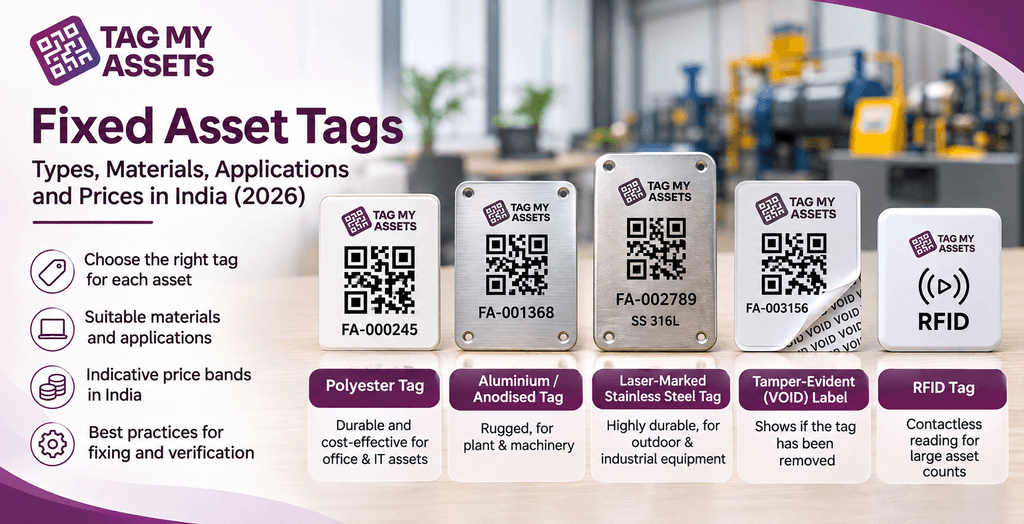
1. Polyester Fixed Asset Tags
Polyester tags are widely used for indoor assets because they combine reasonable cost, clear print quality and durability. They suit:
- Laptops, desktops and monitors
- Office furniture and workstations
- Printers, scanners and IT peripherals
- General office equipment
- Indoor electrical and electronic assets
Polyester labels can carry QR codes, barcodes, company logos and unique asset numbers. The adhesive and construction are chosen to suit the surface and operating environment.
Printed on site. Our field teams carry a tag printer to site, so polyester tags are printed on location as required. When an additional asset is found during physical verification, it can be given an asset code and tagged the same day, following the agreed coding and approval process.
Suited to: most indoor office, furniture and IT asset tagging.
2. Aluminium and Anodised Aluminium Asset Tags
Aluminium tags suit assets where an adhesive label would face frequent handling, moderate heat, oil or workshop conditions. They are commonly used for:
- Plant and machinery
- Manufacturing equipment
- Workshop tools and installations
- Electrical panels
- Mechanical equipment
- Industrial furniture and fixtures
Anodised aluminium tags use a treated metal surface; depending on the marking process, the identification can resist wear better than ordinary surface printing. Aluminium tags may be fixed with industrial adhesive, rivets or screws, and the design should account for operating temperature, surface condition and exposure to abrasion or chemicals.
Suited to: industrial assets that need a rigid identification plate without the full specification of stainless steel.
3. Laser-Marked 316L Stainless Steel Asset Tags
Stainless steel tags are used for fixed assets in demanding industrial or outdoor conditions, where corrosion resistance and long-term identification matter. They suit:
- Outdoor plant and machinery
- Utility equipment
- Process plant installations
- Pumps, motors and valves
- Water treatment equipment
- Equipment exposed to moisture or selected chemicals
Asset numbers and QR codes are laser-marked onto the 316L stainless steel surface. Grade, marking, operating temperature and fixing method are selected together, and the tags may be fixed with screws, rivets, industrial adhesive or stainless steel banding.
Lead time. Unlike polyester labels, laser-marked stainless steel tags are made in India in advance. Allow 10 to 12 working days for manufacture and dispatch. Where additional steel tags are needed during a project, allow at least one week.
Suited to: outdoor, utility and industrial assets that need durable metal identification.
4. Tamper-Evident (VOID) Asset Labels
Tamper-evident labels show evidence of attempted removal. Some leave a visible “VOID” pattern when peeled from a suitable surface; others fracture when removed. They are used on:
- Laptops and portable computers
- Monitors and IT equipment
- Portable electronic devices
- Equipment issued to employees
- Selected high-value movable assets
A tamper-evident label does not prevent theft or unauthorised movement. Its purpose is to make removal or interference visible at the next verification. Check its performance on the actual asset surface before a bulk order.
Suited to: portable assets where tag removal or replacement needs to be detectable.
5. RFID Fixed Asset Tags
RFID tags carry an electronic identifier read by compatible RFID readers. Unlike QR codes and barcodes, RFID generally does not need direct line of sight, and some RFID technologies can read several tags in one pass. This can make verification of large asset populations substantially faster, provided the readers are set up correctly and stray reads are controlled.
Soft RFID labels: thin, flexible labels for office equipment, furniture and some IT assets, often combined with a printed QR code or barcode.
On-metal RFID tags: standard RFID labels can lose performance on metal. On-metal tags are built to work on metallic surfaces such as machinery, metal cabinets and server racks.
Hard RFID tags: tags in a protective housing for rough handling, outdoor exposure or industrial use.
Active RFID tags: battery-powered tags used where longer-range identification or ongoing location monitoring is needed. They cost far more than passive tags and are not normally needed for routine fixed asset verification.
For more detail, see our guide to types of RFID tags and the comparison of hard RFID tags vs soft RFID labels.
Fixed Asset Tags Compared by Material
| Tag type | Suitable assets | Identification | Key consideration |
|---|---|---|---|
| Polyester | Furniture, computers, office equipment | QR code / barcode | Economical; printed on site |
| Aluminium / anodised aluminium | Machinery, workshop assets | QR code / barcode | Rigid metal construction |
| 316L stainless steel | Outdoor and industrial equipment | Laser-marked QR / barcode | Corrosion resistance; made in advance |
| Tamper-evident (VOID) | Laptops, monitors, portable assets | QR code / barcode | Shows evidence of removal |
| Soft RFID label | Office assets, large asset counts | RFID, often with QR | Read without line of sight |
| On-metal RFID | Metal equipment and installations | RFID | Built for metal surfaces |
| Hard RFID tag | Rugged industrial environments | RFID | Protective housing; specialised fixing |
The right tag depends on more than the asset category. Surface preparation, temperature, chemicals, cleaning practice, adhesive and fixing method all affect how long a tag lasts.
How to Choose the Right Fixed Asset Tags
1. What Surface Will Be Tagged?
A smooth plastic surface may take an adhesive polyester label, while a rough, oily or uneven industrial surface may need a metal plate or a specialised adhesive. For RFID, metal surfaces need on-metal tags rather than standard labels.
2. Where Is the Asset Used?
Consider whether the asset is in an air-conditioned office, in direct sunlight, exposed to moisture or regular washing, in contact with oils or cleaning chemicals, or running at high temperature. Outdoor and industrial conditions may justify stainless steel or another specialist construction.
3. How Often Will the Asset Be Verified?
Under clause 3(i)(b) of CARO 2020, property, plant and equipment must be physically verified by management at reasonable intervals. The tag should stay readable across the verification cycle the company follows, so choose it on expected use and exposure rather than price alone, and test sample tags before a bulk order where the conditions are demanding.
4. How Many Assets Need Tags?
QR codes and barcodes are practical for most tagging projects, including those with several thousand assets. RFID adds value where asset counts are large, verification is frequent, or individual scanning is difficult, but it also needs compatible readers and a controlled verification method.
Many organisations use a mix of fixed asset tags: polyester QR tags for office assets, metal plates for plant and machinery, and RFID for selected high-volume areas.
Asset Tags for Laptops and Computers
Laptops and computers need labels that stay readable through movement, cleaning and daily handling. Polyester and tamper-evident labels are the usual choices. Fix the tag on an accessible surface, away from ventilation openings, hinges, worn contact areas and manufacturer markings that must stay visible. Use the same position across desktops and peripherals so field teams can find and scan tags quickly.
Capture the manufacturer’s serial number at tagging, where available. This gives three references for each asset:
- The asset tag number
- The manufacturer’s serial number
- The corresponding FAR record
Together, these help identify an asset even after it has been transferred, renamed or found in a different location.
Where Should Fixed Asset Tags Be Attached?
- Use a consistent tag position for each asset category
- Clean and dry the surface before fixing
- Avoid moving parts, vents, sharp edges and high heat
- Avoid surfaces likely to be repainted, scrubbed or worn
- Keep tags accessible for future verification
- Use mechanical fixing or banding where adhesive is unsuitable
- Test RFID readability after fixing, particularly on metal equipment
Tagging at height. Our field teams tag up to a working height of 10 feet, subject to site safety conditions. Assets above that height are tagged by the client’s maintenance personnel, using suitable access equipment and the tag position agreed for that asset class.
Choosing the Adhesive
Many tag failures come from the adhesive rather than the tag material. Before choosing one, consider the surface texture, paint finish, temperature, moisture, chemical exposure, cleaning process and whether the asset is indoors or outdoors.
- Acrylic adhesive: a general-purpose choice for most indoor office assets and many industrial ones
- High-tack adhesive: for textured, rough or powder-coated surfaces where ordinary adhesive does not bond well
- Foam adhesive: for machinery with continuous vibration or minor surface irregularities
- Weather-resistant adhesive: for outdoor assets exposed to rain, sunlight, humidity and seasonal temperature changes
Where adhesive is unsuitable, use rivets, screws or banding instead.
Common Asset Tag Sizes
There is no universal size. The right size depends on the surface available, the information on the tag and the scanning distance. Commonly used sizes include:
| Tag size | Typical application |
|---|---|
| 20 × 10 mm | Small accessories and tools |
| 30 × 15 mm | Laptops and IT assets |
| 38 × 19 mm | Desktop computers and printers |
| 50 × 25 mm | Furniture and office equipment |
| 75 × 25 mm | Industrial equipment |
| 100 × 50 mm | Heavy machinery |
A tag that is too small is harder to scan; one that is too large may not sit flat on compact equipment.
Fixed Asset Tags Price in India
The price of an asset tag depends on its material, size, print specification, order quantity and application. Indicative planning ranges per tag:
| Asset tag type | Indicative price per tag |
|---|---|
| QR code / barcode label | ₹2 to ₹15 |
| Passive RFID tag | ₹10 to ₹200 |
| Active RFID tag | ₹500 to ₹3,000 |
| Aluminium / anodised aluminium | Quoted per project |
| Laser-marked 316L stainless steel | Quoted per project |
| Tamper-evident (VOID) label | Quoted per project |
Prices are indicative, per tag before volume discount, and are not fixed quotations. Specialised RFID tags sit towards the top of the range. GST, minimum order quantities and customisation are confirmed at quotation.
What Affects Asset Tag Price
- Material and construction: an indoor polyester label costs less than an industrial metal plate
- Size: larger tags use more material
- Quantity: larger orders reduce the unit cost
- Printing and customisation: variable codes, logos and special finishes
- Adhesive and fixing: specialised adhesive, rivets, screws or banding
- RFID specification: inlay, frequency, on-metal design, housing and encoding
Tag Price vs Tagging Service Cost
Buying tags and engaging a team to run a tagging project are priced differently. Tag-only supply covers making, printing or encoding and delivering the tags. A tagging engagement can also cover:
- FAR review and asset code mapping
- Physical identification of assets
- Tag printing and fixing
- Asset data capture
- QR, barcode or RFID scanning
- Physical verification and exception reporting
- FAR reconciliation and the final report
The project cost therefore depends on scope, locations and manpower. For RFID figures, see our page on RFID tag price in India.
Are Fixed Asset Tags Mandatory Under CARO 2020?
CARO 2020 does not require companies to fix QR codes, barcodes or RFID tags to their assets. For companies to which CARO 2020 applies, clause 3(i)(a)(A) asks the auditor to report whether proper records are maintained showing full particulars, including quantitative details and situation, of property, plant and equipment. Clause 3(i)(b) asks whether management has physically verified property, plant and equipment at reasonable intervals, and whether material discrepancies have been properly dealt with in the books of account.
Asset tagging supports both by giving each asset a consistent identity that can be matched with the accounting records. Tags alone do not establish compliance: proper records, management verification, reconciliation, documentation and the right accounting treatment are still needed. See does CARO require asset tagging for more.
GS1 Standards and Fixed Asset Identification
Asset tags can use the organisation’s own internal asset numbers without adopting a GS1 identifier. Where a standard identification system is needed, the relevant GS1 keys are the GIAI (Global Individual Asset Identifier, AI 8004) for individual assets and the GRAI (Global Returnable Asset Identifier, AI 8003) for returnable assets. These are useful where asset identifiers have to be exchanged consistently across organisations or systems.
A QR code or barcode used only for internal identification does not become GS1-compliant just because it carries a unique asset number. The choice depends on the organisation’s own needs; see the GS1 standards for details.
Why Fixed Asset Tagging Must Be Linked to FAR Reconciliation
A tag is useful only when it is linked to the right record. A machine can carry a correctly printed QR code and still be misclassified, duplicated or shown at the wrong location in the FAR. A tagging exercise therefore follows a set sequence:
Step 1: Review the Fixed Asset Register
Check asset descriptions, existing numbers, quantities, locations and likely duplicates.
Step 2: Identify and Verify Physical Assets
Locate the assets and compare their physical details with the records.
Step 3: Allocate and Validate Asset Codes
Give each individually tracked asset a unique identification number.
Step 4: Print and Fix the Tags
Use the agreed material and position for each asset class.
Step 5: Capture Verification Data
Record the asset code with category, location, department, condition, serial number and photograph where needed.
Step 6: Reconcile with the FAR
List matched, missing, additional and possibly duplicated assets, and records needing clarification.
Step 7: Agree the Exceptions
Review discrepancies with the client’s teams and agree the findings before the final report.
This turns fixed asset tagging from a labelling exercise into a structured verification and control activity.
Fixed Asset Tagging Services by TagMyAssets
TagMyAssets provides fixed asset tagging, physical verification and FAR reconciliation across India, with 395+ projects, 1,500+ locations and 10 lakh+ assets tagged. Our field teams combine on-site identification, tag printing, data capture on our own verification applications, and reconciliation with the FAR.
Depending on the project, we supply polyester QR and barcode tags, aluminium and anodised tags, laser-marked stainless steel tags, tamper-evident labels and RFID tags, and help choose the right tag for each asset category rather than one tag for everything. For complete engagements, see our fixed asset tagging services.
Need Fixed Asset Tags or a Tagging Project?
Whether you need only tags or a complete engagement covering physical verification, tagging and FAR reconciliation, share your approximate asset count, asset categories, number of locations and operating conditions. Contact TagMyAssets for a project-specific recommendation and quotation.
Frequently Asked Questions About Fixed Asset Tags
What are fixed asset tags?
Fixed asset tags are labels or plates fixed to physical assets. They carry a unique asset code with a QR code, barcode or RFID identifier that links the asset with its Fixed Asset Register record.
Which material should be used for fixed asset tags?
Polyester suits most indoor office and IT assets. Aluminium and anodised aluminium suit many industrial assets, and laser-marked 316L stainless steel suits outdoor and demanding environments. The final choice depends on exposure and fixing requirements.
What is the price of fixed asset tags in India?
Indicative prices are ₹2 to ₹15 for QR code or barcode labels, ₹10 to ₹200 for passive RFID tags and ₹500 to ₹3,000 for active RFID tags, per tag before volume discount. Metal and tamper-evident tags are quoted per project.
Which fixed asset tags suit laptops?
Polyester QR code labels and tamper-evident labels are common choices, placed on an accessible surface away from vents, hinges and manufacturer markings.
Can fixed asset tags be printed at the client’s location?
Yes. TagMyAssets field teams carry a tag printer, so polyester QR and barcode tags are printed on site, including for assets found during the project once their codes are agreed.
How long do stainless steel asset tags take to make?
Laser-marked 316L stainless steel tags are made in India in advance. Allow 10 to 12 working days for manufacture and dispatch, or at least one week if arranged during a project.
Are RFID tags better than QR code asset tags?
Not necessarily. QR code tags suit most verification needs. RFID adds value where contactless or bulk reading justifies the extra cost of tags and readers.
Are asset tags mandatory under CARO 2020?
No. CARO 2020 does not mandate asset tags, but tagging supports the proper records, physical verification and reconciliation that clauses 3(i)(a)(A) and 3(i)(b) report on.
Can one type of tag be used on every asset?
It is not advisable. Office equipment, outdoor machinery, portable electronics and metal installations usually need different materials, adhesives and fixing methods.
Does TagMyAssets supply asset tags without physical verification?
Yes, where the client already has an approved asset coding structure and needs only printed or manufactured tags.

