
Statutory audits play a critical role in verifying the accuracy of a company’s financial records, including fixed assets recorded in the Fixed Asset Register (FAR). During audits, auditors frequently review whether assets physically exist, whether records are accurate, and whether proper internal controls are maintained.
However, many companies struggle during fixed asset audits because:
- assets are not traceable,
- FAR records are outdated,
- physical verification becomes difficult,
- or assets cannot be uniquely identified.
This is where asset tagging becomes extremely important.
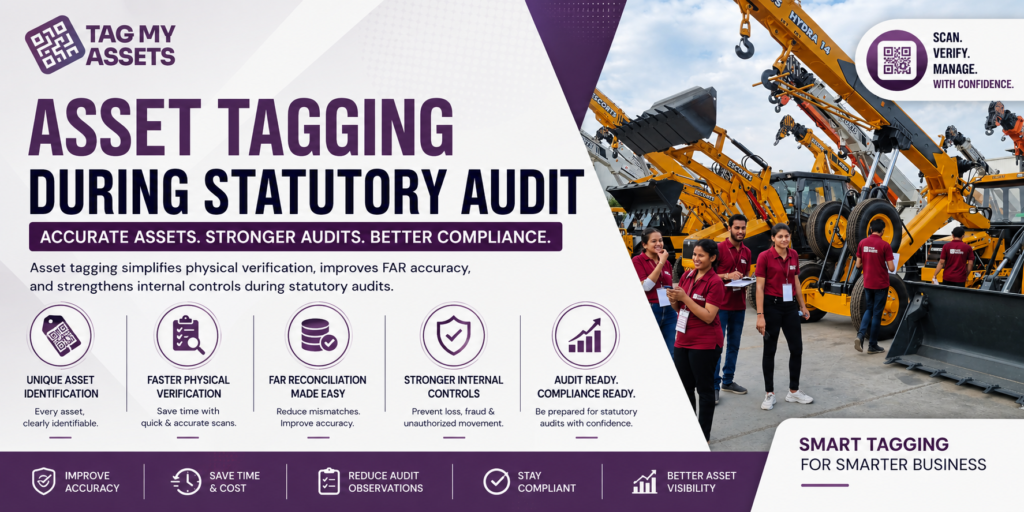
Asset tagging during statutory audit helps organizations improve asset traceability, strengthen internal controls, simplify physical verification, and reduce audit observations significantly.
In this guide, we explain how asset tagging supports statutory audits and why companies across India are increasingly implementing barcode and RFID-based asset tagging systems.
What Is Asset Tagging?
Asset tagging is the process of assigning a unique identification label to every fixed asset.
These tags may include:
- QR codes,
- barcodes,
- RFID tags,
- serial numbers,
- or asset identification numbers.
The tags are physically pasted or attached to assets and linked with asset records in the FAR or asset management system.
Asset tagging helps companies uniquely identify and track:
- machinery,
- IT assets,
- office equipment,
- furniture,
- warehouse assets,
- tools,
- and operational equipment.
Why Asset Tagging During Statutory Audit Is Important
Asset tagging during statutory audit is important because it helps companies uniquely identify, verify, and track fixed assets accurately during physical verification exercises. Auditors often face challenges when assets are not properly labeled, recorded, or traceable with the Fixed Asset Register (FAR).
In large organizations with multiple locations, manual asset identification becomes time-consuming and increases the risk of:
- missing assets,
- duplicate records,
- FAR mismatch,
- and inaccurate audit reporting.
Asset tagging during statutory audit improves:
- asset traceability,
- physical verification accuracy,
- FAR reconciliation,
- and internal financial controls.
Barcode and RFID-based asset tagging systems also help auditors complete verification processes faster while reducing operational disruption. Companies implementing proper asset tagging during statutory audit are generally better prepared for compliance reviews, CARO 2020 reporting, and internal audit requirements.
Why Statutory Audits Require Proper Asset Identification
During statutory audits, auditors verify:
- existence of assets,
- asset ownership,
- asset location,
- capitalization accuracy,
- and depreciation records.
Without proper tagging, auditors often face challenges such as:
- duplicate asset identification,
- missing assets,
- FAR mismatch,
- and unverified assets.
This increases audit risk and weakens internal financial controls.
Asset tagging during statutory audit helps address these issues by creating clear asset-level identification.
1. Improves Physical Verification Accuracy
One of the biggest advantages of asset tagging during statutory audit is improved physical verification accuracy.
Tagged assets can be:
- quickly identified,
- scanned,
- verified,
- and mapped with FAR records.
This reduces:
- manual errors,
- duplicate counting,
- and verification delays.
Companies with large factories, hospitals, retail stores, and multiple branch locations benefit significantly from tagged asset verification.
2. Reduces FAR Mismatch During Audit
Auditors frequently identify mismatches between:
- physical assets,
- and FAR records.
These mismatches may include:
- missing assets,
- excess assets,
- duplicate entries,
- or incorrect locations.
Asset tagging helps companies reconcile physical assets with FAR data more efficiently.
Every tagged asset becomes traceable and linked to:
- asset code,
- asset category,
- location,
- department,
- and capitalization details.
This significantly improves FAR reconciliation accuracy.
3. Helps Auditors Verify Asset Existence Easily
Statutory auditors are primarily concerned with whether assets actually exist physically.
Without tagging, auditors may struggle to differentiate between:
- similar machines,
- identical furniture,
- or repetitive IT equipment.
Asset tagging during statutory audit simplifies this process because each asset carries a unique identification number.
Auditors can:
- scan tags,
- verify records,
- confirm location,
- and validate asset existence efficiently.
4. Strengthens Internal Financial Controls (IFC)
Asset tagging supports Internal Financial Controls by improving:
- asset accountability,
- movement tracking,
- approval controls,
- and audit trails.
Companies implementing asset tagging generally maintain stronger control over:
- asset transfers,
- disposals,
- employee allocation,
- and capitalization records.
This helps reduce audit observations related to weak controls.
5. Helps Prevent Ghost Assets and Asset Fraud
Ghost assets are assets recorded in FAR but not physically available.
These are among the most serious audit concerns.
Asset tagging helps organizations identify:
- non-existing assets,
- duplicate assets,
- obsolete assets,
- and unauthorized movements.
Periodic verification of tagged assets reduces the risk of:
- financial manipulation,
- asset fraud,
- and inaccurate reporting.
6. Simplifies Multi-Location Asset Verification
Companies operating across:
- factories,
- warehouses,
- retail stores,
- hospitals,
- schools,
- and branch offices
often face challenges during statutory audit verification.
Asset tagging allows centralized asset tracking across locations.
Auditors can review:
- location-wise verification,
- movement history,
- and verification reports more efficiently.
This improves audit readiness significantly.
7. Improves Asset Traceability
Asset traceability is critical during audits.
Tagged assets can be tracked based on:
- location,
- department,
- user allocation,
- asset type,
- or verification history.
This improves transparency and strengthens compliance reporting.
8. Supports Faster Audit Completion
Manual asset verification consumes significant time during audits.
Asset tagging during statutory audit helps reduce verification time because:
- assets become easier to locate,
- scanning speeds increase,
- and FAR reconciliation becomes faster.
This helps companies:
- reduce audit delays,
- improve reporting timelines,
- and minimize operational disruption.
9. Enhances Compliance and Documentation
Tagged assets help companies maintain better documentation for:
- physical verification,
- asset transfers,
- capitalization,
- disposals,
- and audit reporting.
This improves compliance under:
- Companies Act requirements,
- CARO 2020 reporting,
- and internal audit procedures.
10. Enables Better Asset Lifecycle Management
Asset tagging is not useful only during audits.
It also helps companies manage:
- asset acquisition,
- utilization,
- maintenance,
- transfers,
- and disposal processes.
This creates better long-term asset governance and operational control.
Industries Where Asset Tagging Is Most Important During Audit
Asset tagging during statutory audit is especially important for:
- manufacturing companies,
- retail chains,
- hospitals,
- logistics companies,
- educational institutions,
- warehouses,
- hotels,
- IT companies,
- and infrastructure businesses.
Organizations with large asset bases benefit the most from structured asset tagging systems.
Barcode vs RFID Asset Tagging for Audit Verification
Barcode / QR Code Tagging
Best for:
- office assets,
- furniture,
- IT equipment,
- and moderate asset volumes.
Advantages:
- cost-effective,
- easy implementation,
- simple scanning process.
RFID Asset Tagging
Best for:
- warehouses,
- manufacturing plants,
- high-volume assets,
- and fast verification environments.
Advantages:
- bulk scanning,
- faster verification,
- long-range identification,
- improved operational efficiency.
Best Practices for Asset Tagging During Statutory Audit
Companies should follow these best practices:
- use durable asset tags,
- maintain standardized asset coding,
- conduct periodic verification,
- update FAR regularly,
- track asset movement,
- and maintain digital verification records.
It is also important to classify assets properly during tagging and verification exercises.
Conclusion
Asset tagging during statutory audit has become an essential practice for companies managing large fixed asset bases across multiple locations.
Proper asset tagging improves:
- physical verification accuracy,
- FAR reconciliation,
- audit readiness,
- compliance,
- and internal controls.
Organizations implementing barcode or RFID-based asset tagging systems are better prepared for statutory audits, internal audits, and compliance reporting requirements.
As audit expectations and compliance requirements continue to increase, companies investing in structured asset tagging and verification systems gain better visibility, stronger controls, and improved operational confidence.