
Unlike a conventional office where all assets belong to one company, co-working spaces involve multiple businesses operating under one roof. On the same floor, you may find:
- Shared workstations
- Common meeting room furniture
- Projectors and display screens
- Printers and networking devices
- Pantry equipment
- Reception furniture
- CCTV and access control systems
- Client-specific laptops, desktops, storage cabinets, or branding fixtures
Over time, assets get shifted between cabins, hot desks, meeting rooms, and common areas. Tenants move in and out. Shared resources are used by multiple teams. New furniture or IT equipment may be added frequently.
Asset tagging for co-working spaces helps operators clearly differentiate shared infrastructure and client-owned assets, improving control and accountability.
If these assets are not properly tagged and recorded, the result is confusion over:
- Who owns the asset
- Where the asset is located
- Whether it is shared or exclusive
- Who is responsible for its damage or loss
- Which assets should be included in verification and billing records
This is why asset tagging for co-working spaces is now considered a best practice for modern managed offices.
According to reports on the global growth of co-working spaces, flexible office environments are expanding rapidly as companies adopt hybrid work models.
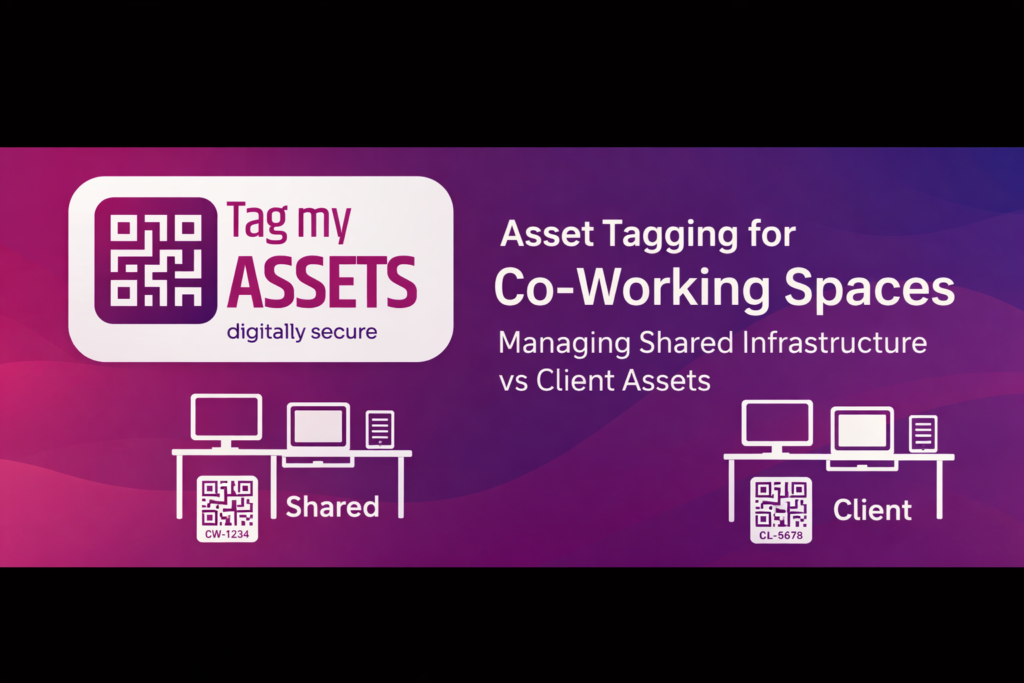
Shared Infrastructure vs Client Assets
A strong asset tagging strategy starts with proper classification.
Shared Infrastructure Assets
These are assets owned by the co-working space operator and provided as part of the facility. Examples include:
- Workstations and desks
- Chairs and storage units
- Conference room tables
- TV screens and projectors
- Routers, switches, and Wi-Fi access points
- Biometric devices and access systems
- Pantry appliances
- Reception counters
- HVAC support equipment
- Fire safety and security equipment
These assets are generally used across multiple occupants or are part of the common facility.
Client Assets
These are assets owned by the tenant or client using the co-working space. Examples include:
- Laptops and desktops
- Docking stations
- Printers
- Personal monitors
- Specialized machines or devices
- Locked storage cabinets
- Team-specific conference equipment
- Temporary branding stands or custom furniture
The challenge is that both asset categories may physically sit in the same office area. Without clear tagging, they can easily get mixed up during relocation, audits, or exit formalities.
Why Asset Tagging Is Important for Co-Working Spaces
Asset tagging helps create a clear identification system for every asset in the facility. Each item is assigned a unique code through a QR code, barcode, or RFID tag, linked to asset details in a digital register.
This gives co-working operators several advantages.
1. Clear Ownership Identification
A tagged asset can instantly show whether it belongs to the facility operator or a tenant. This reduces disputes during move-outs, handovers, or internal shifting.
2. Easier Physical Verification
Periodic verification becomes much faster when every asset is tagged and mapped location-wise. Teams can scan assets and reconcile them against records.
3. Better Accountability
If a meeting room screen, chair, or access device goes missing, tagging helps determine ownership, department, floor, and last verified location.
4. Smooth Tenant Onboarding and Exit
When new tenants occupy a space, shared assets can be listed separately from client-installed assets. On exit, both can be verified properly.
5. Reduced Asset Loss and Mix-Up
In flexible office environments, furniture and IT assets often move around. Tagging minimizes confusion and helps maintain accurate records.
6. Better Maintenance Planning
Shared assets such as projectors, printers, coffee machines, or networking hardware need regular maintenance. Tagged records help schedule checks and replacements.
Common Problems Faced Without Asset Tagging
Many co-working operators still rely on manual Excel sheets or incomplete handover notes. This often leads to:
- Assets not recorded at the time of installation
- No distinction between operator-owned and tenant-owned items
- Difficulty in identifying missing items
- Inaccurate floor-wise or cabin-wise asset counts
- Disputes during security deposit settlement
- Poor maintenance history
- Duplicate procurement of already available assets
In premium managed office spaces, these issues can directly affect client satisfaction and operational efficiency.
Best Practices for Asset Tagging in Co-Working Spaces
To make asset tagging successful, the process should be structured carefully.
Create Separate Asset Categories
The asset database should clearly classify assets as:
- Shared infrastructure
- Client-owned assets
- Consumables
- Temporary installation items
- Scrap or inactive assets
This classification avoids confusion in reports and verification.
Use Different Tag Series or Prefixes
A practical approach is to use different prefixes for different ownership types. For example:
- CW- for co-working operator assets
- CL- for client assets
- IT- for technology devices
- PAN- for pantry assets
This makes identification easier even without opening the software.
Map Assets Location-Wise
Each asset should be linked to:
- Building
- Floor
- Zone
- Cabin or room number
- Workstation area or common area
This is especially useful in large co-working campuses with multiple tenants and frequent internal movements.
Maintain Tenant-Wise Records
Client assets should be mapped tenant-wise so the operator knows what belongs to each company. This is helpful during lease renewal, relocation, or exit clearance.
Use Durable Tags
Office furniture, networking equipment, and electronic assets should have durable, tamper-evident tags suited for indoor use. The choice may vary depending on surface and usage.
Perform Periodic Verification
Quarterly or half-yearly asset verification is a good practice for co-working environments because layouts and occupants change frequently.
How Technology Helps
Modern asset tagging is no longer just about sticking labels. With mobile-based verification systems, an operator can:
- Scan tagged assets through a phone or handheld device
- Update asset condition
- Mark location changes
- Record transferred or missing assets
- Generate verification reports
- Maintain tenant-wise and floor-wise asset summaries
This brings speed, transparency, and accuracy to co-working asset management.
For larger managed office spaces, cloud-based dashboards can further help management track asset movement, utilization, and status across locations.
Ideal Assets to Tag in a Co-Working Space
Some of the most important assets that should be tagged include:
- Desks and chairs
- Conference tables
- Filing cabinets
- TV screens and presentation devices
- Access control units
- Routers and switches
- Printers and scanners
- Pantry machines
- Reception furniture
- Server racks and IT infrastructure
- Client-installed furniture and equipment
- Storage lockers
- Security systems
Not every low-value item needs formal tagging, but all significant movable and trackable assets should be included.
How TagMyAssets Helps with Asset Tagging for Co-Working Spaces
TagMyAssets provides professional asset tagging for co-working spaces including QR code tagging, asset verification, and digital asset registers.
Our services can support:
- Physical asset identification
- QR code, barcode, and suitable tag implementation
- Asset data capture
- Shared vs client-owned asset classification
- Location-wise mapping
- Verification and reconciliation
- Digital asset register creation
- Ongoing asset tracking support
Whether the requirement is for a single co-working facility or multiple managed office locations, a structured asset tagging system improves control, reduces confusion, and supports smooth operations.
Asset tagging for co-working spaces is becoming essential as flexible offices continue to grow. Proper tagging ensures shared infrastructure and client assets remain clearly identifiable across workstations, meeting rooms, and common areas.
Conclusion
Co-working spaces are built on flexibility, but flexibility should not mean loss of control. When multiple tenants, shared facilities, and movable assets operate in the same space, proper identification becomes critical.
Implementing asset tagging for co-working spaces ensures better visibility of shared infrastructure and client assets across managed offices. Companies that implement asset tagging for co-working spaces benefit from improved asset visibility, easier verification, and better control over shared office infrastructure.
Asset tagging for co-working spaces helps operators clearly distinguish between shared infrastructure and client assets, reduce disputes, improve verification, and maintain better operational discipline.
As co-working and managed office models continue to grow, asset tagging is becoming less of an option and more of a necessity.
FAQs
1. What is asset tagging in co-working spaces?
Asset tagging in co-working spaces is the process of assigning unique identification tags to furniture, IT equipment, and other assets so they can be tracked, verified, and managed properly.
2. Why is asset tagging important for managed offices?
It helps separate operator-owned shared infrastructure from tenant-owned assets, reducing confusion, disputes, and missing asset issues.
3. Which assets should be tagged in a co-working space?
Desks, chairs, monitors, networking devices, access systems, printers, meeting room equipment, pantry machines, and other movable or important assets should ideally be tagged.
4. Can asset tagging help during tenant exit?
Yes. Tagged records make it easier to verify which assets belong to the operator and which belong to the client during exit or relocation.
5. What type of tags are suitable for co-working assets?
Usually QR code or barcode tags are suitable for indoor office assets. The tag type depends on the asset surface, usage, and durability requirement.
6. How often should co-working assets be verified?
Quarterly or half-yearly verification is generally recommended, especially in spaces with frequent movement and changing tenants.
