
Hospitals carry some of the most mobile asset bases of any industry. Ventilators, infusion pumps, monitors and wheelchairs move between ICU, operation theatres, laboratories, emergency wards and patient rooms — often without anything in the records changing. Over a few years, the gap between the Fixed Asset Register and what is physically on the floor becomes wide enough that nobody can close it from a desk.
Asset tagging for hospitals is what makes that gap measurable. Every device gets a unique physical identity, linked to a line in the register, so equipment can be identified on sight, traced to its recorded department, and reconciled line by line during verification.
TagMyAssets has completed 395+ projects across 1,500+ locations in India, covering 10 lakh+ assets tagged, across manufacturing, retail, laboratories, offices and multi-location branch networks.
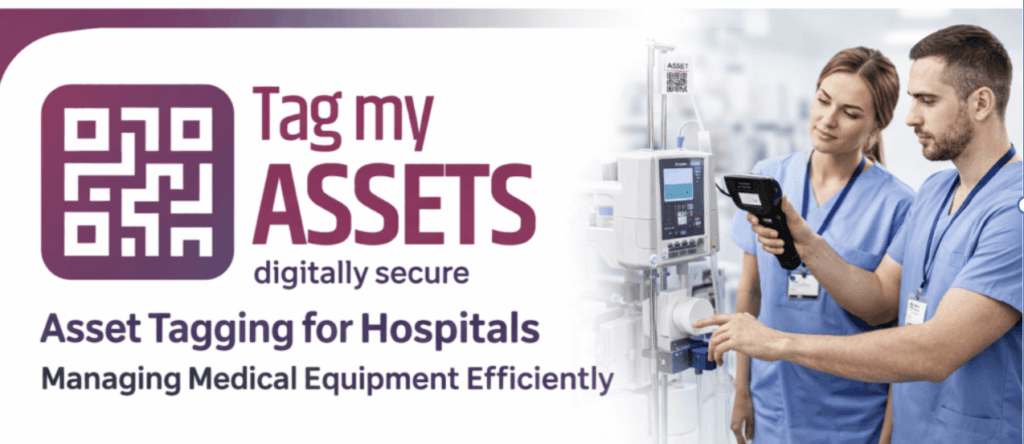
What Is Asset Tagging in Hospitals?
Asset tagging is the process of affixing a unique identification tag to each asset in the hospital and linking that tag to a specific line in the Fixed Asset Register.
Each tag record typically holds:
- Asset ID
- Asset description
- Serial number
- Department or location
- Responsible department
- Purchase value
Staff scan the tag on a standard smartphone to retrieve the record. No separate handheld hardware is needed for QR or barcode; RFID is the exception, and needs a reader.
What Gets Tagged in a Hospital
A hospital register spans several asset types, and they do not all get tagged the same way.
Medical and biomedical equipment — ventilators, patient monitors, infusion pumps, defibrillators, ECG machines, ultrasound and imaging systems, laboratory and pathology instruments, blood storage units. High value, frequently moved, and the category where unique identification matters most.
IT assets — computers, laptops, printers, servers and networking equipment, often reassigned between departments without the register changing.
Furniture and fixtures — beds, ICU beds, cabinets, nursing stations, waiting area furniture. Usually department-fixed, so barcode labels are sufficient.
Facility and infrastructure assets — HVAC systems, DG sets, UPS systems, fire equipment, CCTV infrastructure. Some of these fall into the non-auditable category described below.
The classification step decides which of these is tagged individually, which is counted, and which cannot be physically verified at all.
Why Hospitals Need Asset Tagging
Hospitals manage large volumes of movable equipment across departments — ICU, operation theatres, laboratories, radiology, emergency wards and patient rooms. Without unique identification, three problems recur.
Equipment cannot be traced to a location. Devices move between departments and the record does not follow them. Verification then becomes a search rather than a check.
The register drifts out of step with the floor. Assets are transferred, retired or replaced without the register being updated, so the FAR carries lines that no longer have equipment behind them. Closing those out is a FAR reconciliation exercise, not a bookkeeping one.
Verification cannot be evidenced. Under CARO 2020, auditors report on whether proper records of property, plant and equipment are maintained, whether management has physically verified them at reasonable intervals, and whether material discrepancies were dealt with in the books. Untagged assets make that difficult to demonstrate.
For the full clause-by-clause position, see our CARO 2020 fixed asset verification requirements guide.
Types of Asset Tags Used in Hospitals
Tag material is matched to the asset and its environment rather than applied uniformly across the site.
QR code tags are the common choice for most hospital equipment — inexpensive, scannable on a phone, and able to carry more data than a barcode of the same size. See how QR and barcode based asset tagging works in practice.
Barcode labels suit medical instruments, furniture, computers and diagnostic devices where the asset stays in one department.
RFID tags are used where assets move constantly or where scanning at close range is impractical — high-value devices and equipment that circulates between departments. Read more about RFID asset tagging services.
Tamper-evident polyester is the usual specification for medical equipment. Hospital surfaces are cleaned frequently and with chemicals that lift ordinary adhesive labels, so the fixing method is selected per asset category.
How Asset Tagging for Hospitals Works
Step 1 — Asset identification
Assets are identified and categorised across departments: medical equipment, biomedical devices, IT equipment, furniture and laboratory instruments.
Step 2 — Asset classification
Not every line in a fixed asset register can be physically tagged. Assets are classified into three groups before field work:
Taggable — individually identifiable assets that can physically carry a tag. Most of the register.
Countable — items verified by count rather than individually tagged, where tagging each unit is impractical or units are not individually distinguishable.
Non-auditable — register lines with no physically verifiable form: civil structures, electrical wiring and installations, software licences and other intangibles. These cannot be tagged or counted and are mapped notionally instead.
Identifying the non-auditable portion up front is what stops the reconciliation appearing to show a shortfall when those items were never physically verifiable in the first place.
Step 3 — Physical verification
Existence, location and condition are confirmed on site. Verifying before tagging means you tag against a clean register rather than carrying forward whatever the old one contained. See physical verification of assets for how this stage runs.
Step 4 — Tagging
Unique QR, barcode or RFID tags are affixed and mapped to the corresponding FAR line.
Step 5 — Data capture
Asset ID, department, serial number, description, purchase value and condition are captured on site, along with a photograph.
Step 6— FAR reconciliation
Field findings are matched line by line against the register. Missing assets, unrecorded additions and department mismatches are classified and documented in a report your auditor can work from.
What Tagging Changes in Practice
Equipment becomes traceable. A tagged device can be matched to its recorded department during verification, rather than located by asking around.
The register becomes reconcilable. Each tag number maps to a FAR line, so discrepancies are classified rather than estimated.
Each cycle gets faster than the last. Without unique tags, every verification restarts the matching problem — vague register descriptions mapped by hand to physical items. Tags convert that into a scan-based process.
Idle equipment surfaces. Devices sitting unused in storage tend to appear during verification, which sometimes avoids a repeat purchase.
Best Practices for Hospital Asset Tagging
Verify before you tag. A physical verification pass first establishes what actually exists across departments, so tagging is applied to a clean base.
Match tag material to the asset. Cleaning chemicals, frequent handling and sterilisation areas each call for different specifications. A single tag type across the whole hospital will fail somewhere.
Standardise the numbering. A consistent scheme covering department, asset type and location makes assets traceable and reporting straightforward.
Map every tag to a register line. This is the step that determines whether next year’s verification is a scan or a search.
Verify at regular intervals. Periodic verification keeps the register current and gives the statutory auditor a documented programme to review.
Brief the departments. The scan only holds value if the staff handling equipment use it consistently. A short walkthrough per department is usually enough.
Hospital Asset Tagging and NABH Accreditation
NABH accreditation standards require hospitals to demonstrate control over equipment — that devices are identified, maintained on a schedule, and traceable to a responsible department. Tagging is not named as a requirement, but it is the practical mechanism by which most hospitals evidence it.
A tagged asset carries a fixed identity that a maintenance record, a warranty document and a register line can all point to. Without one, equipment is identified by description and location, both of which change.
The same tag base serves the statutory audit under CARO 2020 and the accreditation assessment. The two exercises ask different questions — one about the books, one about clinical equipment control — but both are answered from the same physical identification.
What Makes Hospital Tagging Different
Two constraints separate a hospital exercise from an office or plant exercise, and both need planning before any field team arrives.
Cleaning and infection control. Clinical surfaces are cleaned frequently with alcohol, chlorine and similar agents that lift ordinary adhesive labels. Tag material and adhesive have to be specified by area rather than applied uniformly, and a tag that peels is worse than no tag — the register then shows an identity the asset no longer carries.
Restricted clinical areas. ICUs, operation theatres, isolation wards and radiology cannot be entered on a field team’s schedule. Access has to be arranged with each department in advance and timed around procedures and shift changes. Equipment in continuous clinical use is covered on a return visit rather than interrupted.
Both of these are planning questions, not field questions. They are settled before mobilisation or they stall the exercise halfway through.
How We Approach a Hospital Engagement
Our role is the on-ground layer: tagging, physical verification and FAR reconciliation. We do not replace your ERP or your biomedical equipment records — we produce the physical evidence base they should be reconciled against.
A hospital engagement covers:
- Pan-India field execution teams
- Physical verification of hospital assets across departments, before tagging
- QR code, barcode or RFID tagging matched to asset environment
- Asset data capture with photographic record
- FAR cleanup and register mapping
- Reconciliation report with variances classified for management review
Learn more about our fixed asset tagging services, or about inventory verification services for consumables and supplies.
Conclusion
Hospital equipment moves, and registers rarely keep up on their own. Tagging gives every device an identity that survives between verification cycles, so the register can be reconciled against the floor, discrepancies can be classified rather than guessed at, and the verification programme can be evidenced during statutory audit.
Timelines depend on asset volume and the number of departments involved — we confirm a schedule after reviewing your FAR.
FAQs
What is asset tagging in hospitals?
Asset tagging is the process of affixing a unique identification tag — QR code, barcode or RFID — to each hospital asset and linking it to a specific line in the Fixed Asset Register.
Why is asset tagging important for hospitals?
It lets equipment be located and identified on sight, reconciled against the Fixed Asset Register, and evidenced during statutory audit under CARO 2020.
What types of asset tags are used in hospitals?
QR codes for most equipment, barcode labels for department-fixed assets, and RFID where devices circulate constantly. Tamper-evident polyester is the usual material specification for medical equipment.
Do you need special hardware to scan hospital asset tags?
No. QR and barcode tags are scanned on a standard smartphone. RFID is the exception and needs a reader.
How often should hospital assets be physically verified?
Most organisations verify annually. CARO 2020 requires the auditor to report on whether management has verified the assets at reasonable intervals, with material discrepancies dealt with in the books.
Good Reads
NABH India — accreditation standards
WHO — Medical Equipment Management guidance
Ministry of Health and Family Welfare