
In the current regulatory landscape, professional Asset Tagging Services in India have evolved from a best practice into a mandatory requirement for corporate governance With the tightening of CARO 2020 and GST reconciliation protocols, Indian enterprises are rapidly moving away from legacy systems to embrace contactless asset intelligence.
At TagMyAssets, we have phased out basic barcodes in favor of Dynamic QR and RFID/IoT ecosystems that offer 100% data integrity and zero-touch auditing.
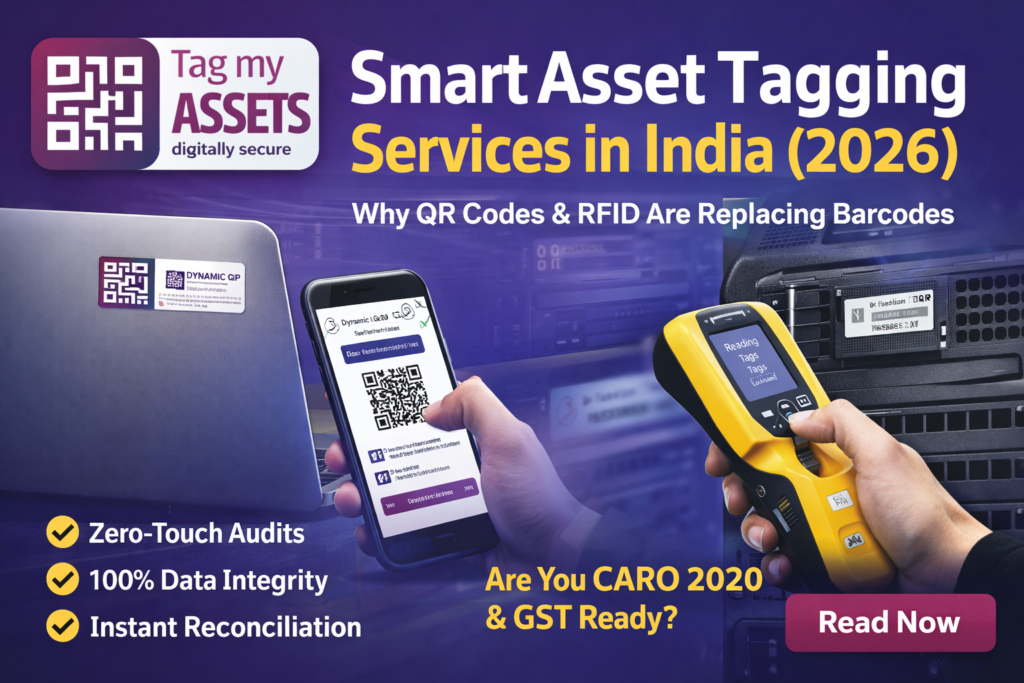
1. Why Barcodes are Obsolete in 2026
- Manual Friction: Barcodes require a direct line-of-sight laser hit. In a facility with 10,000+ items, this is a massive productivity killer.
- Zero Intelligence: A barcode is a “dumb” link. Dynamic QR and RFID allow for cloud-synced history, maintenance logs, and GPS timestamps.
- Durability Issues: Once a barcode is scratched, the data is lost. Our next-gen tags use error-correction technology to remain readable even when partially damaged.
2. The 2026 Tech Stack: QR vs. RFID
A. Dynamic QR Code Tagging (The Professional Standard)
Unlike static codes, our Dynamic QR tags link to a live cloud profile.
- Mobile-First: Any authorized employee with a smartphone can scan and update asset status.
- Rich Data: Stores manuals, warranty certificates, and last-service dates directly in the digital twin.
- Best For: Office IT, Medical equipment, and Distributed retail assets.
B. RFID & IoT Tagging (The Automation Peak)
For organizations requiring “Gate-Level” or “Room-Level” visibility without manual intervention.
- Bulk Scanning: Scan an entire server rack or a whole truckload of equipment in 3 seconds.
- Passive & Active RFID: From low-cost proximity tags to battery-powered BLE (Bluetooth Low Energy) tags for real-time location tracking.
- Best For: Data Centers, High-value Manufacturing, and Large-scale Warehousing.
3. The “Smart” Tagging Process: How We Execute
We don’t just stick labels; we build a Digital Asset Registry.
- ERP Data Mapping: We sync with your SAP S/4HANA, Oracle Cloud, or Microsoft Dynamics to align your Fixed Asset Register (FAR).
- Environmental Tag Selection: We provide Anodized Aluminum QR plates for heavy machinery or On-Metal RFID tags for IT servers.
- Contactless Verification: Our teams use long-range scanners to verify assets without moving furniture or opening sealed boxes.
- Instant Reconciliation: Our proprietary app generates an Immediate Discrepancy Report, highlighting “found,” “missing,” or “ghost” assets in real-time.
4. The 2026 ROI: Why Automation Pays for Itself
When evaluating the financial impact, the return on investment for Asset Tagging Services in India is realized through significantly reduced labor costs and the elimination of capital leakage from lost equipment. For a mid-sized Indian organization with 1,000+ assets, the math is undeniable:
| Operational Phase | Manual / Legacy Barcode | TagMyAssets (Smart RFID/QR) | ROI Impact |
| Verification Time | 40+ Man-hours | 2 Man-hours (Bulk Scan) | 95% Labor Saving |
| Data Entry Errors | 5-8% (Typo risks) | 0% (Direct ERP Sync) | Audit Readiness |
| Ghost Asset Loss | High Risk | Zero (Total Visibility) | Capital Conservation |
| Audit Prep Time | 2 Weeks of Stress | 1 Click (Instant Report) | C-Level Efficiency |
Export to Sheets
5. Specialized Materials for Indian Conditions
Our specialized Asset Tagging Services in India utilize industrial-grade materials specifically engineered to survive the country’s diverse and often harsh climatic conditions. We utilize industrial-grade materials designed for the diverse Indian climate:
- Anti-Tamper Polyester: Leaves a “VOID” pattern if removed (ideal for laptops).
- Ceramic Tags: Withstands 100°C+ temperatures in chemical and manufacturing plants.
- UV-Resistant Aluminum: 10+ year lifespan for outdoor assets like solar panels or HVAC units.
6. Industry-Specific Compliance
- Manufacturing: ISO 55001 alignment through ruggedized RFID.
- IT/ITES: SOC2 and ISO 27001 data security compliance via encrypted tagging.
- Hospitals: NABH-ready asset tracking for life-saving medical equipment.
By integrating these specific standards, our Asset Tagging Services in India ensure that your organization remains fully compliant with both local and international regulatory bodies
7. Why Choose TagMyAssets for Asset Tagging Services in India?
- Pan-India Execution: Rapid deployment teams across 25+ major cities.
- Zero-Error Guarantee: AI-validation ensures no duplicate tags or incorrect entries.
- Audit Defense: We provide a Certificate of Physical Verification signed by experts to satisfy statutory auditors and CARO 2020 requirements.
As we move further into 2026, partnering with a professional provider of Asset Tagging Services in India is the most effective way to secure your company’s physical assets and maintain a transparent, audit-ready balance sheet
8. Frequently Asked Questions (2026)
Q: How long does an RFID project take? A: Depending on volume, a mid-sized facility can be fully tagged and reconciled in 2–4 weeks.
Q: Can we use our existing smartphones? A: Yes, for Dynamic QR solutions. For RFID, we provide professional handheld readers or gate scanners.
9. Combatting “Ghost Assets”: The Financial Impact
A major driver for Asset Tagging Services in India is the elimination of “Ghost Assets”—items that appear in your Fixed Asset Register (FAR) but do not physically exist on-site. These typically occur when assets are lost, stolen, or disposed of without updating the records.
- Hidden Costs: Companies with ghost assets often overpay on insurance premiums and taxes for equipment they no longer own.
- Operational Drag: Productivity drops when employees waste time searching for missing tools that are listed as “available” in the system.
- The Solution: Regular physical verification using RFID or QR tags ensures that your physical reality matches your financial books, instantly identifying discrepancies.
10. The 2026 Asset Lifecycle Framework
Professional Asset Tagging Services in India now integrate with the entire lifecycle of an asset, from procurement to disposal.
| Lifecycle Stage | Role of Smart Tagging | Business Value |
| Acquisition | Immediate assignment of a “Digital Identity” | Prevents duplicate purchases |
| Deployment | Location-based tracking and user assignment | High accountability & traceability |
| Maintenance | Auto-logging of service and calibration history | Minimizes machine downtime |
| Audit/Compliance | “One-click” verification for auditors | Zero audit stress & compliance |
| Retirement | Secure decommissioning and eco-friendly disposal | Risk reduction & accurate scrap value |
11. Best Practices for Manufacturing Teams
For industrial facilities in India, asset tracking is a critical safety and efficiency requirement.
- Unique Identification: Every tool and machine must have a unique ID to ensure a clear digital audit trail.
- Real-Time Monitoring: Using IoT sensors or BLE tags allows for proactive maintenance, preventing catastrophic failures.
- Integrated CMMS: Linking tags directly to your Computerized Maintenance Management System (CMMS) ensures that maintenance teams have instant access to equipment specs and history on the floor.
- Lean Inventory: By understanding usage trends through tag data, manufacturing plants can adopt “just-in-time” stocking, reducing warehousing costs.
12. Checklist: Choosing an Asset Tagging Vendor in India (2026)
Selecting the right partner is just as critical as selecting the right technology. Before signing a contract, use this 10-point checklist to evaluate your vendor’s capabilities:
- Technical Expertise: Does the vendor support multiple technologies like RFID (Passive/Active), Dynamic QR, and BLE as per your requirement?
- Scalability: Can the vendor manage multi-location rollouts across different Indian states simultaneously without losing brand or data standards?
- Data Security & Compliance: Are they certified for data security (e.g., ISO 27001 or SOC 2) to protect your sensitive financial information?
- Hardware Compatibility: Do their tags integrate seamlessly with your existing ERP (SAP, Oracle, Microsoft Dynamics) or asset management software?
- Durability Guarantee: Does the vendor provide environmental testing data for their tags to ensure they survive harsh industrial conditions like chemicals, UV, and high heat?
- Full-Lifecycle Support: Do they assist with the entire process, including pre-audit planning, physical verification, and final reconciliation?
- Customization: Can they provide tamper-evident or custom-branded tags with your company logo and specific security warnings?
- Audit Readiness: Does their reporting output satisfy the requirements of CARO 2020 and other statutory audit bodies in India?
- Training & Adoption: Do they offer staff training to ensure your team can properly use the scanners and update the system post-implementation?
- Post-Project Support: Is there a clear protocol for tag replacement or regular “health check” reviews to maintain the system’s accuracy over time?
13. Avoiding Common Implementation Pitfalls
To ensure your investment in Asset Tagging Services in India delivers a measurable ROI, watch out for these common mistakes:
- Ignoring Non-Taggable Assets: Some high-value items, like mirrors or fine art, cannot be physically tagged due to aesthetics. A professional vendor will have a SOP (Standard Operating Procedure) to verify these as “non-taggable” but still include them in your FAR.
- Poor Surface Preparation: Tags will fail if applied to greasy, dusty, or wet surfaces. Ensure your team (or the vendor) follows strict cleaning protocols before affixing any adhesive labels.
- Inconsistent ID Formats: Avoid using manufacturer serial numbers as your primary ID, as they vary in format. Use a standardized unique identifier that reflects your own department or location codes for easier internal tracking.
- Data Silos: Ensure your tagging data isn’t trapped in a standalone spreadsheet; it must be integrated into your central business database for real-time visibility.
