
Compliance, Control and an Accurate Fixed Asset Register
Executive Summary
Asset tagging has moved from a clerical task to a financial control. Under CARO 2020, the statutory auditor reports on whether the company maintains proper records of its Property, Plant and Equipment and whether management has physically verified them at reasonable intervals — and a register that cannot be matched to the floor makes both hard to evidence.
This guide covers how QR, barcode and RFID tagging are applied across Indian industrial and corporate sites, and what a well-run tagging exercise delivers. For end-to-end execution, see our asset tagging company in India page.
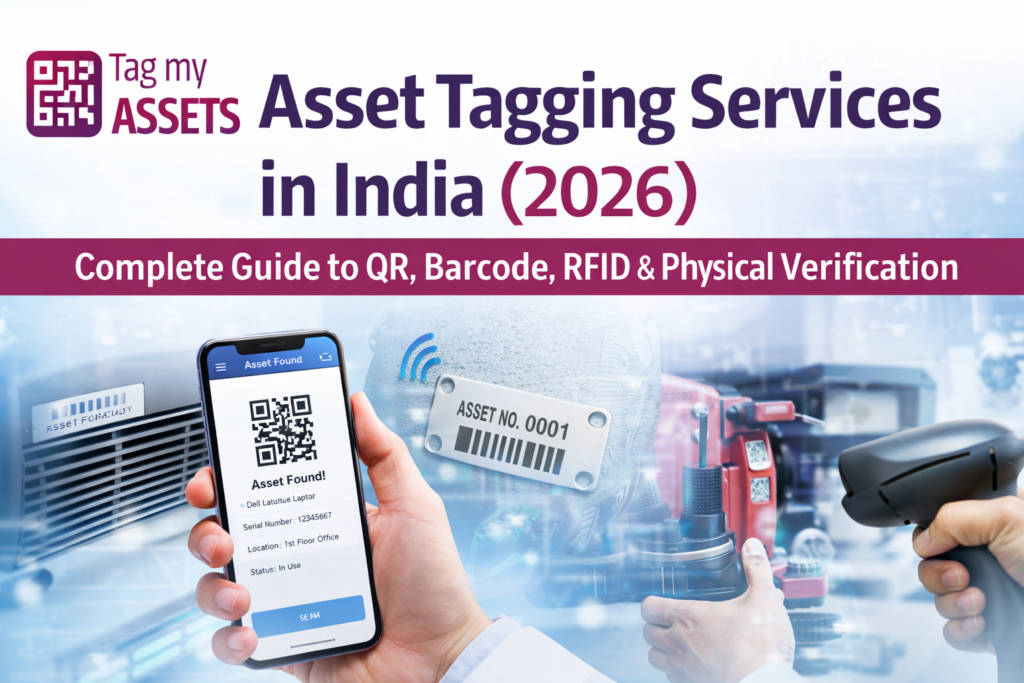
Choosing the right asset tagging services in India is a financial decision as much as an administrative one. A verified Fixed Asset Register is what allows management to evidence physical verification when the statutory auditor asks for it.
1. Why Asset Tagging Matters in 2026
Ghost assets — items still on the register that no longer exist on the floor — carry depreciation and insurance cost for nothing.
In first-time verification exercises, a meaningful share of the assets listed in the Fixed Asset Register cannot be located at the recorded position — either scrapped without an entry, transferred without an update, or never tagged in the first place.
Professional tagging addresses four exposures:
- Audit observations: discrepancies between the FAR and the floor are identified and resolved before the auditor finds them.
- Cost on missing assets: insurance premiums and depreciation continue on assets that no longer exist.
- Operational friction: time lost searching for specific machinery and equipment.
- Verification evidence: the item-level record the auditor’s CARO 2020 reporting relies on.
The Regulatory Trigger: CARO 2020 & Beyond
Under the Companies (Auditor’s Report) Order, CARO 2020, the auditor reports on whether the company maintains proper records showing full particulars, including quantitative details and situation, of its Property, Plant and Equipment — clause 3(i)(a)(A) — and whether management has physically verified them at reasonable intervals — clause 3(i)(b). Tagging provides the physical evidence base management needs when the auditor tests the register.
2. Choosing the Technology: QR vs Barcode vs RFID
The right tag depends on the asset and its environment:
- QR code tags: a common choice for IT assets and corporate offices, owing to low cost and smartphone scanning.
- RFID: suited to warehouses and high-volume environments where bulk scanning without line of sight is needed; requires an RFID reader.
- Laser-marked stainless steel tags: for heavy machinery in heat-intensive or chemical-heavy plants.
- Tamper-evident labels: for high-value electronics, showing when a label has been removed or switched.
3. The 7-Step Implementation Process
At TagMyAssets, the methodology is built around what a statutory auditor will test.
- Scoping: we align with your finance and operations teams to define asset thresholds, locations and timelines.
- Asset master review: we review the current Fixed Asset Register, identifying missing data fields and standardising asset descriptions.
- Sheet-to-floor verification: we physically locate each asset on the register and capture photographic evidence.
- Tagging and labelling: we apply a unique tag (QR, barcode, RFID or metal) to each asset and check adhesion for long-term readability.
- Data capture: we record the asset description, serial number, location and custodian at the point of tagging.
- Floor-to-sheet verification and reconciliation: we trace assets found on the floor back to the register and classify variances such as ghost assets and unrecorded items.
- Reporting: we deliver variance reports and a reconciled register as a structured file your ERP team can load.
4. Industry-Specific Asset Tagging Solutions
Manufacturing & Heavy Industry
In automotive, textile and engineering plants, assets are exposed to grease, heat and vibration.
Solution: laser-marked stainless steel tags.
Benefit: each machine carries a durable identity that maintenance records and the fixed asset register can both reference.
IT & Corporate Offices
With hybrid work, laptops and servers move between people and locations constantly.
Solution: tamper-evident QR labels, with serial number capture at the point of tagging.
Benefit: every device is mapped to a custodian and location, so unreturned hardware surfaces at verification rather than at exit.
5. The Financial Case for Tagging
Many companies view tagging purely as an expense. Verification typically surfaces value in four areas: insurance premiums paid on assets that no longer exist, depreciation charged on scrapped assets, duplicate purchases of equipment the company already owns, and audit time spent reconciling differences.
The size of each depends on how long it has been since the register was last verified.
6. Common Pitfalls in Asset Tagging (and How to Avoid Them)
- Weak adhesives: in humid conditions, standard stickers can lift within months. Use industrial-grade pressure-sensitive adhesive, or metal tags where the surface demands it.
- Ignoring software licences: licences are often left out of the register. Record them against the hardware they are installed on.
- No internal ownership: if the people who will scan are not briefed, the register drifts again. Brief the users and document the procedure in an SOP.
7. What Professional Asset Tagging Services in India Deliver
- Financial accuracy: identifying assets that have been scrapped but remain in the books, so insurance and depreciation can be corrected.
- Operational control: tagged assets can be traced to a custodian and location, which supports better capital planning and utilisation.
- Planning data: an accurate register supports CAPEX planning and replacement forecasting.
- Compliance evidence: verification evidence and a reconciled register that support CARO 2020 reporting, with a documented audit trail your statutory auditor can review.
8. Frequently Asked Questions (FAQ)
Q1: Is asset tagging mandatory under Indian law?
No. CARO 2020 does not mandate tagging. It requires the auditor to report on whether proper records of Property, Plant and Equipment are maintained and whether management has physically verified them at reasonable intervals. Verification can be done without tags, but identification is slower and more error-prone, which is why most companies use tagging to evidence both.
Q2: Can we use QR codes for outdoor assets?
Yes, but use UV-protected polyester or metal-backed QR tags to prevent fading in outdoor exposure.
Q3: How long does a typical project take?
Timelines depend on asset volume, number of locations, site access and the state of the existing register. We confirm a schedule after reviewing your FAR.
Q4: Does asset tagging help with ISO 55001?
ISO 55001 does not prescribe tagging. It expects an organisation to maintain reliable information about its assets, and a tagged, verified register is one practical way to support that.
9. Why Partner with TagMyAssets?
TagMyAssets is a field services firm: our own teams tag, verify and reconcile, and the report is built for the statutory auditor.
- Pan-India execution: large projects run with our own field teams from Gurugram; smaller counts spread across many locations run through associate teams.
- Structured data: we deliver the reconciled register in a structured format your ERP can take in, not just a spreadsheet of findings.
- Audit support: our reports are structured for statutory audit, and we respond to auditor queries on the data we produced.
For the verification side, see our guide to physical verification of assets.
10. Conclusion
You cannot evidence physical verification from a register that does not match the floor. Asset tagging is the first step towards a register that does.
To discuss an asset tagging project, contact us:
Head Office: A1, New Palam Vihar, Gurugram, Haryana 122017
Email: connect@tagmyassets.com
Phone: +91 96500 03293
Website: tagmyassets.com