
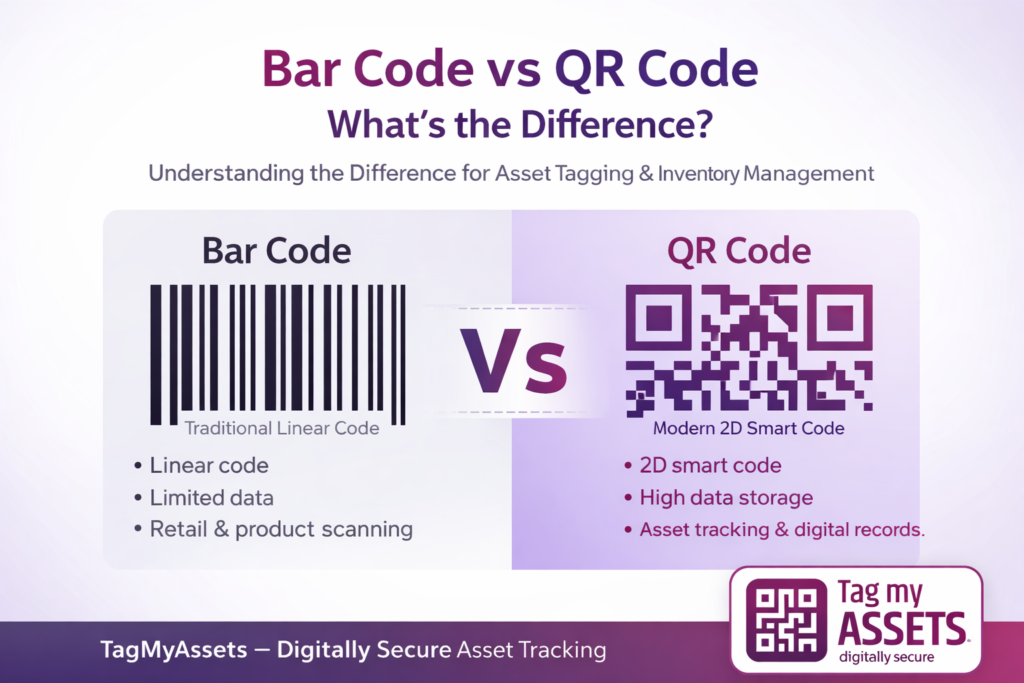
Bar code vs QR code is a common comparison for businesses looking to improve asset tracking, inventory management, and operational control. While both technologies help store and retrieve information quickly, they are designed differently and serve different business needs. A traditional bar code is linear and usually stores limited data, whereas a QR code is two-dimensional and can store far more information, including URLs, product details, asset records, and contact data. Choosing the right code depends on where and how you plan to use it in your business.
Barcodes and QR codes are widely used across industries for tracking and identification. According to GS1 standards, barcodes are commonly used in retail supply chains worldwide for product identification and inventory control.
What Is a Bar Code?
A bar code is a one-dimensional code made of vertical black lines and spaces. It is widely used in retail stores, warehouses, and inventory systems to identify products and assets quickly. Bar codes are simple, cost-effective, and easy to print, making them ideal for basic tracking applications.
What Is a QR Code?
A QR code, or Quick Response code, is a two-dimensional code made of square patterns. It can store much more data than a traditional bar code and can be scanned from different angles. QR codes are commonly used for digital payments, product authentication, asset management, maintenance history, and smart inventory systems. Businesses implementing QR-based labels can significantly improve their fixed asset tracking and verification processes.
Bar Code vs QR Code: Main Differences
QR code and bar code are both types of codes used to store and retrieve information. However, there are differences between the two:
1. Design: Bar codes are one-dimensional while QR codes are two-dimensional. Bar codes consist of a series of vertical lines of varying thickness and spacing while QR codes are made up of a grid of black and white squares.
2. Storage capacity: Bar codes can store a limited amount of information, usually up to 20 digits, while QR codes can store much more information, up to several hundred characters.
3. Scanning: Bar codes can only be scanned in one direction, from left to right, while QR codes can be scanned in any direction, including diagonally.
4. Error correction: QR codes have built-in error correction, which means that if part of the code is damaged or obscured, the scanner can still read the information (if the 3 eyes of the QR code is not damaged). Bar codes do not have this feature.
5. Usage: Bar codes are commonly used in retail stores for inventory and pricing purposes while QR codes are used in a variety of applications, including advertising, marketing, and mobile payments in India, enabling businesses to engage with their target audience in innovative ways. Additionally, the convenience and security provided by QR codes have made them a preferred choice for mobile payments, further driving their adoption across the Country
6. Business Applications: Bar codes are ideal for retail billing, stock counting, and simple product identification. QR codes are better for asset tagging, maintenance tracking, digital forms, location-based data, and mobile-based verification systems.
Moreover, it is worth noting that countries beyond India are rapidly adopting QR codes for inventory management and pricing purposes, following the trend set by their Indian counterparts
Which Is Better for Asset Tracking?
For basic product identification, bar codes work well. But for fixed asset management, inventory verification, and field audits, QR codes are often the better choice. They can link directly to cloud records, asset histories, user details, images, and verification logs. This makes QR codes more powerful for companies that need detailed asset visibility.
When Should You Use Bar Codes?
Use bar codes when:
your use case is retail or standard warehouse stock movement
you need a low-cost labeling system
your scanning process is simple
you only need a short product or item code
When Should You Use QR Codes?
Use QR codes when:
you want better traceability and smarter audits
you need to store more information
you want mobile scanning
you want to connect labels to digital records
you are managing fixed assets, IT assets, equipment, furniture, or tools
Bar Code vs QR Code in Asset Management
For companies managing large numbers of physical assets, choosing between bar codes and QR codes can impact operational efficiency. QR codes are increasingly preferred because they can store more information and integrate easily with modern asset tracking systems. Businesses using QR-based tagging systems for fixed asset management can link asset labels directly to digital records, maintenance history, and verification reports.
According to GS1 global barcode standards, barcodes remain widely used for retail and supply chain product identification.
Final Thoughts on Bar Code vs QR Code
When comparing bar code vs QR code, the right choice depends on your business objective. If you need simple identification, a bar code may be enough. If you need better data access, faster scanning, and smarter asset management, QR codes offer more flexibility and long-term value. For modern businesses focused on digital asset tracking and inventory control, QR codes are usually the more scalable solution.
Many organizations rely on asset verification services India to maintain accurate financial and physical records.