
Introduction
Construction WIP management is a critical yet often neglected part of financial oversight. After reviewing hundreds of Fixed Asset Registers (FARs) across industries, one issue appears again and again — long-pending Construction WIP that has never been properly capitalised. This creates what we call “The WIP Mess,” leading to distorted financial statements and serious audit risks.
This is the “WIP Mess.”
Managing Construction WIP is a major challenge for many companies, and after reviewing hundreds of . Fixed Asset Registers (FARs) across industries, one issue appears again and again — long-pending Work-in-Progress (WIP) that has never been properly capitalised.
This is not just a cluttered ledger. It is a serious financial, compliance, and governance risk that affects profitability, audit ratings, insurance coverage, and tax compliance.
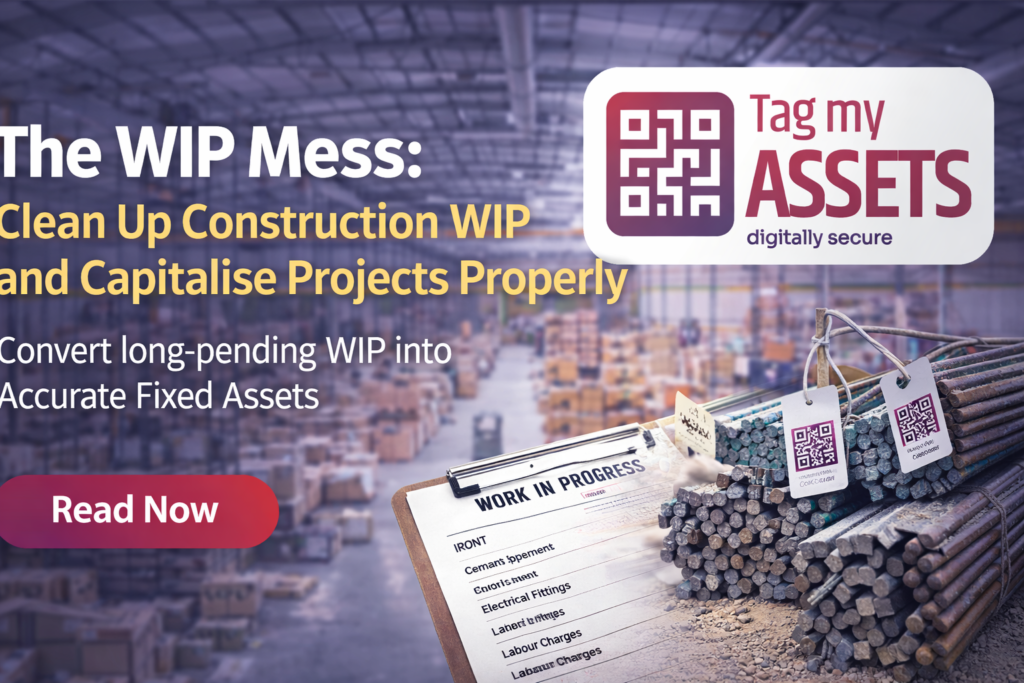
Why Construction WIP Management Fails or The Financial Impact of Construction WIP.
1. What Exactly Is the “WIP Mess”?
Construction Work-in-Progress (WIP) represents costs incurred for assets that are still under development.
These typically include:
- Civil construction materials
- Structural steel and fabrication
- Electrical and plumbing fittings
- Machinery foundations
- Installation and commissioning
- Contractor and labour charges
Ideally, these costs should remain in WIP only until the asset is ready for intended commercial use.
The Reality
In many companies, the shed is built, machinery is running, and production has started — yet the costs remain stuck in WIP.
The Fixed Asset Register does not reflect the actual assets on the ground.
2. A Common Real-Life Scenario
In one manufacturing company, a shed was constructed over two years. During this period, the company purchased:
- Iron bars and steel fabrication components
- Cement and civil materials
- Lubricating oil and consumables
- Electrical fittings and contractor services
The Result
The shed became fully operational.
However:
- The asset was never capitalised
- No depreciation was charged
- FAR remained incomplete
- Auditors raised serious red flags
Even after several years, the entire project cost remained in WIP.
This situation is far more common than most organisations realise.
3. Why Does WIP Become “Permanent”?
If it looks like a shed and works like a shed, why is it still shown as “iron and cement” in the books?
Usually, it happens due to these reasons:
✔ Departmental Silos
Engineering completes the project but does not formally inform Finance.
✔ No Formal Closure
Projects fade out instead of having a documented completion date.
✔ Missing Documentation
Invoices, drawings, and completion certificates are lost.
✔ Lack of Physical Verification
Finance teams rarely visit sites to verify asset status.
✔ Staff Turnover
Project knowledge leaves with resigning employees.
✔ Outdated Systems
Spreadsheets cannot track project life cycles properly.
Over time, this converts WIP into “permanent WIP.”
4. The High Cost of Messy Accounting
Leaving assets in WIP is not a minor accounting error. It directly impacts financial reporting and compliance.The True Cost of a Construction WIP Mess
Key Consequences
❌ Incorrect Depreciation
No depreciation is charged, leading to inflated profits and incorrect tax liability.
❌ Distorted Balance Sheet
Fixed assets are understated while WIP is overstated.
❌ Audit Observations
CARO remarks, management letters, and compliance risks increase.
❌ Insurance Gaps
Unrecorded assets are often under-insured or excluded.
❌ Tax & GST Risks
Wrong ITC claims, capital goods classification issues, and penalties arise.
These discrepancies affect credibility with banks, investors, and regulators.
5. The 7-Step Workflow to Clean Up Your WIP
To convert a messy ledger into an audit-ready Fixed Asset Register (FAR), follow this structured approach.
Phase 1: Discovery
Step 1: Prepare a WIP Register
Create a project-wise register with:
- Project name
- Start date
- Cost incurred
- Current status
- Responsible department
Step 2: Physical Asset Verification
Conduct site visits to verify:
- Completion status
- Operational readiness
- Usage condition
Phase 2: Reconciliation
Step 3: Match Books to Physical Assets
Align vendor invoices, material issues, and contractor bills with the physical structure.
Step 4: Identify Capitalisable Costs
Separate:
- Capital costs (structure, foundations, installations)
- Revenue costs (repairs, consumables, oil)
Phase 3: Execution
Step 5: Determine “Ready for Use” Date
Fix the date when the asset became usable. Depreciation starts from here.
Step 6: Capitalise and Update FAR
Transfer eligible WIP to fixed assets and update:
- Asset code
- Location
- Cost
- Useful life
- Depreciation method
Step 7: Asset Tagging and Documentation
Physically tag assets and archive:
- Photographs
- Layout maps
- Technical documents
This ensures long-term control.
6. How TagMyAssets Solves the WIP Mess
At TagMyAssets, we specialise in physical asset verification, fixed asset tagging, and FAR reconciliation for manufacturing, logistics, and infrastructure companies.
Our structured methodology includes:
- Site-level physical verification
- Mapping WIP with completed assets
- QR-based asset tagging
- FAR reconciliation
- Capitalisation support
- Audit-ready documentation
This converts unclear balances into verified, compliant fixed assets.
7. Best Practices for 2026: The Golden Rules
To prevent future WIP problems, implement these three rules:
⭐ The 95% Rule
When a project reaches 95% of budget, trigger physical verification.
⭐ Monthly WIP Reviews
Review balances every 30 days — not only during audits.
⭐ Joint Certification
Require sign-off from Engineering and Finance before capitalisation.
These controls prevent future accumulation.
8. Frequently Asked Questions (FAQs)
Q1. When should construction WIP be capitalised?
When the asset is ready for intended commercial use.
Q2. Can old WIP be capitalised after many years?
Yes, after physical verification and proper reconciliation.
Q3. Does uncapitalised WIP affect audits?
Yes. It often results in CARO observations and compliance risks.
Q4. How often should WIP be reviewed?
Ideally, every month.
Conclusion: Transform Your Assets Today
Don’t let your Construction WIP become a permanent liability:
It leads to:
- Incorrect depreciation
- Distorted financial statements
- Audit complications
- Insurance risks
- Tax exposure
By conducting regular physical verification, maintaining proper documentation, and following disciplined capitalisation procedures, companies can ensure accurate and reliable Fixed Asset Registers.
A clean FAR is not just good accounting — it is good governance.
Ready to Clean Up Your Records?
If your organisation has old WIP balances, uncapitalised projects, or mismatched FAR data, it is time to take corrective action.
TagMyAssets helps you transform messy records into transparent, compliant, and audit-ready systems through professional asset tagging and verification services.
📞 Contact us today for a professional asset audit and FAR reconciliation.
