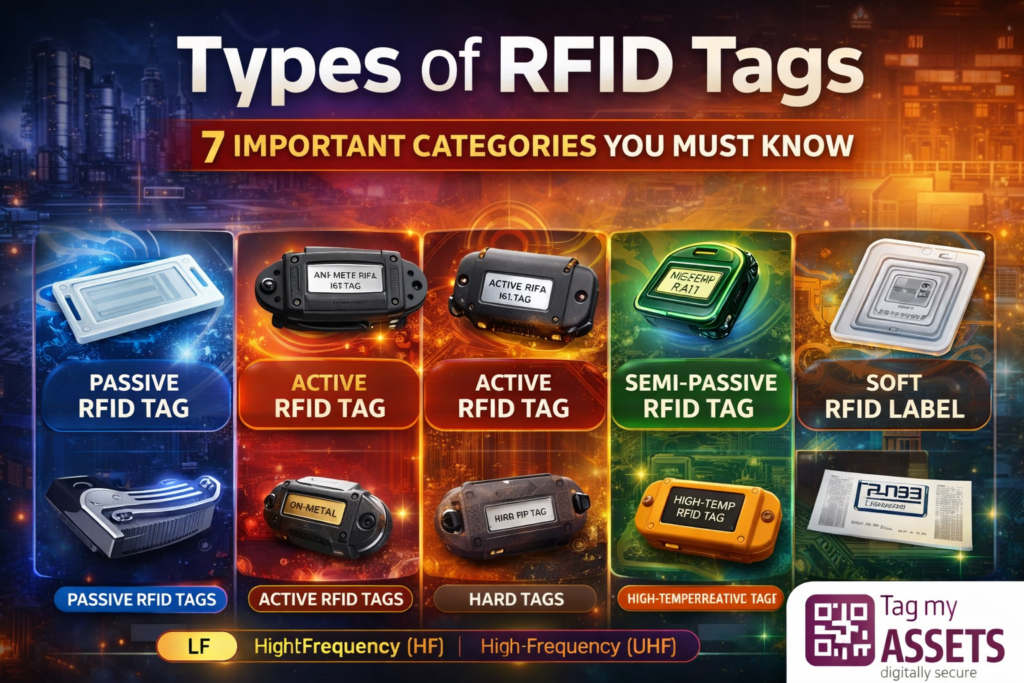
Types of RFID tags explained: Complete guide for businesses

INTRODUCTION

RFID tags are not one product — they vary by power source, frequency, surface compatibility and environmental resistance, and choosing the wrong type is the single most common reason RFID projects fail in the field. A standard label applied to a metal machine simply stops reading; a low-cost tag in a hot kitchen peels off within weeks. This guide explains every major RFID tag type used in Indian businesses, what each costs, where it works and — just as importantly — where it fails.


MAIN TYPES OF RFID TAGS

Passive RFID tags

Passive tags have no battery. They draw power from the reader’s radio signal, reflect back their encoded ID, and that’s the entire mechanism — which is why they are thin, cheap and last 10+ years with nothing to recharge or replace.

Typical cost: ₹20–₹200 per tag. Read range: up to about 10 metres for UHF passive tags. Best for: fixed asset tagging, IT assets, furniture, warehouse and retail verification — the overwhelming majority of asset tagging projects in India use passive UHF tags.

Limitation: read range and reliability drop near metal and liquids unless a specialised tag is used (covered below).

Active RFID tags

Active tags carry their own battery and broadcast their signal continuously or at intervals, giving read ranges of 100 metres or more. They are physically larger and significantly more expensive.

Typical cost: ₹500–₹3,000 per tag, plus battery replacement every 3–5 years. Best for: real-time location of high-value movable assets — vehicles in a yard, containers, expensive medical or testing equipment that moves between sites.

Limitation: cost makes them impractical for tagging thousands of ordinary fixed assets; they suit a small number of high-value items.

Semi-passive RFID tags

Semi-passive (battery-assisted) tags sit between the two: a small battery powers the chip and any built-in sensors, but the tag still relies on the reader’s signal to communicate. They are mainly used where a sensor needs continuous power — for example temperature logging in cold-chain and pharmaceutical storage.

Best for: condition monitoring use cases. For standard fixed asset tagging and verification, they are rarely the right choice.


TYPES OF RFID TAGS BASED ON USAGE

On-metal RFID tags. Standard RFID labels detune on metallic surfaces and stop reading — one of the most common causes of failed RFID rollouts. On-metal tags use a spacer or foam backing that isolates the antenna from the metal, making them essential for plant and machinery, server racks, steel furniture and racking. Typical cost: ₹40–₹200 per tag.

High-temperature RFID tags. Built to survive sustained heat, washdown cycles and chemical exposure. Kitchens, food-service equipment, foundries and process industries need these — and just as critically, they need mechanical fixing or high-temperature epoxy, because standard adhesive fails against grease and heat regardless of how good the tag is.

Hard RFID tags. Rigid, encased tags for rough handling — tools, returnable crates, outdoor assets, construction equipment. They cost more than labels but survive conditions that destroy them.

Soft RFID labels. Thin printable labels combining a barcode/QR layer with an RFID inlay — the workhorse for office assets, IT equipment and furniture. Lowest cost per tag, printable on demand, ideal for high-volume indoor tagging.

Types of RFID Tags-Passive, active and semi-passive RFID tags compared with cost and use cases

Field tip from our projects: Large verification projects almost never use one tag type. A typical site mixes soft UHF labels on office assets, on-metal tags on machinery, and high-temperature tags in kitchen or process areas. Specifying a single tag type for every asset is one of the most common causes of poor read performance and avoidable replacement cost.


TYPES OF RFID TAGS BASED ON FREQUENCY

Ultra-High Frequency (UHF, 860–960 MHz). Long read range (up to ~10 m) and bulk reading of hundreds of tags at once. This is the standard for fixed asset verification, warehouse audits and multi-location rollouts, and what most people mean when they say “RFID asset tagging.” In India, UHF RFID operates in the 865–867 MHz band licensed for this use, and reputable tag and reader suppliers provide equipment tuned to this band.

High Frequency (HF/NFC, 13.56 MHz). Short range (~10 cm), tap-to-read with even a smartphone. Used for IT asset check-in/out, documents, access cards and secure environments where you want deliberate, one-at-a-time reads.

Low Frequency (LF, 125–134 kHz). Short range but penetrates liquids and performs near metal better than higher frequencies. Used for livestock, vehicle immobilisers and some rugged industrial applications.

For fixed asset verification at scale, UHF passive is the default choice — the other frequencies solve specific niche problems.


RFID TAG COMPARISON AT A GLANCE

Tag typeTypical costRead rangeBest for
Passive UHF label₹20–₹200Up to ~10 mFixed assets, IT, furniture, warehouses
On-metal UHF₹40–₹200Up to ~8 mMachinery, server racks, steel assets
High-temperaturevaries by specSimilar to UHFKitchens, foundries, washdown areas
HF / NFC₹20–₹80~10 cmIT check-in/out, documents, access
LF₹20–₹50ShortLivestock, vehicles, near-liquid assets
Active₹500–₹3,000100 m+High-value movable assets, real-time location

HOW TO IDENTIFY AN RFID TAG BY LOOKING AT IT

If you’re auditing an existing tagged asset base and don’t know what was used, the construction usually tells you: a thin printable sticker is a passive soft label; a foam or raised backing under the tag means on-metal; a rigid plastic or ceramic housing is a hard tag; a ceramic or specially encased body rated for heat is a high-temperature tag; and anything with a visible battery compartment or larger enclosure is an active tag. If existing tags on metal assets are flat stickers with no spacer, expect read failures — that asset base will likely need selective retagging.


COMMON MISTAKES WHEN SELECTING RFID TAGS

The failures we encounter in the field trace back to a handful of repeated decisions: applying standard labels to steel and machinery instead of on-metal tags; ignoring operating temperature and grease, so adhesive fails within weeks; purchasing tags in bulk before any site survey; choosing HF tags for warehouse audits where UHF bulk scanning was needed; and specifying active tags for thousands of ordinary fixed assets where passive tags do the same job at a fraction of the cost. Each of these is avoidable at the survey stage — and expensive to fix after rollout.


TYPICAL TAG LIFESPAN

Tag typeTypical working life
Passive UHF label10+ years (no battery)
On-metal / hard tag10+ years, built for rough conditions
High-temperature tagDepends on environment and fixing method
Active tagTag 10+ years; battery 3–5 years

HOW TO CHOOSE THE RIGHT RFID TAG

1. Identify the surface. Metal assets need on-metal tags — this decision alone prevents the most common failure.

2. Assess the environment. Heat, grease, moisture or washdown means high-temperature tags with mechanical or epoxy fixing, not adhesive.

3. Match the read requirement. Bulk audit scanning points to UHF; deliberate one-at-a-time reads point to HF/NFC.

4. Then look at budget. Cost per tag matters at volume, but a ₹20 tag that fails costs more than a ₹100 tag that survives — retagging a site is far more expensive than tagging it correctly once.

Quick selection guide

  • Metal asset → high heat too? Yes: high-temperature tag with mechanical/epoxy fixing. No: on-metal UHF tag.
  • Office / IT asset → soft UHF label
  • Warehouse / bulk-audit environment → passive UHF
  • High-value movable asset → active RFID

A site survey before procurement is how professional projects get this right — it identifies metal surfaces, environmental conditions and read-distance requirements before tags are ordered, preventing expensive retagging later. TagMyAssets includes this assessment as the first step of its RFID asset tagging services across India.


CONCLUSION

There is no single best among the types of RFID tags— there is only the right tag for each asset’s surface, environment and read requirement. Getting that mix right at the survey stage, before tags are purchased, is what separates RFID projects that support audits from RFID projects that get redone.


FAQ

What are the main types of RFID tags?

The main types by power source are passive, active and semi-passive tags. By frequency, tags are classified as UHF, HF (NFC) or LF, and by construction as soft labels, hard tags, on-metal tags and high-temperature tags. Most fixed asset tagging projects in India use passive UHF tags.

Which RFID tag is best?

It depends on the asset surface and environment. Passive UHF labels suit most office and warehouse assets; metal assets need on-metal tags; hot or greasy environments need high-temperature tags with mechanical fixing; and high-value movable assets may justify active tags. A site survey before procurement determines the right mix.

Are all RFID tags the same?

No. Tags differ by power source (passive, active, semi-passive), frequency (UHF, HF, LF) and construction (labels, hard tags, on-metal, high-temperature). Using the wrong type — such as a standard label on a metal surface — is a leading cause of RFID project failure.

Which RFID tag is used in industries?

Industrial environments typically use on-metal UHF tags for machinery and racking, hard tags for tools and rough handling, and high-temperature tags for heat-exposed equipment. Standard soft labels are generally limited to office areas within industrial facilities.


GOOD READS

For end-to-end implementation, explore our RFID asset tagging services.

For complete RFID understanding, read https://tagmyassets.com/rfid-asset-tagging-services/

For industrial challenges, visit https://tagmyassets.com/rfid-tags-for-industrial-use/

For cost considerations, read https://tagmyassets.com/rfid-tagging-cost-in-india/

For professional support, explore https://tagmyassets.com/asset-tagging-services/

For implementation challenges, visit https://tagmyassets.com/rfid-implementation-challenges/

For detailed comparison, read https://tagmyassets.com/passive-vs-active-rfid-tags/

For industry best practices, refer to https://www.gs1.org/standards/epc-rfid

For enterprise use cases, refer to https://www.ibm.com/topics/rfid


Facebook
Twitter
LinkedIn
Print
Picture of Why Choose Our Asset Tagging Services in India?
Why Choose Our Asset Tagging Services in India?

We tag and physically verify fixed assets across plants, offices, warehouses, and branch networks — from Delhi NCR to PAN India — and reconcile findings against your fixed asset register.

WhatsApp Chat with us