
Introduction
Asset tagging and verification for manufacturing companies in India is what makes a Fixed Asset Register defensible when an auditor asks for evidence that assets were physically verified.
A manufacturing plant holds several thousand assets spread across sheds, departments, utilities and open yards. Without a structured tagging and verification system, the gaps surface during the statutory audit rather than before it: machines scrapped without a record, equipment shifted between plants with no documentation, idle assets still depreciating on the books.
This guide explains what tagging looks like on a shop floor, how mobile-based verification runs without disrupting production, how long it takes, and what the reconciliation actually produces. For the general process rather than the manufacturing-specific one, see our complete guide to asset tagging in India.
What Manufacturing Plants Get Wrong About Their Fixed Asset Register
The problems below are the ones that recur across plant engagements. None of them are accounting errors. They are all record-keeping gaps that only become visible when someone walks the floor with the register in hand.
- Assets moved and never re-recorded. A line is rebalanced, machines shift from one shed to another, and the FAR still shows the old location. The asset exists; the record does not find it.
- Scrapped equipment still on the books. Machines cut up or sold as scrap years ago, still carrying a written-down value and still attracting depreciation.
- FAR lines with no unique identification. Entries reading “electrical items” or “plant and machinery — miscellaneous” against a single capitalised value. These cannot be verified individually, because there is nothing to verify against.
- Parent and child assets capitalised inconsistently. A machine capitalised as one line in the register but made up of several separately identifiable units on the floor, or the reverse.
- Idle and non-working assets not flagged. Equipment sitting unused for years, invisible to management because nothing in the record distinguishes running from idle.
Spreadsheet-based tracking does not resolve any of these, because each one is a difference between what the sheet says and what is physically present. Only a floor-level exercise closes that gap.
What Asset Tagging Means on a Shop Floor
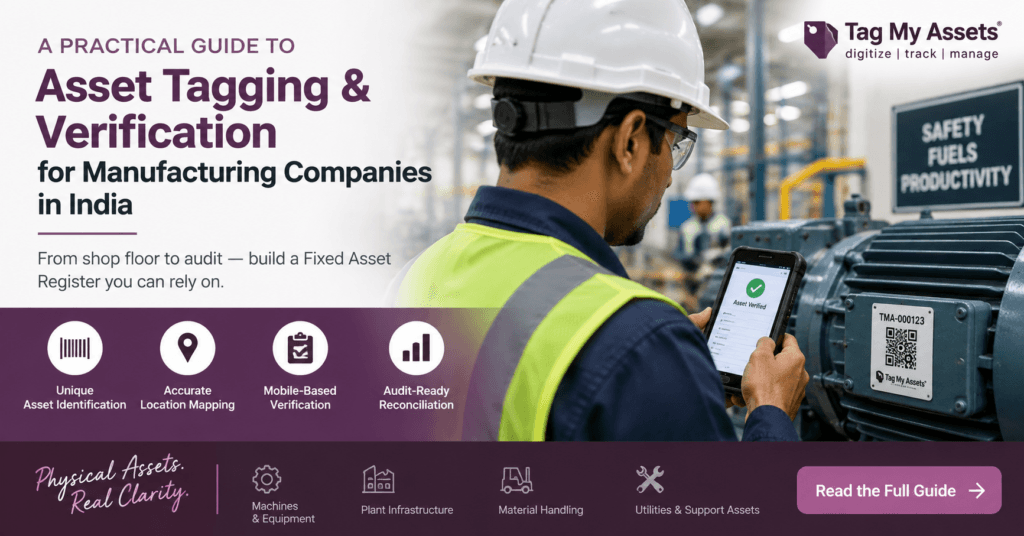
Tagging means fixing a durable, uniquely numbered tag to each identifiable asset and mapping that number to the register line it belongs to. The tag carries the identity; the mapping carries the accounting.
What gets captured against each tag:
- Asset description, category and the FAR line it reconciles to
- Plant, department, line or shed location
- Make, model and serial number where the asset carries one
- Capitalisation reference
- Condition and usage status — running, idle, under repair, or not traced
- A photograph of the asset in position
Choosing the Tag for a Plant Environment
Manufacturing environments are harder on tags than offices are. Heat, coolant, vibration, dust and metal surfaces all rule out the standard paper label used for furniture and IT equipment.
- QR and barcode labels (roughly ₹2–15 per tag) suit IT assets, office and administrative equipment, and any asset in a clean, dry area.
- Polyester and metalised labels handle moderate heat and cleaning chemicals on the shop floor.
- On-metal RFID tags are used where the asset is a metal body and bulk scanning is wanted. These sit at the upper end of the passive RFID band, which runs ₹10–200 per tag across all types before volume discount.
- Engraved or riveted plates are used on high-temperature and high-abrasion assets where no adhesive survives.
Most plants use a mix, decided asset by asset during the survey rather than chosen for the site as a whole.
How Verification Runs Without Stopping Production
Fixed asset verification runs during working hours. Fixed assets do not move, so there is no need for a shutdown or a night shift — unlike an inventory count, where stock is moving and the count needs a closed environment to reconcile against.
Using a mobile application on a standard smartphone, the verification team:
- Scans the tag on each asset
- Captures a photograph and the asset’s condition
- Records the department, line or shed it was found in
- Captures location coordinates
- Syncs to a cloud record as the walk progresses
Mobile capture matters more in a plant than it looks. A handheld scanner has to stay tethered to a laptop as the team moves, which means at least two people at every location — one on the scanner, one on the machine. A phone in one hand removes the second person and lets the team split across sheds.
Where a machine can only be identified by the person who runs or maintains it, the pace of verification is set by that person’s availability, not by the team’s. Plant and machinery is the slowest asset class to verify for exactly this reason.
How Long It Takes, and With How Many People
A duration means nothing without a headcount attached to it. These are per person, per day, for tagging and data capture:
| Asset type | Assets per person per day | What sets the pace |
|---|---|---|
| Office furniture and fittings | 100–150 | Found and recognised without help |
| Laptops and IT equipment | 100–120 | Serial numbers must be read and recorded |
| Plant and machinery | 80–100 | Identification often depends on the machine’s user or the maintenance team being available |
So a plant with 6,000 assets, mostly machinery, is roughly 60–75 man-days: a team of eight for eight to ten working days, or a larger team across a shorter window. Multi-plant projects are sequenced with parallel teams. The survey before the project is what fixes the team size and the sequence.
The reconciled report follows within about a week of the client agreeing the findings. In practice the longer wait sits on the client’s side: assets recorded in the FAR but not traced on site get searched for thoroughly before anyone writes them off, and that search can run for weeks.
What the Reconciliation Produces
The output is not a scan log. It is a reconciliation between the register and the floor, in four parts:
- Traced and matched — the asset exists, is where the register says, and the description agrees.
- Traced with corrections — the asset exists but the location, description or condition in the FAR was wrong and has been updated.
- Recorded but not found — in the books, not on the floor. These are the write-off candidates, and they are the ones the client searches for hardest.
- Found but not recorded — physically present, absent from the register. Usually assets bought and expensed, or received and never capitalised.
Each line carries the tag number, the photograph and the date, which is what turns the exercise into audit evidence rather than a management estimate.
CARO 2020 and Asset Tagging and Verification for Manufacturing Companies
The Companies (Auditor’s Report) Order, 2020 places the reporting duty on the auditor, not on the company.. Two clauses bear on fixed assets in a manufacturing company:
- Clause 3(i)(a)(A) — whether the company maintains proper records showing full particulars, including quantitative details and situation, of Property, Plant and Equipment. “Situation” means location, and a register that cannot say where an asset is does not satisfy it.
- Clause 3(i)(b) — whether PPE has been physically verified by management at reasonable intervals, whether the interval is reasonable, and whether material discrepancies were noticed and properly dealt with in the books.
The verification itself is management’s responsibility. Tagging is not a statutory requirement anywhere in the Order — it is the mechanism that makes the records and the verification capable of being evidenced. Auditors work to SA 500 on audit evidence and SA 330 on responses to assessed risks, both of which are easier to satisfy when each asset carries a unique identity.
What One Manufacturing Engagement Found
An auto components manufacturer engaged us for tagging, physical verification and FAR reconciliation across multiple plants and a corporate office, ahead of a system migration.
- Around 9,200 assets in the fixed asset register at the start
- Reconciled down to 8,400, with 800 assets written off as no longer physically present
- Physical verification completed in nine working days
- The reconciled register was then used as the asset master for the client’s own system migration
The last point is the one worth noting. The value of the exercise was not the count. It was that the client ended up with a register clean enough to build on.
What It Costs
Pricing is built up, not quoted as a single number:
- Manpower — ₹15–35 per asset for tagging, data capture and verification. The lower end applies in Delhi NCR and anywhere a small count can be handled by a local team; the upper end where a full team travels to site and accommodation, transport and daily allowance load the cost.
- Tags — from ₹2–15 for QR and barcode labels up to the ₹10–200 passive RFID band, depending on the tag type the asset environment requires.
- A complete engagement — tagging plus physical verification plus FAR reconciliation delivered together — runs ₹80–350 per asset. Tagging alone costs less, because it is only the manpower and the tag.
Asset count, number of locations, tag type and the condition of the existing register are what move a quote within those bands.
What We Do
We tag and physically verify fixed assets across manufacturing plants, offices, warehouses and branch networks, and reconcile the findings against your fixed asset register. Work is delivered by our own field teams, and through associate teams where a small asset count is spread across many locations. We have completed 395+ projects across 1,500+ locations in India, covering 10 lakh+ assets tagged.
Frequently Asked Questions
What is asset tagging and verification for manufacturing companies?
It is the process of fixing a uniquely numbered tag to each identifiable fixed asset, mapping that tag to its line in the Fixed Asset Register, and then physically verifying each asset against the register to produce a reconciled position.
Does verification require stopping production?
No. Fixed asset verification runs during working hours, because fixed assets do not move. The team works around the production schedule rather than against it. Where a machine can only be identified by its operator or the maintenance team, that asset is sequenced for when they are available.
Can it be done without handheld scanners or RFID readers?
Yes. QR and barcode tagging with a mobile application on a standard smartphone covers most plant requirements. RFID is used where bulk scanning without line of sight is worth the additional tag cost, typically on high asset volumes.
How long does it take for one plant?
It depends on asset count, asset mix and team size. At 80–100 machinery assets per person per day, a 6,000-asset plant is roughly 60–75 man-days — eight to ten working days for a team of eight. The survey fixes the team size before the project starts.
Is asset tagging mandatory in India?
No. CARO 2020 requires the auditor to report on whether proper records of PPE are maintained, including situation, and whether management has physically verified assets at reasonable intervals. Tagging is not itself required; it is what makes those records and that verification capable of being evidenced.
What happens to assets that cannot be found?
They are reported as recorded-but-not-traced, with the register line and the search already carried out. The write-off decision sits with the company and its auditor. Most clients search for these assets thoroughly before deciding, which is usually what determines how long the closing report takes.