
Businesses often use the terms inventory verification and stock audit interchangeably. However, these two processes serve different purposes and are conducted in different ways.
For companies dealing with large volumes of inventory—such as manufacturing plants, warehouses, retail stores, hospitals, and logistics companies—understanding the difference between inventory verification and stock audit is critical for maintaining accurate records and preventing financial discrepancies.
Inventory errors can lead to financial losses, incorrect reporting, insurance issues, and audit qualifications. Therefore, businesses must clearly understand when to perform inventory verification and when a stock audit is required.
For how the count itself is run — controlling cut-off, checking in both directions and keeping the evidence — see our guide to physical verification of inventory.
In this guide, we explain the key differences between inventory verification and stock audit, their objectives, processes, and benefits.
What is Physical Stock Verification?
Inventory verification is the process of physically verifying inventory quantities and confirming their existence at a specific location.
It involves counting inventory items and reconciling them with inventory records maintained in ERP systems, stock registers, or warehouse management systems.
The main objective of inventory verification is to ensure that the physical inventory matches the recorded inventory.
Inventory verification typically focuses on:
• Physical existence of inventory
• Accuracy of inventory quantities
• Correct location of stock
• Identification of damaged or obsolete items
• Differences between physical stock and system records
Inventory verification is commonly performed in:
- Warehouses
- Manufacturing plants
- Retail stores
- Distribution centers
- Hospitals and laboratories
Companies often perform inventory verification before financial audits or at periodic intervals to maintain accurate stock records.
What is a Stock Audit?
A stock audit is a detailed examination of inventory records, valuation methods, and internal controls related to inventory management.
Unlike inventory verification, which focuses on physical counting, a stock audit evaluates the financial accuracy and accounting treatment of inventory.
Stock audit is usually conducted by Chartered Accountants, internal auditors, or independent audit firms.
The main objectives of a stock audit include:
• Evaluating inventory valuation methods
• Verifying accounting records related to stock
• Assessing internal inventory controls
• Detecting discrepancies and potential fraud
• Ensuring compliance with accounting standards
Stock audits are often conducted for:
- Statutory audit purposes
- Bank stock statements
- Internal audit requirements
- Financial reporting compliance
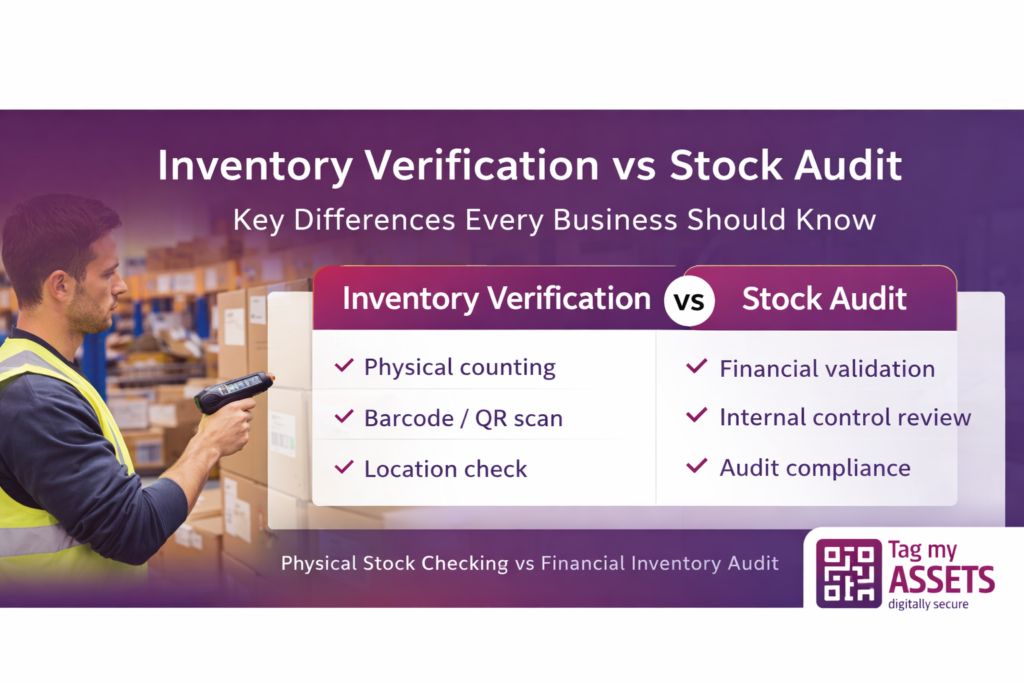
Key Differences Between Inventory Verification and Stock Audit
Although both processes relate to inventory management, their objectives and methods are different.
| Basis | Inventory Verification | Stock Audit |
|---|---|---|
| Purpose | Confirm physical stock availability | Evaluate financial and accounting accuracy |
| Focus | Quantity and condition of inventory | Valuation and accounting treatment |
| Method | Physical counting and reconciliation | Audit procedures and financial analysis |
| Performed By | Internal teams or verification agencies | Chartered accountants or auditors |
| Frequency | Periodic or operational | Annual or regulatory requirement |
In simple terms, inventory verification focuses on physical stock, whereas stock audit focuses on financial reporting and internal controls.
Why Inventory Verification is Important for Businesses
Stock verification plays a crucial role in ensuring operational efficiency and financial accuracy.
Some key benefits include:
1. Accurate Inventory Records
Regular inventory verification ensures that system records match the physical stock available at warehouses or stores.
2. Fraud Prevention
Physical verification helps detect unauthorized stock movement, theft, or manipulation of inventory records.
3. Better Inventory Control
By identifying discrepancies, companies can improve inventory management processes and stock monitoring systems.
4. Financial Accuracy
Inventory is often one of the largest assets on a company’s balance sheet. Accurate verification ensures reliable financial reporting.
5. Improved Operational Efficiency
Inventory verification helps identify obsolete stock, damaged inventory, and excess stock, improving overall operational efficiency.
When Should Companies Conduct Inventory Verification?
Organizations should conduct inventory validation in the following situations:
• Before statutory audit
• During internal audit
• During warehouse relocation
• After ERP implementation
• During insurance valuation
• When discrepancies are suspected
Many companies perform annual or quarterly inventory verification to maintain inventory accuracy.
Industries Where Inventory Verification is Critical
Stock Inspection is particularly important for industries dealing with large volumes of stock.
These include:
Manufacturing Industry
Manufacturing companies maintain inventory of:
- Raw materials
- Work-in-progress
- Finished goods
- Spare parts
Regular verification ensures accurate production planning.
Retail Industry
Retail businesses handle thousands of SKUs across multiple locations. Inventory verification helps ensure accurate stock availability and shrinkage control.
Mobile App-Based Inventory Scanning for Retail Chains — No Dedicated Scanners Needed
For retail chains with dozens or hundreds of stores, the biggest practical barrier to regular inventory verification is hardware. Buying and maintaining dedicated barcode scanners for every store location is costly, and shipping scanner kits between stores slows every count cycle.
Mobile app-based scanning removes this barrier. Store inventory carrying barcode or QR code labels can be scanned using a smartphone camera — no dedicated scanner hardware at any location. This changes the economics of multi-store verification:
- No hardware investment per store. A smartphone with the verification app replaces the scanner kit.
- Parallel counting across stores. Multiple locations can be verified in the same window instead of waiting for equipment to rotate between stores.
- SKU-wise capture with location tagging. Each scan records the item, quantity, and store location directly into the count data.
- Real-time reporting. Count progress and discrepancies are visible as the verification happens, not weeks later after manual compilation.
- Reconciliation-ready output. Scanned data is matched against system records to produce shortage, excess, and mismatch reports store by store.
How TagMyAssets Helps Retail Chains
TagMyAssets conducts mobile app-based inventory verification for retail chains across India. Our field teams carry out SKU-wise physical counting using our verification app, with barcode and QR code scanning through the phone camera — no scanner hardware required at your stores. Store-wise counts are reconciled against your system records, and you receive location-wise discrepancy reports suitable for audit and internal control purposes. For chains that prefer to run counts with their own store staff, we can structure the verification approach and handle the reconciliation and reporting layer.
Warehousing and Logistics
Warehouse operators need inventory verification to maintain accurate stock levels and efficient order fulfilment.
Hospitals and Laboratories
Medical equipment, pharmaceuticals, and laboratory materials require accurate inventory tracking to ensure availability and compliance.
Inventory Verification Process
The inventory verification process typically involves the following steps:
Step 1 – Data Collection
Obtain inventory data from ERP systems or stock registers.
Step 2 – Physical Counting
Conduct location-wise or SKU-wise physical counting of inventory items.
Step 3 – Tagging or Identification
Assets or inventory items may be tagged using barcode or QR codes for better tracking.
Step 4 – Reconciliation
Compare physical inventory with system records and identify discrepancies.
Step 5 – Reporting
Prepare a detailed report showing:
- Shortages
- Excess stock
- Misplaced items
- Damaged inventory
How Professional Inventory Verification Services Help
Many companies hire professional agencies to conduct independent inventory verification.
Professional inventory verification services provide:
• Accurate physical verification of stock
• Barcode or QR code tagging of assets
• Inventory reconciliation reports
• Identification of discrepancies
• Recommendations for improving inventory control
Independent verification provides greater reliability and transparency in inventory management.
Accounting Standards Related to Inventory
Inventory valuation and audit procedures are governed by accounting standards such as IAS 2 – Inventories and guidance issued by the Institute of Chartered Accountants of India (ICAI).
Frequently Asked Questions
What is the main difference between inventory verification and stock audit?
Inventory verification focuses on physically counting inventory, while stock audit evaluates financial records and accounting controls related to inventory.
Who performs inventory verification?
Inventory verification can be performed by internal teams or specialized verification agencies.
Is inventory verification required before statutory audit?
Yes. Many companies conduct inventory verification before statutory audit to ensure that physical inventory matches accounting records.
How often should inventory verification be conducted?
Most organizations conduct inventory verification annually or quarterly, depending on the size and nature of their inventory operations
Conclusion
Inventory verification and stock audit are both essential processes for maintaining accurate inventory records and financial transparency.
While inventory verification ensures that physical stock exists and matches inventory records, a stock audit evaluates financial accuracy and internal inventory controls.
Organizations that regularly perform both processes can significantly improve inventory accuracy, operational efficiency, and financial reliability.
For businesses managing large inventories, professional inventory verification services can provide reliable and independent validation of stock records.
If you are looking for professional inventory verification services, our team at TagMyAssets provides nationwide inventory verification, barcode tagging, and asset reconciliation services.