
Asset Tagging for Manufacturing Plants is becoming essential for companies that operate large factories with hundreds or even thousands of assets such as machinery, production equipment, tools, vehicles, and IT infrastructure. A structured asset tagging system gives each machine a unique physical identity, so plant assets can be located, matched against the fixed asset register, and evidenced during audit.
However, many manufacturing companies struggle to locate equipment on demand, and to keep their asset records matched to what is physically on the floor. Assets frequently move between production lines, warehouses, and maintenance departments, making it difficult to maintain proper visibility.
This is where asset tagging for manufacturing plants becomes an essential solution.
By implementing a structured asset tagging system using QR codes, barcodes, or RFID tags, manufacturing plants can identify assets accurately and reconcile them against the register.
In this guide, we will explore how asset tagging works in manufacturing environments and how companies can implement it successfully.
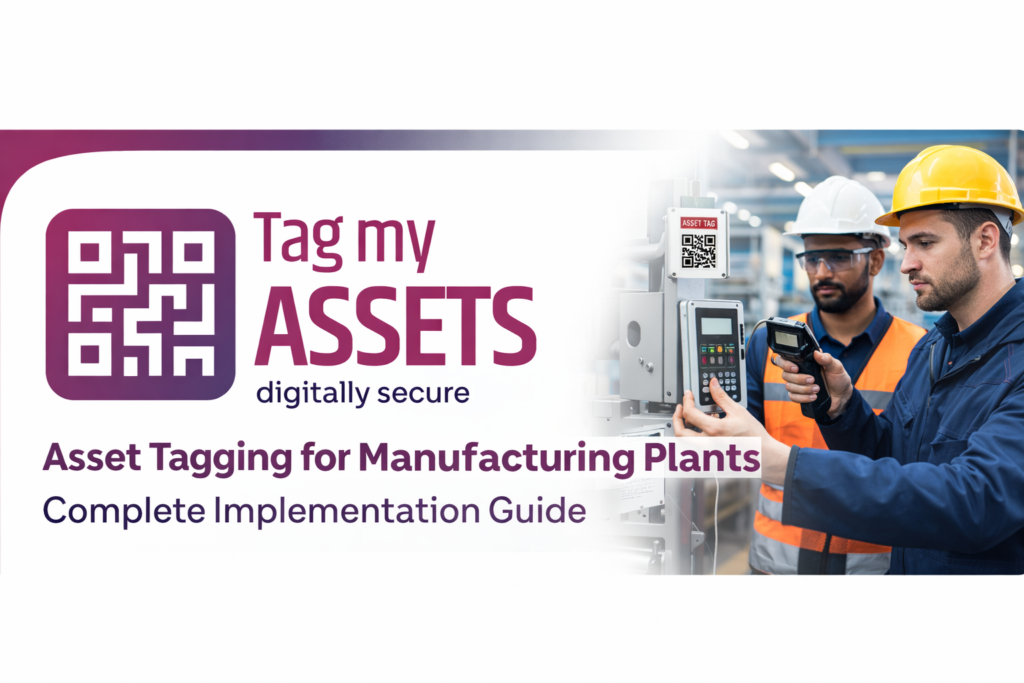
What is Asset Tagging in Manufacturing Plants?
Asset tagging is the process of attaching a unique identification label to each asset in the manufacturing plant.
These tags help identify and track assets such as:
- Production machinery
- Industrial tools
- Forklifts and vehicles
- Electrical equipment
- IT assets and computers
- Laboratory equipment
Each tag is linked to the asset record, which typically holds:
- Asset ID
- Equipment name
- Department or location
- Purchase information
- Asset value
Plant staff scan the tag on a mobile device to retrieve the asset record.
Why Asset Tagging is Important for Manufacturing Plants
Manufacturing plants rely heavily on equipment and machinery to maintain production efficiency. Without proper asset tracking systems, companies face several operational challenges.
Equipment Misplacement
Tools and equipment often move between departments such as production floors, warehouses, and maintenance areas. Without asset tagging, locating equipment becomes time-consuming.
Poor Asset Visibility
Plant managers may not know where certain assets are located or whether they are currently in use.
Audit and Compliance Challenges
Manufacturing companies must maintain accurate Fixed Asset Registers (FAR) for accounting and audit purposes.
Asset tagging makes the register easier to reconcile and the audit easier to evidence.
Types of Asset Tags Used in Manufacturing Plants
Different types of asset tags are used depending on the asset environment and tracking requirements.
QR Code Asset Tags
QR code tags are widely used because they are:
- cost effective
- easy to scan
- suitable for most factory equipment
hese tags are scanned on a standard smartphone.
Barcode Asset Tags
Barcode tags are commonly used for:
- tools
- IT equipment
- storage racks
- office equipment
They provide a simple and reliable asset identification system.
RFID Asset Tags
RFID tags are used for large-scale industrial asset tracking where automatic scanning and real-time tracking are required.
RFID is commonly used for:
- high-value machinery
- vehicle tracking
- warehouse asset management
Asset Tagging Implementation Process in Manufacturing Plants
Implementation usually runs in five stages.
Step 1 – Asset Identification
The first step is identifying all assets within the manufacturing facility including machinery, tools, and equipment.
Step 2 — Asset classification
Not every line in a fixed asset register can be physically tagged. Assets are classified into three groups before field work:
Taggable — individually identifiable assets that can physically carry a tag. Most of the register.
Countable — items verified by count rather than individually tagged, where tagging each unit is impractical or units are not individually distinguishable.
Non-auditable — register lines with no physically verifiable form: civil structures, electrical wiring and installations, software licences and other intangibles. These cannot be tagged or counted and are mapped notionally instead.
Identifying the non-auditable portion up front is what stops the reconciliation appearing to show a shortfall when those items were never physically verifiable in the first place.
Step 3 – Physical Verification
A detailed physical verification process is conducted to confirm asset existence, location, and condition.
Step 4 – Asset Tagging
Unique asset tags such as QR codes or RFID tags are attached to each asset.
Step 5 – Asset Data Collection
Make, model, serial number, location and condition are captured on site, along with a photograph.
Step 6 – FAR Reconciliation
Field findings are matched line by line against the Fixed Asset Register. Missing assets, unrecorded additions and location mismatches are classified and documented in a report your auditor can work from.
Best Practices for Asset Tagging for Manufacturing Plants
A few practices make implementation hold up over time.
Conduct Asset Verification Before Tagging
Perform a detailed physical verification of assets before implementing the tagging process.
Use Durable Industrial Tags
Manufacturing environments require high durability tags that can withstand heat, dust, oil, and industrial conditions.
Map Tag Numbers to FAR Lines
Every tag number should map to a specific line in the register, so the next verification cycle is a scan rather than a manual search.
Conduct Periodic Asset Audits
Verifying at regular intervals keeps the register current and gives the auditor a documented programme to review.
How TagMyAssets Works with Manufacturing Plants
Professional asset tagging services help manufacturing plants implement structured asset tracking systems.
These services include:
- Physical verification of assets
- QR code or RFID asset tagging
- Asset register creation and cleanup
- Asset data digitization
Learn more about our fixed asset tagging services.
Regulatory and Compliance Importance of Asset Tagging in Manufacturing Plants
Asset tagging is not only useful for operational efficiency but also plays a crucial role in meeting regulatory, financial, and audit compliance requirements in manufacturing organizations.
Manufacturing companies are required to maintain accurate asset records for statutory audits, financial reporting, and internal control systems. Without a structured asset tracking system, companies may face challenges in maintaining accurate records of machinery, equipment, and plant assets.
Statutory Audit Requirements
Under CARO 2020, auditors report on whether proper records of plant and machinery are maintained, whether management has physically verified those assets at reasonable intervals, and whether material discrepancies were dealt with in the books. Tagged assets and a reconciliation report give you the evidence base for all three.
For the full clause-by-clause position, see our CARO 2020 fixed asset verification requirements guide.
Internal Control and Asset Management
Many manufacturing organizations follow internal financial control frameworks where asset tagging supports:
- asset identification
- asset tracking
- audit trail creation
Tagging gives those controls a physical anchor — each register line maps to an identifiable asset.
Insurance and Risk Management
Manufacturing plants often insure high-value machinery and equipment. Insurance companies may require accurate asset records during:
- insurance valuation
- claim settlement
- risk assessment
Documented asset records with photographs and location detail support insurance valuation and claim assessment .
Why Asset Tagging Matters for Compliance and Audit
Tagged assets make physical verification faster to execute and easier to evidence. Machinery can be traced to its recorded location, verification findings can be matched to the register line by line, and the resulting documentation supports statutory audit review of plant and machinery.
Common Asset Types in Manufacturing Plants
Manufacturing plants operate with a wide range of assets that are critical for production, operations, and facility management. Tagging helps track these categories consistently and maintain accurate asset records.
Below are some of the most common asset categories found in manufacturing environments.
1. Production Machinery
Production machinery forms the backbone of manufacturing operations. These machines include equipment used for cutting, shaping, assembling, or processing raw materials into finished products. Asset tagging lets each machine be traced to its recorded location during verification.
Examples include:
- CNC machines
- Injection molding machines
- Press machines
- Packaging machines
2. Industrial Tools and Equipment
Manufacturing plants use numerous portable tools and equipment for maintenance and production support. Without proper asset tagging, these tools can easily get misplaced across departments.
Examples include:
- Power tools
- Measuring instruments
- Calibration equipment
- Maintenance tools
Tagging makes portable tools traceable across departments.
3. Material Handling Equipment
Material handling equipment is essential for moving raw materials and finished goods across the factory.
Examples include:
- Forklifts
- Pallet trucks
- Conveyor systems
- Cranes and hoists
Tagging lets material handling equipment be traced across the site during verification.
4. Electrical and Utility Equipment
Manufacturing plants also rely on various electrical and utility systems to maintain operations.
Examples include:
- Air compressors
- Electrical panels
- Transformers
- Diesel generators
Tagging keeps utility equipment on the register with its correct location.
5. IT and Office Equipment
Modern manufacturing plants also depend on IT infrastructure for production planning and inventory management.
Examples include:
- Computers and servers
- Barcode scanners
- Printers
- Networking equipment
Tagged IT assets are easier to reconcile during verification.
6. Safety and Compliance Equipment
Safety equipment is essential for maintaining workplace safety and regulatory compliance in manufacturing environments.
Examples include:
- Fire extinguishers
- Safety alarms
- Emergency lighting
- Personal protective equipment storage units
Proper asset tagging helps companies maintain accurate records for safety audits and inspections.
Conclusion
Manufacturing plants rely on efficient asset management to maintain productivity and control operational costs. Without proper asset tracking systems, companies may face equipment losses, production delays, and inaccurate asset records.
By tagging plant assets, companies get a register that matches the floor, a faster verification cycle, and documentation their auditor can work from. Tagging is not a one-time exercise — it is what makes each subsequent cycle repeatable.
Asset tagging helps manufacturing plants locate equipment, reconcile it against the Fixed Asset Register, and evidence verification during statutory audit.
FAQ
What is asset tagging in manufacturing plants?
Asset tagging in manufacturing plants is the process of labeling machinery and equipment with unique identification tags such as QR codes, barcodes, or RFID tags to track assets efficiently.
Why is asset tagging important for manufacturing plants?
Asset tagging helps manufacturing plants locate equipment, reconcile it against the Fixed Asset Register, and evidence verification during statutory audit
What types of asset tags are used in factories?
Factories commonly use QR code tags, barcode labels, and RFID tags depending on the asset type and industrial environment.