
Inventory verification for retail chains is a critical process to ensure accurate stock records, prevent losses, and maintain audit-ready inventory across multiple locations. This inventory verification for retail chains ensures better control, faster counting, and minimum duplication and minimum missed stock entries. This guide explains inventory verification for retail chains in a simple step-by-step manner.
That’s why organizations conduct inventory physical verification to match actual stock with book/ERP records and ensure accuracy. Inventory verification for retail chains helps prevent stock mismatch, pilferage, and wrong replenishment decisions.
At TagMyAssets, we follow a structured and technology-driven approach for inventory verification using barcode/QR scanning tools and mobile-based data capturing, ensuring high accuracy and audit-ready reporting.
To understand our end-to-end audit-ready approach, also explore our
Inventory Verification Servicesfor warehouses, retail chains, and manufacturing organizations.
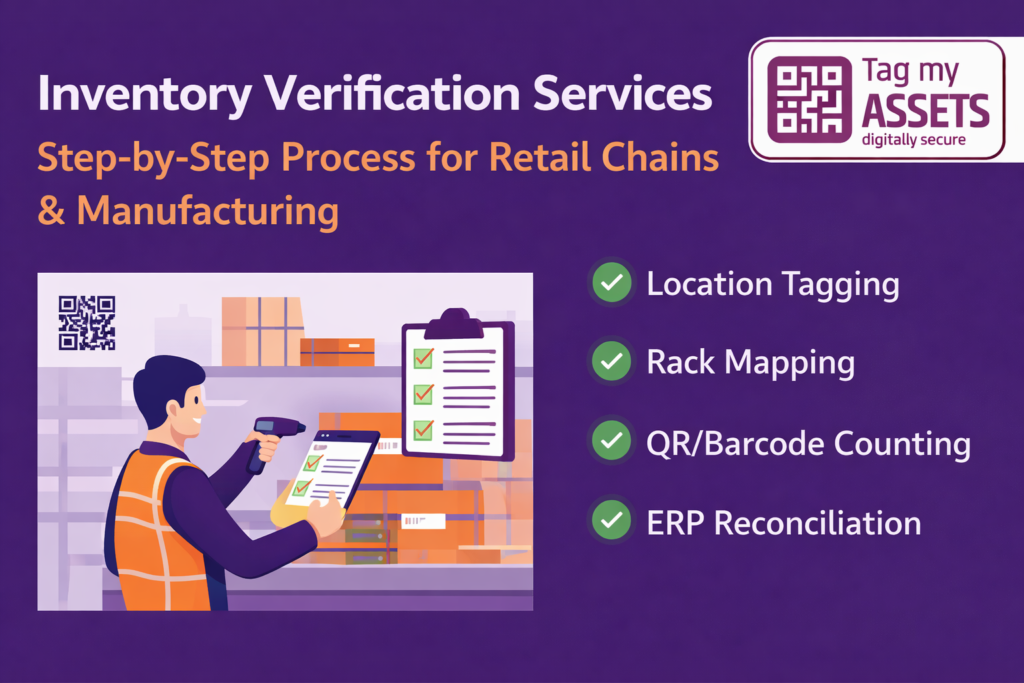
✅ Inventory Verification for Retail Chains: Meaning and Importance
Inventory verification is the process of physically checking stock quantities and conditions and reconciling the same with inventory records, ERP systems, or stock registers.
The objective is to identify:
- Shortages or excess stock
- Damaged, obsolete, expired or slow-moving items
- Wrong placement or wrong SKU issues
- Mismatch between physical stock and book records
This process helps management and auditors gain confidence that inventory balances reported in financial statements are reliable.With our inventory verification for retail chains, brands get clean stock data, faster audits, and better store-level control.
Why Inventory Verification Is Important
Without proper inventory verification, organizations may face:
- Wrong stock valuation in books
- Pilferage / loss not identified
- Wrong planning for purchase and production
- Overstocking or understocking
- Internal control gaps and audit observations
- Incorrect financial reporting and decision-making
A well-planned verification ensures clean data, better control, and improved operational efficiency.Inventory verification services help retail chains maintain accurate stock records and reduce losses.
Inventory Verification Methodology for Retail Chains (Step-by-Step)
Step 1: Planning & Preparation
Before physical counting starts, our team performs a structured pre-verification planning, which includes:
✅ Understanding your stock nature (RM / FG / WIP / trading / retail items)
✅ Identifying storage areas (warehouse, shop floor, racks, bins, yards, stores)
✅ Finalizing verification date & cut-off timing
✅ Defining scope (SKU-wise / bin-wise / location-wise)
✅ Ensuring the latest stock report / ERP extract is available
✅ Allocating teams location-wise for smooth execution
This ensures the verification is systematic, fast, and error-free, especially in large sites with multiple locations.
Step 2: Location Tagging & Rack Number Mapping
To ensure full control and traceability, we first start with location tagging and storage mapping.
✅ Every floor/store/warehouse zone is marked properly
✅ Each Rack / Bin / Shelf / Aisle reference is captured
✅ Rack number entry is done in the system
This helps in:
- Easy tracking of stock location
- Better accountability for each storage area
- Future audits and verification speed
- Stronger inventory controls
Step 3: SKU-wise Scanning, Counting & Punching in System
After mapping, we start physical verification through SKU-wise scanning and counting.
✅ Items are scanned using barcode/QR-based tools
✅ Quantity is counted and punched directly in the system
✅ Real-time data capture ensures accuracy
We follow a controlled scanning method because in warehouses and retail environments:
- If everything is scanned without control, chances of double scanning increase
- If scanning is missed, items can remain uncounted
- High-volume counting can create confusion without structured rules
So our process ensures minimum duplication, minimum missed entries, and maximum accuracy.
Step 4: Stock Condition Check & Observations
Along with counting, we also check the physical condition of inventory, such as:
- Damaged or broken items
- Expired inventory (where applicable)
- Slow-moving / non-moving stock
- Wrongly placed items
- Unidentified stock without proper label/SKU
These observations are captured for management control and reporting.
Step 5: Cut-Off Check (To Ensure Correct Stock as on Date)
Inventory numbers can change due to inward/outward movement.
That’s why we follow cut-off checks such as:
✅ Ensuring no dispatch happens during verification
✅ Marking inward/outward movement separately
✅ Verifying GRN / issue records near cut-off time
✅ Ensuring physical stock matches “as on date” records
This makes the results more reliable and audit-friendly.
Step 6: Reconciliation With ERP / Stock Register
After counting, we match physical quantities with book/ERP stock.
We prepare variance reports such as:
- Excess stock (physical > book)
- Shortage stock (physical < book)
- Mismatch due to wrong SKU / wrong location
- Condition-based variances (damaged/obsolete)
This reconciliation helps the organization identify the root cause and take corrective action.
Step 7: Final Reporting & Deliverables
After verification and reconciliation, TagMyAssets submits structured reports such as:
✅ Location-wise summary
✅ SKU-wise count report
✅ Variance quantity & value report
✅ Slow-moving / non-moving analysis (if required)
✅ Damaged/expired/obsolete stock list
✅ Management-friendly reporting & audit-ready documentation
Our reports are suitable for:
- Statutory audits
- Internal audits
- Management review
- ERP cleanup and control strengthening
Technology & Tools We Use
To improve accuracy, transparency and speed, we use:
- Mobile-based verification tools
- Barcode / QR-based scanning
- SKU-wise structured count sheets
- Location mapping & rack tagging
- Downloadable data reports anytime
Data can be downloaded from the app multiple times, which helps in:
- preparing different report formats
- cross-checking and reviewing
- reconciliation and audit documentation
Why Handheld Scanners Slow Down Multi-Store Verification
Handheld terminals were the standard tool for retail stock counts for many years. On large multi-store projects they now create three practical problems.
Data sits on the device. Counts captured on a handheld have to be transferred to a laptop by cable or dock before anyone can see them. Until that happens the head office has no view of progress, and the transfer step is itself a point at which data can be lost or overwritten.
Device fleets need maintenance. Running a large pool of handhelds across a national store network means managing battery life, screen damage and firmware versions. Time spent waiting for a replacement device is time the counting team is not counting.
Multiple devices produce multiple files. When several auditors work one large store on separate handhelds, each produces its own data file. Merging those files by hand is where double counting and SKU duplication tend to enter the data.
Mobile-Based Verification: What Changes on the Floor
TagMyAssets carries out retail inventory verification using its own mobile verification application, operated by our field teams. The practical differences on a multi-store count are these.
Progress is visible while the count is running. Scans sync to a central view, so the head office and the engagement lead can see which stores and which sections are complete without waiting for a consolidated file.
Shortages can be evidenced at the point of counting. Where a high-value item is not found, the counter can attach a photograph of the location to the record, which supports the variance report later.
Each scan carries location and time. Scans are timestamped and location-stamped, which supports the audit trail on the question of where and when counting actually took place.
Counting continues without connectivity. In basement stockrooms and back-of-store areas with no signal, records are held on the device and sync when the counter returns to coverage.
Batch and expiry details can be captured alongside quantity, which matters for pharmacy, food and other date-controlled stock.
Two Problems Specific to Indian Retail Stores
Congested store layouts. Many Indian retail stores are space-constrained, with narrow aisles, high racking and deep back-of-store storage. Counting equipment that requires a counter to also carry a laptop is difficult to use in that environment. A handheld phone leaves both the aisle and the counter free to move.
Unrecorded inter-store transfers. Stock moved between branches without a corresponding entry in the ERP is a recurring cause of variance in multi-store networks. Because verification records the store against each scan, stock found in a location it is not booked to is identified during the count rather than at reconciliation.
Inventory Accuracy and Quick Commerce Fulfilment
Retail chains fulfilling orders through quick commerce platforms and dark stores depend on store-level stock records being accurate in close to real time. Where the system shows stock that is not physically present, the order is accepted and then cancelled at the picking stage.
The consequences sit outside the stock ledger. Cancellations can attract platform penalties, affect how the store is surfaced within the platform, and affect the customer relationship. Verification that brings recorded stock into line with physical stock addresses the cause rather than the cancellation.
The same accuracy problem also affects procurement, since stock that cannot be located is often reordered, and affects the treatment of inventory that has been damaged or written off but remains on the books.
Industries We Serve
Our inventory verification services are widely used in:
- Retail stores and multi-location retail chains
- Warehouses and distribution centers
- Manufacturing plants (RM/WIP/FG)
- FMCG and consumer goods businesses
- Trading & distribution companies
- Logistics and service organizations
Common Inventory Issues Found During Retail Store Verification
During inventory verification for retail chains, several common discrepancies are frequently identified across stores and warehouses.
1. Stock Shortages
Physical stock available is lower than the quantity recorded in ERP or stock registers.
2. Excess Inventory
Physical stock exceeds the quantity recorded in books due to delayed entries or process gaps.
3. Wrong SKU Mapping
Products are available physically but mapped against incorrect SKU codes.
4. Damaged or Unsaleable Stock
Items that are broken, expired, obsolete, or unsuitable for sale.
5. Duplicate Counting
The same inventory is counted multiple times due to poor verification controls.
6. Unidentified Inventory
Products available physically but without proper SKU identification, barcode, or documentation.
7. Location Mismatch
Inventory recorded against one store, warehouse, rack, or bin but physically found elsewhere.
A structured inventory verification process helps identify these issues and enables management to take corrective action, improve inventory accuracy, and strengthen internal controls across retail locations.
Why Choose TagMyAssets for Inventory Verification?
TagMyAssets provides structured inventory verification across India with technology-enabled execution.
We ensure:
✅ High accuracy and speed
✅ Organized location-wise control
✅ Strong reconciliation and clean reporting
✅ Audit-ready documentation
✅ Professional ground teams for multi-location projects
FAQs
Do you verify inventory across multiple locations?
Yes, we execute inventory verification across multiple sites including warehouses, branches, retail outlets and plants.
Can you verify inventory even if ERP stock is not clean?
Yes. We first conduct clean physical verification and then assist in reconciliation and stock record cleanup.
Do you provide variance report with value impact?
Yes, we provide variance reports both in quantity and value, depending on the client’s requirement and data availability.
Can you support barcode/QR-based inventory counting?
Yes. We use barcode/QR-based tools and mobile systems to improve speed and accuracy.
Does mobile scanning read damaged or non-standard barcodes?
Mobile scanning reads standard retail barcode formats including EAN and UPC, along with internally generated codes. Labels that are torn, faded or partially obscured may need manual entry, and our teams record those items separately so they can be identified in the variance report.
✅ Also explore our Inventory Verification Services:
Inventory Verification Services https://tagmyassets.com/inventory-verification-services/
📩 For enquiry: connect@tagmyassets.com
Reference: ICAI (Institute of Chartered Accountants of India)
Auditing & Assurance Standards (Guidance / Standards Section)
https://www.icai.org/post/auditing-and-assurance-standards