
Complete Compliance, Technology & Implementation Guide for CFOs, Auditors, Facility Managers & IT Heads
If you are searching for the most comprehensive guide on Asset Tagging in 2026, this is your complete knowledge hub.
Whether you are a CFO preparing for statutory audit, a plant head managing thousands of machines, a retail chain struggling with inventory mismatches, or an auditor reporting under CARO 2020 — this guide covers everything:
- What is Asset Tagging?
- Why it is critical in 2026
- Compliance requirements in India
- QR vs RFID vs Barcode comparison
- Step-by-step implementation process
- FAR reconciliation methodology
- Mobile scanning challenges
- Cost structure
- ROI analysis
- Industry use cases
- Common mistakes to avoid
- Frequently asked questions
This is not just a blog.
This is your complete Asset Tagging implementation manual. For the complete service overview, see our Ultimate Guide to Asset Tagging in India.
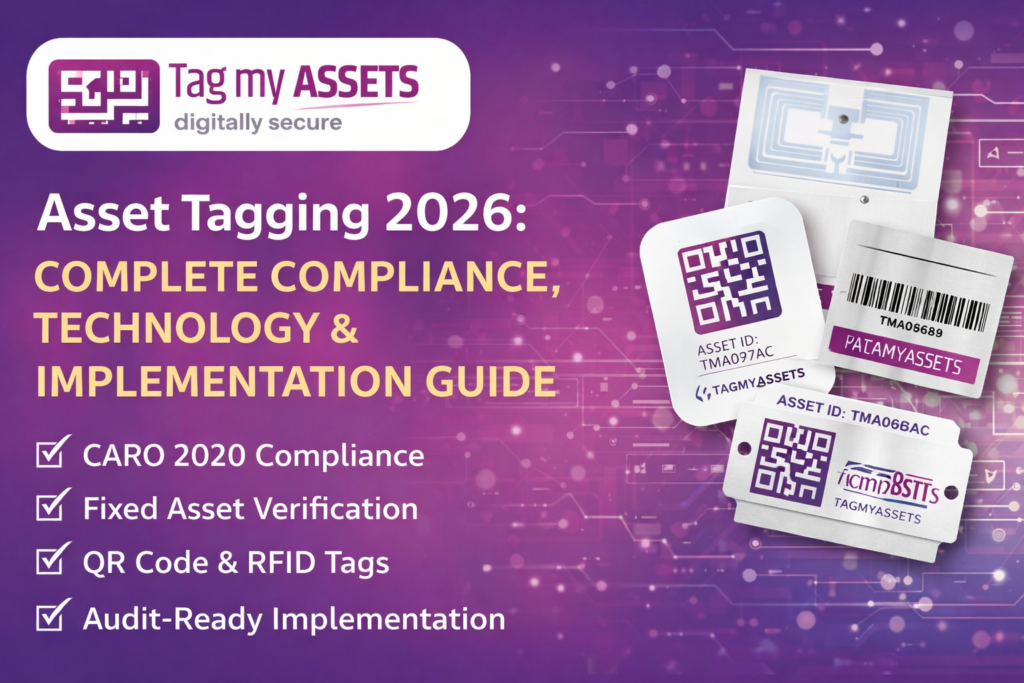
1. What is Asset Tagging?
Asset Tagging is the process of assigning a unique identification code (QR Code, Barcode, RFID, NFC or GPS tag) to every physical asset of an organization for tracking, verification, audit, and lifecycle management.
Each tag links the physical asset to:
- Fixed Asset Register (FAR)
- ERP system
- Accounting records
- Department mapping
- Location tracking
- Maintenance history
Without tagging, assets remain disconnected from records.
With tagging, physical assets become digitally traceable.
2. Why Asset Tagging is Critical in 2026
Asset tagging is no longer optional. It has become a strategic necessity.
Key Drivers in 2026:
- CARO 2020 compliance
- Increasing statutory audit scrutiny
- Internal Financial Controls (IFC) requirements
- Fraud detection and prevention
- Insurance claim validation
- ESG & sustainability reporting
- ERP integration
- Multi-location business complexity
Asset value is lost each year through:
- Ghost assets (exist in books, not physically)
- Missing assets
- Duplicate capitalization
- Improper location mapping
- Unrecorded scrap
Asset tagging transforms asset control from reactive to structured governance.
3. Regulatory & Compliance Framework (India Focus)
Under Companies Act, 2013, companies must maintain proper books and records of Property, Plant & Equipment (PPE).
Under CARO 2020, auditors are required to report:
- Whether proper records showing full particulars of PPE are maintained
- Whether physical verification has been conducted
- Whether material discrepancies exist
Without structured tagging:
- Verification becomes manual
- Serial number validation becomes difficult
- Audit risk increases
- Qualifications may arise
Asset tagging supports:
- Companies Act compliance
- Ind AS reporting
- Internal Financial Controls
- Insurance audit validation
- Bank stock audits
- Due diligence in mergers & acquisitions
For CFOs, this reduces reporting risk.
For auditors, this strengthens evidence.
4. Types of Asset Tags (Complete Comparison Guide)
Choosing the right tag is critical.
4.1 QR Code Labels
Best suited for:
- Offices
- IT equipment
- Manufacturing plants
- Educational institutions
- Hospitals
Advantages:
- Low cost
- Easily scannable via mobile app
- High data capacity
- Easy implementation
- Works offline
Limitation:
- Requires line-of-sight scanning
Most organizations prefer QR codes due to cost-effectiveness and flexibility.
4.2 Barcode Labels
Used primarily for:
- Retail inventory
- Warehousing
- High-volume SKU management
Advantages:
- Fast scanning
- Widely compatible with scanners
Limitation:
- Limited data storage
- Line-of-sight required
- Less durable than industrial QR
4.3 RFID Tags
Best for:
- Large warehouses
- High-speed inventory environments
- Logistics hubs
- Manufacturing tool tracking
Advantages:
- No line-of-sight needed
- Bulk scanning capability
- Faster stock-taking
Limitations:
- Higher cost
- Requires RFID readers
- Infrastructure investment
4.4 NFC Tags
Used for:
- Controlled asset access
- High-value electronics
- Maintenance logging
Advantages:
- Secure
- Smartphone-compatible
4.5 GPS Tags
Used for:
- Vehicles
- Heavy movable machinery
- Construction equipment
Provides real-time location tracking.
5. Asset Tagging vs Manual Asset Registers
| Manual Excel Tracking | Structured Asset Tagging |
|---|---|
| Human error prone | Scan-based accuracy |
| No physical linking | Physical-digital mapping |
| Difficult audit trail | Instant traceability |
| High duplication risk | Unique ID system |
| Time-consuming verification | Fast digital scanning |
Manual systems fail when:
- Assets exceed 500+
- Multiple departments exist
- Multi-location operations begin
- Auditors demand serial number verification
Excel is a record.
Asset tagging is control.
6. Step-by-Step Asset Tagging Implementation Framework
This is the most important section for practical execution.
Phase 1: Pre-Implementation Planning
- Collect Fixed Asset Register (FAR)
- Clean duplicate asset codes
- Categorize asset types
- Freeze tagging scope
- Define tag material
- Define unique coding logic
This stage avoids chaos during fieldwork.
Phase 2: Tag Design & Material Selection
Tag materials vary:
- Polyester labels (indoor use)
- Tamper-proof labels
- Anodized aluminum plates (harsh environment)
- Chemical-resistant labels
- Heat-resistant tags
Artwork includes:
- Company logo
- Unique asset ID
- QR code
- Year
- Department
Proper design increases durability.
Phase 3: Physical Verification & Tagging
Field team responsibilities:
- Locate asset
- Validate serial number
- Capture condition
- Capture department
- Fix tag properly
- Scan & update software
Professional tagging is systematic, not random sticking of labels.
Phase 4: FAR Reconciliation
Reconciliation identifies:
- Missing assets
- Surplus assets
- Scrap items
- Location mismatches
- Capitalization errors
- Wrong asset classification
This is where maximum financial value is created.
Phase 5: Reporting & Dashboard
Deliverables include:
- Updated asset master
- Variance report
- Department summary
- Condition analysis
- Scrap recommendation
- Management dashboard
This final report strengthens audit documentation.
7. Fixed Asset Verification Methodology (Professional Approach)
Verification must include:
- Physical existence
- Serial number matching
- Asset condition
- Department mapping
- Photo evidence (if required)
- Functional status
Handheld scanners often create issues:
- Data stored locally
- Compilation required later
- Device lag in congested areas
- Laptop dependency during audit
Modern mobile-based systems solve:
- Real-time sync
- Offline mode
- Central dashboard
- Instant reporting
8. Inventory Verification for Retail & Warehouses
Retail and warehouses face unique challenges:
- SKU mismatch
- Expired stock
- ERP vs physical difference
- Misplaced inventory
- Batch confusion
Professional inventory verification captures:
- SKU code
- Product name
- Batch
- Expiry
- Quantity
- Storage condition
Inventory verification productivity depends on how the stock is held and whether items are barcoded. Where stock is scannable, counts run far faster than fixed asset verification, because the exercise is counting rather than identifying each item individually.
9. Common Asset Tagging Mistakes to Avoid
- Using low-quality labels
- No pre-cleaning of FAR
- Not freezing scope
- Ignoring serial numbers
- No reconciliation report
- No department mapping
- Tagging scrap assets
- Not defining tagging policy
- Over-reliance on Excel
- No management dashboard
Mistakes lead to rework and cost escalation.
10. ROI of Asset Tagging (Financial Impact)
Return on Investment areas:
- Recovery of ghost assets
- Scrap identification
- Accurate depreciation
- Reduced audit time
- Insurance claim support
- Reduced theft
- Improved budgeting
The recovery period depends on the size of the asset base and what the exercise surfaces.
Indirect benefits:
- Stronger internal controls
- Improved asset visibility
- Faster audits
- Reduced compliance stress
11. Industry-Wise Asset Tagging Use Cases
Manufacturing
- Plant & machinery
- Tools & dies
- Molds
- Electrical panels
- Production equipment
Hospitals
- ICU equipment
- Lab analyzers
- Portable machines
- Wheelchairs
- Biomedical devices
Corporate Offices
- Laptops
- Desktops
- Printers
- Furniture
- Conference systems
Retail Chains
- POS devices
- Display racks
- Storage units
- Store equipment
Educational Institutions
- Lab equipment
- Classroom assets
- IT labs
- Library systems
12. Asset Tagging Software vs Excel
Excel:
- Static file
- Manual update
- No scanning
- No audit trail
- High human dependency
Software:
- QR-based scanning
- Department-wise dashboards
- Transfer history
- Scrap marking
- Role-based access
- Real-time reporting
In 2026, asset control requires digital systems.
13. Data Structure & FAR Reconciliation Explained
A strong data structure includes:
- Asset Code
- Asset Description
- Category
- Location
- Department
- Serial Number
- Purchase Date
- Gross Block
- Accumulated Depreciation
- Net Book Value
- Condition
Reconciliation process:
- Import FAR
- Capture physical data
- Auto-match based on code or serial
- Flag unmatched items
- Manual review
- Generate variance report
This strengthens financial accuracy.
14. Asset Lifecycle Management
Asset lifecycle includes:
- Procurement
- Capitalization
- Tagging
- Deployment
- Transfer
- Maintenance
- Impairment
- Disposal
Tagging integrates into entire lifecycle.
Without tagging, lifecycle tracking becomes weak.
15. ESG & Sustainability Impact
Environmental reporting requires:
- Energy-intensive equipment tracking
- Asset age analysis
- Carbon footprint estimation
- Responsible disposal documentation
Tagged assets improve sustainability data accuracy.
16. Cost Structure of Asset Tagging Projects
Cost depends on:
- Number of assets
- Number of locations
- Tag material type
- Reporting complexity
- Software usage
- Travel & logistics
Pricing models:
- Per asset rate
- Per man-day basis
- Lump-sum project cost
Always define scope before finalizing cost.
17. Frequently Asked Questions
What is asset tagging?
Assigning unique identification to physical assets for tracking and verification.
Is asset tagging mandatory?
While not explicitly mandated, physical verification under CARO 2020 makes tagging practically essential.
What is better: QR or RFID?
QR is cost-effective and suitable for most companies. RFID suits high-speed warehouses.
How long does implementation take?
Depends on asset volume and number of locations.
Which tag material is best?
Polyester for offices; anodized aluminum for industrial environments.
18. Why Professional Asset Tagging Matters
Professional execution ensures:
- Structured planning
- Accurate reconciliation
- Compliance alignment
- Proper reporting
- Long-term durability
- Audit readiness
Tagging is not sticker pasting.
It is asset governance.
19. Real-Life Asset Tagging Case Scenario (Illustrative Example)
To understand the true impact of asset tagging, let’s consider a practical example.
Scenario: Multi-Location Manufacturing Company
- 3 Plants
- 28,000 assets as per FAR
- Last physical verification done 4 years ago
- No serial number tracking
- Department transfers not recorded properly
Observations During Physical Verification:
- 1,842 assets not physically found (book value significant)
- 617 excess assets not appearing in FAR
- 312 assets tagged as “working” in books but physically scrap
- Multiple duplicate asset codes
- High-value equipment shifted between departments without documentation
Financial Impact:
- Scrap identification improved depreciation accuracy
- Ghost asset removal corrected insurance valuation
- Excess asset capitalization corrected prior year errors
- Audit qualification risk reduced
Key Outcome:
- FAR accuracy improved after reconciliation
- Insurance premium optimized
- Internal control strengthened
- CFO gained visibility into real asset base
This demonstrates that asset tagging is not just compliance — it is financial governance.
20. Asset Tagging Policy Framework (Sample Structure)
Every organization implementing asset tagging should define a formal policy.
Below is a recommended structure:
20.1 Objective
To ensure all physical assets are uniquely identified, traceable, and periodically verified.
20.2 Scope
Applies to:
- Property, Plant & Equipment (PPE)
- IT Assets
- Furniture & Fixtures
- Tools & Equipment
- High-value inventory items
20.3 Tagging Guidelines
- All assets above capitalization threshold must be tagged.
- Tags must contain unique ID and company logo.
- Damaged tags must be replaced immediately.
- Scrap assets must be recorded before disposal.
20.4 Verification Frequency
- Annual verification for high-value assets
- Biennial verification for low-value items
- Surprise checks for sensitive departments
20.5 Department Responsibility
- Department head accountable for asset custody.
- Finance responsible for FAR reconciliation.
- IT responsible for software maintenance.
Having a policy strengthens Internal Financial Controls (IFC).
21. Asset Tagging Implementation Timeline (30–90 Day Model)
Week 1–2: Planning
- FAR review
- Scope freeze
- Tag material selection
- Software configuration
Week 3–6: Field Execution
- Physical verification
- Tag fixing
- Data capture
- Photo documentation
Week 7–8: Reconciliation
- FAR vs Physical comparison
- Exception analysis
- Department validation
Week 9–10: Reporting & Closure
- Final reports
- Management presentation
- Policy handover
- Future verification roadmap
Project duration varies depending on asset count and locations.
22. Advanced Technical Comparison: QR vs RFID (Deep Dive)
| Feature | QR Code | RFID |
|---|---|---|
| Cost per tag | Low | Moderate to High |
| Reader requirement | Mobile camera | RFID reader |
| Line of sight | Required | Not required |
| Bulk scanning | No | Yes |
| Infrastructure cost | Minimal | High |
| Best suited for | Offices, plants | Warehouses, logistics |
Passive RFID
- Powered by reader signal
- Lower cost
- Suitable for medium-range scanning
Active RFID
- Battery powered
- Long-range tracking
- Higher cost
- Used for vehicles & heavy machinery
Most mid-sized companies prefer QR due to cost-efficiency and ease of implementation.
23. Common Auditor Observations in Fixed Asset Verification
Auditors frequently report:
- Incomplete FAR details
- Serial numbers not recorded
- No evidence of physical verification
- Department mismatch
- Fully depreciated assets still in use without reassessment
- Scrap assets not removed from books
- No policy for transfer documentation
Asset tagging addresses these audit risks.
24. Handling Special Asset Categories
24.1 Fully Depreciated Assets
Even if fully depreciated, if physically in use, they must be tagged and tracked.
24.2 Capital Work-in-Progress (CWIP)
CWIP typically not tagged until capitalization, but physical tracking during project stage is advisable.
24.3 Leased Assets
Should be separately identified and tagged for control purposes.
24.4 Embedded Plant & Machinery
For heavy embedded equipment:
- Metal plates
- Laser engraving
- Nearby tag fixing
24.5 Land & Buildings
Land cannot be tagged physically.
Buildings may have master identification codes.
25. Asset Lifecycle Management Integration
Asset tagging integrates into full lifecycle:
- Procurement
- GRN recording
- Capitalization
- Tag generation
- Deployment
- Transfer
- Maintenance tracking
- Impairment review
- Disposal
- Archive
Digital lifecycle management reduces leakage and improves capital planning.
26. Asset Tagging & Insurance Benefits
Insurance companies rely on declared asset value.
Without accurate physical verification:
- Over-insurance increases premium
- Under-insurance increases claim risk
Tagged assets provide:
- Clear identification
- Claim support documentation
- Theft investigation support
- Fire damage traceability
27. ESG & Sustainability Reporting Support
Environmental reporting increasingly requires:
- Asset age profiling
- Energy-intensive equipment tracking
- Scrap documentation
- Responsible disposal proof
Tagged assets support sustainability transparency.
28. Internal Control Testing & IFC Strengthening
Under Internal Financial Controls:
- Asset existence assertion
- Completeness assertion
- Accuracy assertion
- Valuation assertion
Asset tagging strengthens:
✔ Existence
✔ Completeness
✔ Ownership
✔ Location control
This reduces risk during statutory audit.
29. Technology Integration Possibilities
Modern asset tagging systems integrate with:
- ERP systems
- Accounting software
- Maintenance systems
- Helpdesk software
- Cloud dashboards
API-based integration allows real-time data synchronization.
30. How to Evaluate an Asset Tagging Vendor
Before selecting a vendor, ask:
- Do they conduct reconciliation or only tagging?
- Do they provide audit-ready reports?
- What tag material quality do they use?
- Is software included?
- Is data backup ensured?
- Do they provide policy drafting support?
- What is post-implementation support?
Vendor selection determines long-term success.
31. Future of Asset Tagging (2026–2030 Outlook)
Emerging trends:
- AI-based asset image recognition
- IoT-enabled asset monitoring
- Blockchain-based asset tracking
- Predictive maintenance integration
- Cloud-based centralized dashboards
- Digital twin modeling
Organizations investing early gain long-term advantage.
32. Final Implementation Checklist
Before starting asset tagging:
✔ FAR cleaned and verified
✔ Scope defined
✔ Tag material approved
✔ Department coordinators assigned
✔ Site access arranged
✔ Safety clearance obtained
✔ Software tested
✔ Coding logic finalized
✔ Reporting format approved
Preparation ensures smooth execution.
33. Final Strategic Conclusion
Asset Tagging in 2026 is not merely a labeling exercise.
It is:
- A compliance requirement
- A financial governance tool
- A risk mitigation mechanism
- An audit support system
- An operational control framework
- A capital optimization strategy
Organizations that delay structured asset tagging often face:
- Audit stress
- Financial misstatements
- Insurance claim complications
- Internal control weaknesses
- Asset loss
Organizations that implement structured tagging gain:
- Visibility
- Accuracy
- Accountability
- Compliance confidence
- Strategic asset intelligence
Asset tagging transforms assets from “items on paper” into “controlled financial resources.”
Frequently Asked Questions (FAQs) on Asset Tagging & Fixed Asset Verification (2026)
1. What is Asset Tagging?
Asset tagging is the process of assigning a unique identification code (QR code, barcode, RFID, or NFC) to physical assets to enable tracking, verification, audit control, and lifecycle management. It connects the physical asset with the Fixed Asset Register (FAR) and digital systems.
2. Is Asset Tagging mandatory in India?
Asset tagging itself is not explicitly mandated under law. However, under the Companies Act, 2013 and CARO 2020, companies must maintain proper records of Property, Plant & Equipment and conduct periodic physical verification. Asset tagging is the most effective method to ensure compliance.
3. What is the difference between Asset Tagging and Asset Tracking?
Asset tagging refers to physically labeling assets with unique identification codes.
Asset tracking refers to monitoring the location, movement, and status of tagged assets using software systems.
Tagging is the foundation; tracking is the operational use of tagged data.
4. What types of assets should be tagged?
Assets typically tagged include:
- Plant & machinery
- IT equipment
- Furniture & fixtures
- Laboratory equipment
- Tools & dies
- Vehicles
- High-value electrical installations
Low-value consumables are usually not tagged unless required for internal control.
5. Can fully depreciated assets be tagged?
Yes. Even if an asset is fully depreciated in books, if it is physically in use, it should be tagged and tracked to maintain control and prevent misuse or unrecorded disposal.
6. How often should fixed assets be physically verified?
Best practice:
- High-value assets: Annually
- Moderate-value assets: Once in 1–2 years
- Sensitive departments (IT, portable devices): Periodic surprise checks
Frequency depends on internal control policies and risk exposure.
7. What is FAR Reconciliation?
FAR reconciliation is the process of matching the Fixed Asset Register with physically verified assets to identify:
- Missing assets
- Surplus assets
- Location mismatches
- Duplicate asset codes
- Scrap assets still appearing in books
It strengthens financial accuracy and audit readiness.
8. What is the best type of tag material?
Tag material depends on environment:
- Polyester labels: Office use
- Tamper-proof labels: Sensitive equipment
- Anodized aluminum plates: Harsh industrial conditions
- Heat-resistant tags: Manufacturing plants
Selecting correct material ensures durability.
9. What is the difference between QR code and RFID tagging?
QR codes require line-of-sight scanning and are cost-effective.
RFID does not require direct visibility and allows bulk scanning but requires specialized readers and higher investment.
Most mid-sized businesses prefer QR tagging due to lower cost and easier implementation.
10. How long does an asset tagging project take?
Project duration depends on:
- Number of assets
- Number of locations
- Complexity of FAR
- Department coordination
A typical mid-sized organization (5,000–15,000 assets) may take 30–60 days.
11. What are ghost assets?
Ghost assets are assets that appear in the books but are not physically available during verification. They often arise due to poor tracking, unrecorded disposal, or internal control weaknesses.
Asset tagging helps eliminate ghost assets.
12. What are surplus assets?
Surplus assets are physically found assets that are not recorded in the Fixed Asset Register. These may indicate improper capitalization or incomplete accounting entries.
13. Should leased assets be tagged?
Yes. Even if assets are leased, they should be tagged separately to maintain control and avoid confusion with owned assets.
14. Can land and buildings be tagged?
Land cannot be physically tagged.
Buildings can be assigned master identification codes or location-based tagging for control purposes.
15. Is Excel sufficient for asset management?
Excel can store asset data but cannot ensure physical control, real-time tracking, or structured reconciliation. Asset tagging combined with software provides better audit support and operational efficiency.
16. What are common mistakes during asset tagging?
- Tagging without cleaning FAR
- Ignoring serial numbers
- No reconciliation process
- Using low-quality labels
- No department mapping
- No post-verification reporting
Structured planning prevents these errors.
17. How does asset tagging help during statutory audit?
Asset tagging provides:
- Physical existence evidence
- Serial number verification
- Location confirmation
- Reconciliation reports
- Improved audit documentation
This reduces audit qualification risk.
18. How does asset tagging improve insurance claims?
Tagged assets provide clear identification and documentation in case of theft, fire, or damage. It ensures accurate claim support and prevents over or under insurance.
19. What is the ROI of asset tagging?
Return on investment comes from:
- Recovery of ghost assets
- Scrap identification
- Reduced audit time
- Accurate depreciation
- Better insurance management
- Improved capital budgeting
The recovery period depends on the size of the asset base and what the exercise surfaces.
20. How do I choose the right asset tagging vendor?
Evaluate based on:
- Reconciliation capability
- Audit-ready reporting
- Tag material quality
- Software integration
- Industry experience
- Post-implementation support
A professional vendor ensures long-term control, not just temporary tagging.
Final Thoughts
In 2026, asset tagging is not a cost.
It is a control mechanism.
Organizations that implement structured asset tagging gain:
- Financial clarity
- Compliance strength
- Operational efficiency
- Audit confidence
- Strategic visibility
If your organization manages physical assets, structured asset tagging is the foundation of asset control.
This Knowledge Hub serves as your complete guide to understanding, planning, and executing a professional asset tagging program.