
Corporate offices look like simple environments for asset tagging — fixed desks, predictable floor plans, stable departments. In practice the register drifts for the same reasons it drifts everywhere else. Laptops are reassigned between staff. Equipment moves between floors during a refurbishment. Projectors travel between meeting rooms. Fire extinguishers are serviced and returned to a different location than the one recorded.
The bigger issue is what the register carries that was never physical to begin with. Software licences, civil works and electrical installations appear as lines in the fixed asset register but cannot be physically tagged or counted. On a large corporate fit-out those lines can represent a material portion of gross block, and if they are not classified separately the reconciliation may appear to show a shortfall even though those items were never physically verifiable.
Office asset tagging closes the gap between what the register says and what the floor holds. Every identifiable asset gets a unique physical tag mapped to a register line, so it can be located, matched against the FAR, and evidenced during audit.
TagMyAssets has completed 395+ projects across 1,500+ locations in India, covering 10 lakh+ assets tagged.
For the wider picture — tag types, what goes on a tag, the tagging process and costs in India — see our complete guide to asset tagging.
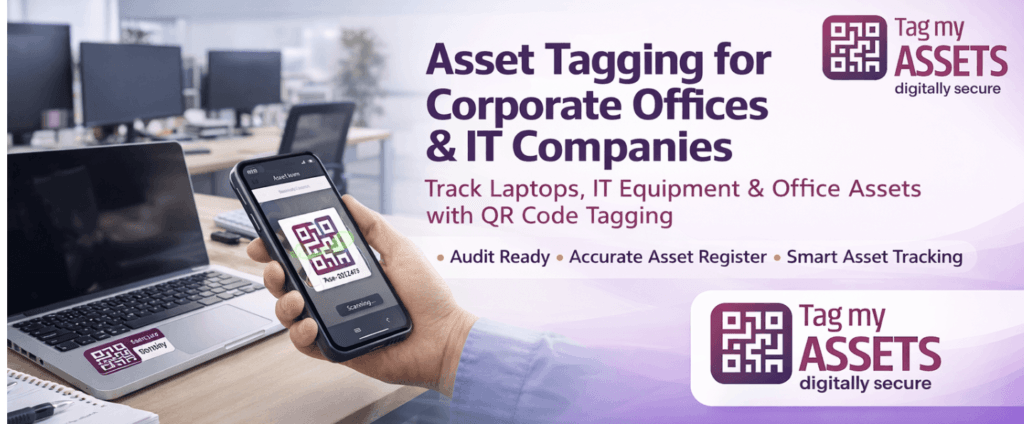
What Office Asset Tagging Involves
Asset tagging is the process of affixing a unique identification tag to each asset and linking it to a specific line in the Fixed Asset Register.
Each tag record typically holds:
- Asset ID and description
- Department and floor location
- Asset category
- Purchase date and value
- FAR reference number
- Condition and verification status at last check
Staff scan the tag on a standard smartphone to retrieve the record. No separate hardware is needed for QR or barcode. RFID is the exception and needs a reader.
What Corporate Offices Typically Tag
Coverage across a corporate office usually runs across four groups:
IT assets — desktops, laptops, monitors, servers, networking switches, WiFi routers, external drives. The highest-movement category on most floors.
Office infrastructure — printers, projectors, video conferencing equipment, CCTV, access control systems.
Furniture and fixtures — workstations, chairs, tables, storage cabinets, conference room furniture.
Facility assets — air conditioners, UPS systems, electrical panels, fire extinguishers.
Employee-level laptop tracking, exit returns and inter-employee transfers are covered separately on the asset tagging for IT companies page.
Types of Tags Used in Corporate Offices
Tag type and material are matched to the asset and its surface rather than applied uniformly across a floor.
QR code tags are the common choice for IT equipment, furniture and infrastructure — scannable on any smartphone, quick to deploy at volume. See how QR and barcode based asset tagging works in practice.
Barcode labels suit furniture, storage and facility assets where the asset stays in a known location.
RFID tags are used where assets circulate between floors or where scanning at close range is impractical. Read more about RFID asset tagging services.
Tag material by surface type
- Metal assets (server racks, electrical panels) — on-metal tags designed for metallic surfaces
- Plastic surfaces (laptops, monitors, printers) — tamper-evident polyester labels
- Rough or painted surfaces — industrial adhesive tags rated for the surface
Surface matching is what determines whether tags survive the next verification cycle. A standard polyester label on a powder-coated metal panel will lift within months.
Why Corporate Office Asset Records Have to Hold Up
Corporate offices in India are almost always run through private or public limited companies, placing them inside CARO 2020. The auditor reports on whether proper records of property, plant and equipment are maintained, whether management has physically verified those assets at reasonable intervals, and whether material discrepancies were properly dealt with in the books.
Section 128 of the Companies Act, 2013 requires companies to maintain proper books of account reflecting their fixed assets. Ind AS 16 requires detailed records of property, plant and equipment — cost, depreciation, disposals and carrying value. Both obligations require the register to match identifiable physical assets.
A register that cannot be tied to tagged, locatable assets does not evidence compliance — it only evidences that a list exists.
For the full clause-by-clause CARO position, see our CARO 2020 fixed asset verification requirements guide.
How an Office Asset Tagging Project Runs
Step 1 — FAR analysis
The existing register is reviewed before field work. Bulk lines, duplicate entries and descriptions too vague to match are identified first.
Step 2 — Asset classification
Not every line in a corporate register can be physically tagged. Assets are classified into three groups before field work:
Taggable — individually identifiable assets that can physically carry a tag. Most of the register.
Countable — items verified by count rather than individually tagged, where tagging each unit is impractical or units are not individually distinguishable.
Non-auditable — register lines with no physically verifiable form: civil structures, electrical wiring and installations, software licences and other intangibles. These cannot be tagged or counted and are mapped notionally instead.
Identifying the non-auditable portion up front is what stops the reconciliation appearing to show a shortfall when those items were never physically verifiable in the first place. On a large fit-out this can be a material number.
Step 3 — Tag format approval
Numbering convention, tag design and material are confirmed before printing. For a multi-floor or multi-city office, this is where the location-encoding scheme is set.
Step 4 — Physical verification
Assets are verified floor by floor and department by department. Existence, location and condition are confirmed on site. See physical verification of assets for how this stage runs.
Step 5 — Tagging
Tags are affixed to approved assets with material matched to surface, and each tag mapped to the corresponding register line.
Step 6 — Data capture
Asset ID, description, serial number, floor, department and condition are captured on site through a mobile app, along with a photograph.
Step 7 — FAR reconciliation
Field findings are matched line by line against the register. Items in the books with nothing behind them, items on site never recorded, and location mismatches are classified and documented. See FAR reconciliation services for how the reconciliation stage works.
Step 8 — Reporting
A verification and reconciliation report is issued with variances classified for management review, in a form the statutory auditor can work from.
What Tagging Changes in Practice
Assets become traceable to a location. A tagged item can be matched to its recorded floor and department rather than located by asking around.
The register becomes reconcilable. Each tag maps to a FAR line, so discrepancies are classified rather than estimated.
Verification stops restarting. Without unique tags every cycle repeats the same matching exercise. Tags turn it into a scan.
Ghost assets surface clearly. Items in the register with nothing behind them are iidentified in the sheet-to-floor direction, not guessed at from the totals.
The non-auditable portion becomes explicit. Civil works, wiring and software that cannot be physically confirmed are separated out, so the reconciliation reflects reality rather than apparent loss.
Best Practices for Office Asset Tagging
Verify before you tag. Tagging a register you have not tested only preserves its errors.
Break down bulk entries. Office furniture — one lot cannot be verified. Bulk lines need splitting into taggable units before field work starts.
Classify non-auditable assets first. Agreeing which lines are civil works, wiring and software up front keeps the final reconciliation honest.
Number by floor and department. A scheme that encodes building, floor and department makes the following year’s verification navigable without re-learning the layout.
Match tag material to the surface. Server racks, laptop casings and painted walls each need a different specification. One tag type across the whole floor will fail somewhere.
Verify at regular intervals. Periodic verification keeps the register current and gives the auditor a documented programme to review.
For pre-tagging preparation, see the asset tagging preparation checklist.
How TagMyAssets Works with Corporate Offices
Asset tagging for offices is field work, not software. Our role is the on-ground layer: tagging, physical verification and FAR reconciliation. We do not supply or replace your ERP, fixed asset module or accounting package — we produce the physical evidence base they should be reconciled against.
What an office engagement covers:
- Pan-India field execution teams, single office or multi-city
- Physical verification floor by floor, before tagging
- Asset classification into taggable, countable and non-auditable before field work starts
- QR code, barcode or RFID tagging with material matched to surface type
- Bulk-entry breakdown and FAR cleanup
- Mobile app data capture with photographic record
- Reconciliation report with variances classified for management review
Learn more about our fixed asset tagging services.
Conclusion
A corporate office register drifts for ordinary reasons — assets move, refurbishments happen, and civil works and software sit on the books as lines that were never physically verifiable. Tagging gives every identifiable asset a physical identity that survives between verification cycles, so the register can be reconciled against what is actually on the floor, discrepancies are classified rather than estimated, and the verification programme can be evidenced when the auditor asks for it.
Timelines depend on asset volume, number of floors and state of the existing register — we confirm a schedule after reviewing your FAR.
FAQs
What is office asset tagging?
It is the process of affixing a unique identification tag — QR code, barcode or RFID — to each office asset and linking it to a specific line in the Fixed Asset Register.
Which assets are tagged in a corporate office?
IT equipment (desktops, laptops, monitors, servers, networking), office infrastructure (printers, projectors, CCTV), furniture (workstations, chairs, conference room), and facility assets (air conditioners, UPS, fire extinguishers).
Does CARO 2020 apply to corporate offices?
Corporate offices are generally run through private or public limited companies, so CARO 2020 applies. The auditor reports on whether proper records of property, plant and equipment are maintained, whether physical verification has been done at reasonable intervals, and whether material discrepancies were dealt with in the books.
What happens to assets that cannot be tagged?
They are classified before field work. Civil structures, wiring, software and other intangibles that have no physically verifiable form are classified as non-auditable and mapped notionally, so the reconciliation separates them from genuine shortfalls.
What type of tag is used for each surface?
Metal assets use on-metal tags; plastic surfaces such as laptops and monitors use tamper-evident polyester; rough or painted surfaces use industrial adhesive tags. Matching material to surface determines whether tags survive the next verification cycle.
Can this be done across multiple office locations?
Yes. A shared numbering convention encoding building, floor and department is agreed before field work so findings from each location consolidate into one reconciliation.
How long does office asset tagging take?
It depends on asset volume, number of floors and the state of the existing register. Bulk entries that need breaking down add time at the start. We confirm a schedule after reviewing your FAR.