
Asset tagging is often misunderstood as a simple cost of labels and manpower.
But in reality, asset tagging budget planning is a strategic financial decision that directly impacts asset control, audit efficiency, and long-term cost savings.
For CFOs, the challenge is not just how much to spend —
👉 it is how to allocate the budget effectively across different components
This guide explains how to plan and allocate asset tagging budgets in a structured and practical way.
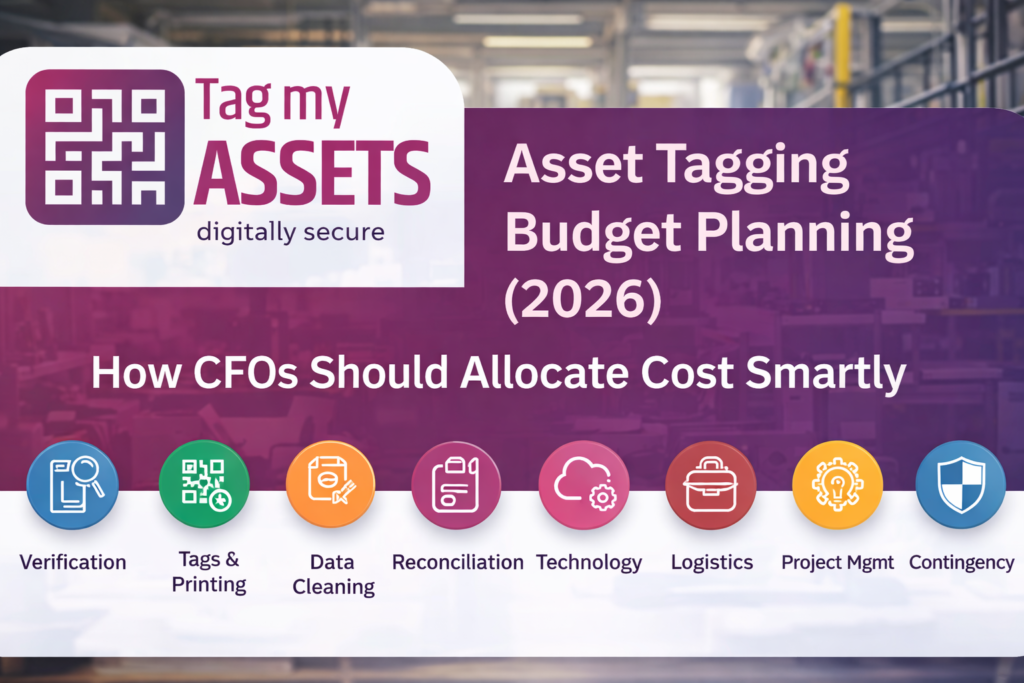
Why Asset Tagging Budget Planning Matters
Poor budget planning leads to:
- underestimation of project cost
- incomplete tagging execution
- poor data quality
- repeated rework
- audit inefficiencies
A well-planned budget ensures:
- complete asset coverage
- accurate FAR reconciliation
- better audit outcomes
- long-term cost control
9 Key Cost Components in Asset Tagging Budget Planning
1. Physical Verification Cost
This is the foundation of any asset tagging project.
Includes:
- on-site manpower
- asset identification
- location mapping
💡 Tip: Never skip verification to reduce cost — it leads to incorrect tagging.
2. Asset Tag Cost (QR / Barcode / RFID)
Tag cost depends on:
- material (polyester, metal, RFID)
- durability requirement
- environment (indoor / outdoor / industrial)
💡 Typical Range (India):
- QR polyester tags: ₹2–₹15
- Passive RFID tags: ₹10–₹200
- Active RFID tags: ₹500–₹3,000
3. Tag Printing & Design Cost
Includes:
- QR generation
- printing setup
- customization (logo, numbering format)
💡 Often ignored but important for consistency.
4. Data Cleaning & FAR Standardization
One of the most critical components.
Includes:
- description standardization
- asset categorization
- duplication removal
💡 Impact: Directly improves financial reporting accuracy.
5. Reconciliation & Reporting Cost
Includes:
- FAR vs physical comparison
- excess / missing asset reporting
- audit-ready reports
💡 This is where real insights are generated.
6. Technology / Software Cost
Includes:
- mobile app for asset capture
- QR scanning system
- cloud data storage
💡 Subscription-based or project-based.
7. Travel & Logistics Cost
Important for multi-location projects.
Includes:
- travel of verification teams
- accommodation
- inter-location coordination
8. Project Management & Supervision
Includes:
- planning and scheduling
- coordination with client teams
- quality control
💡 Ensures project completion on time.
9. Contingency Buffer (5–10%)
Always include buffer for:
- extra assets
- re-tagging
- scope changes
How CFOs Should Allocate Asset Tagging Budget
A practical allocation model:
| Component | % of Budget |
|---|---|
| Physical Verification | 35–45% |
| Tags & Printing | 10–20% |
| Data Cleaning & Reconciliation | 15–20% |
| Technology | 5–10% |
| Travel & Logistics | 10–15% |
| Project Management | 5–10% |
| Contingency | 5–10% |
Common Budgeting Mistakes to Avoid
❌ 1. Considering Only Tag Cost
Tag cost is usually <20% of total project.
❌ 2. Ignoring Data Quality Work
Poor FAR = poor outcomes.
❌ 3. Underestimating Manpower
Asset identification takes time.
❌ 4. Not Planning for Multi-Location Complexity
Logistics can significantly increase cost.
Sample Budget Calculation (India)
For a company with 10,000 assets:
| Component | Estimated Cost |
|---|---|
| Field manpower — tagging, identification and data capture | ₹3,00,000 approx. |
| Supervision and project management | ₹1,00,000 approx. |
| Tags | ₹80,000 |
| Data cleaning and FAR standardisation | ₹1,50,000 |
| Reconciliation and reporting | ₹1,00,000 |
| Travel and logistics | ₹1,20,000 |
| Technology and support | ₹50,000 |
| Total | ₹9,00,000 approx. |
How Asset Tagging Budget Planning Improves ROI
Proper planning ensures:
- no duplicate purchases
- faster audits
- better asset utilization
- reduced losses
When Budget Should Be Approved Immediately
CFOs should act if:
- audit discrepancies are increasing
- asset visibility is poor
- capex is rising without clarity
- FAR is unreliable
- assets are spread across locations
Conclusion
Asset tagging budget planning is not about minimizing cost —
👉 it is about maximizing value from every rupee spent
A structured approach ensures:
- complete asset visibility
- accurate financial records
- efficient audits
- better control over assets
For CFOs, the right budget allocation can transform asset tagging from a cost into a high-return investment. As per accounting best practices defined by ICAI
About TagMyAssets
At TagMyAssets, we help organizations across India plan and execute asset tagging projects with a structured, audit-focused approach. Our services include physical verification, QR-based tagging, FAR reconciliation, and mobile app-based asset tracking to ensure accurate and reliable asset data.
FAQs
1. How much does asset tagging cost in India?
It is built up from manpower and tag cost rather than quoted as a single figure. Manpower for tagging, data capture and verification runs ₹15 to ₹35 per asset, depending on location and the size of the count. Tags are additional — ₹2 to ₹15 for QR and barcode, ₹10 to ₹200 for passive RFID, before volume discount. Data cleaning, reconciliation, reporting and travel are the remaining components, and are set out in the allocation model above.
2. What is the biggest cost component?
Physical verification and manpower.
3. Is RFID necessary?
Not always. QR/barcode is sufficient for most use cases.
4. How to reduce asset tagging cost?
Proper planning, standardized FAR, and clear scope reduce cost significantly.
5. Does asset tagging provide ROI?
Yes, through audit savings, better utilization, and avoiding duplicate purchases.