How Asset Tagging Improves Internal Financial Controls in Companies
Strong internal financial controls are essential for maintaining accurate financial reporting, preventing asset misuse, and improving audit readiness. However, many companies struggle with inaccurate Fixed Asset Registers (FAR), missing assets, duplicate records, and weak asset tracking systems.
This is where asset tagging becomes important.
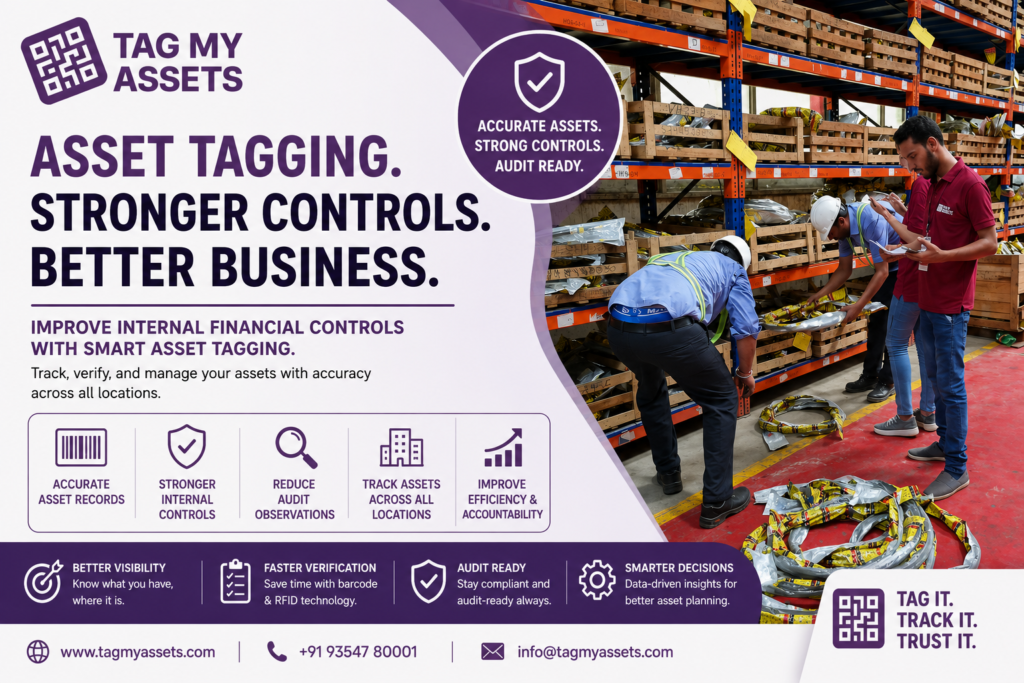
Asset tagging improves internal financial controls by helping organizations uniquely identify, track, verify, and monitor assets across multiple departments and locations. Whether companies use barcode labels, QR code tags, or RFID asset tags, structured asset tagging systems create better accountability and operational transparency.
In this guide, we explain how asset tagging improves internal financial controls and why companies are increasingly adopting asset verification and tagging solutions.
What Are Internal Financial Controls?
Internal financial controls (IFC) are systems and procedures implemented by organizations to:
- protect company assets,
- maintain accurate records,
- prevent fraud and errors,
- ensure compliance,
- improve operational efficiency, and
- support accurate financial reporting.
Under the Companies Act and audit requirements, companies are expected to maintain effective internal financial controls related to fixed assets and financial reporting.
1. Asset Tagging Improves Asset Identification
One of the biggest advantages of asset tagging is unique asset identification.
Every asset receives:
- a unique asset code,
- barcode or RFID tag,
- asset description,
- department mapping,
- location mapping, and
- FAR linkage.
This reduces confusion caused by duplicate asset descriptions or manual records.
2. Asset Tagging Improves FAR Accuracy
Many organizations maintain inaccurate FAR records due to manual updates and poor tracking practices.
Asset tagging improves internal financial controls by helping companies:
- match physical assets with FAR,
- identify missing assets,
- remove duplicate records,
- update transferred assets, and
- improve capitalization accuracy.
Accurate FAR records are critical during audits and financial reporting.
3. Asset Tagging Strengthens Accountability
Tagged assets can be assigned to:
- departments,
- cost centers,
- plants,
- stores,
- project sites, or
- individual users.
This improves accountability and reduces unauthorized movement or misuse of company assets.
4. Asset Tagging Reduces Audit Observations
Auditors frequently report issues such as:
- assets not physically available,
- incorrect asset locations,
- duplicate entries,
- unrecorded disposals, and
- incomplete FAR records.
Asset tagging improves internal financial controls by simplifying physical verification and improving traceability during audits.
5. Asset Tagging Supports Physical Verification
Periodic physical verification becomes faster and more accurate with barcode or RFID-based asset tagging systems.
Verification teams can:
- scan tags quickly,
- validate asset records,
- update asset conditions,
- capture images, and
- reconcile FAR data efficiently.
This reduces manual verification errors.
6. Asset Tagging Helps Prevent Asset Loss
Untracked assets are more vulnerable to:
- theft,
- unauthorized transfers,
- misplacement, and
- ghost asset creation.
Asset tagging systems improve monitoring and reduce the risk of asset loss across multiple operational locations.
7. Asset Tagging Improves Multi-Location Asset Tracking
Organizations operating across:
- factories,
- warehouses,
- branch offices,
- hospitals,
- retail stores, and
- project sites
often struggle with centralized asset control.
Asset tagging improves internal financial controls by creating standardized asset tracking processes across all locations.
8. Asset Tagging Simplifies Asset Reconciliation
FAR reconciliation becomes easier when assets are uniquely tagged and digitally mapped.
Companies can reconcile:
- FAR records,
- physical assets,
- purchase records,
- capitalization data, and
- department-wise asset lists.
This improves transparency and reporting accuracy.
9. Asset Tagging Improves Operational Visibility
Management gains better visibility into:
- asset availability,
- asset utilization,
- idle assets,
- transferred assets, and
- damaged assets.
Better visibility improves decision-making and operational efficiency.
10. Asset Tagging Supports Compliance Requirements
Asset tagging helps companies comply with:
- statutory audit requirements,
- CARO reporting,
- internal audit procedures,
- insurance documentation,
- IFRS/Ind AS reporting, and
- company asset management policies.
11. Asset Tagging Reduces Manual Errors
Manual asset management processes often result in:
- wrong asset codes,
- incorrect quantities,
- missing records,
- spreadsheet errors, and
- outdated asset locations.
Digital asset tagging systems significantly reduce such errors.
12. RFID Asset Tagging Improves Verification Speed
RFID asset tagging enables faster bulk scanning compared to manual verification.
RFID systems are useful for:
- large warehouses,
- manufacturing plants,
- retail chains,
- hospitals, and
- IT asset management.
RFID technology improves efficiency and verification speed.
13. Asset Tagging Improves Asset Lifecycle Tracking
Organizations can track assets from:
- procurement,
- capitalization,
- installation,
- transfer,
- maintenance,
- disposal, and
- retirement.
This creates stronger asset lifecycle management processes.
14. Asset Tagging Helps During Statutory Audits
During statutory audits, auditors verify:
- physical existence,
- FAR accuracy,
- asset ownership,
- capitalization records, and
- asset controls.
Asset tagging improves internal financial controls by simplifying audit verification procedures.
15. Asset Tagging Enhances Internal Audit Efficiency
Internal audit teams can perform quicker and more structured asset audits using tagged assets and digital verification systems.
This improves:
- audit coverage,
- verification quality,
- reporting accuracy, and
- audit documentation.
16. Asset Tagging Improves Decision-Making
Management can make better decisions related to:
- asset replacement,
- procurement planning,
- insurance,
- budgeting, and
- capital expenditure control.
Reliable asset data supports better business decisions.
17. Asset Tagging Builds Stronger Internal Financial Controls
Ultimately, asset tagging improves internal financial controls by creating structured, traceable, and verifiable asset management systems.
Companies implementing:
- asset tagging,
- periodic physical verification,
- FAR reconciliation, and
- digital asset management systems
are better prepared for audits, compliance reviews, and operational growth.
Conclusion
Asset tagging improves internal financial controls by improving asset visibility, FAR accuracy, accountability, audit readiness, and operational transparency.
Organizations implementing barcode or RFID-based asset tagging systems gain:
- stronger internal controls,
- reduced audit observations,
- better compliance,
- improved financial reporting, and
- more accurate asset management.
As businesses continue expanding across multiple locations, structured asset tagging and verification systems are becoming essential for maintaining accurate and audit-ready fixed asset records.
Ministry of Corporate Affairs (MCA) – https://www.mca.gov.in/
ICAI – Internal Financial Controls Guidance – https://www.icai.org/
ISO 55001 Asset Management Standard – https://www.iso.org/standard/55088.html