
Fixed asset verification is the process of physically confirming that the assets recorded in a company’s Fixed Asset Register (FAR) actually exist, are in the recorded location, are in usable condition and are correctly described in the books. It is one of the core controls in fixed asset management and a key input for statutory audits under CARO 2020.
Machinery is moved between plants. Laptops change hands. Furniture is scrapped without an accounting entry. Over time, the gap between what the books say and what exists on the ground keeps widening — until an audit, an insurance claim or an ERP migration exposes it.
This guide explains what fixed asset verification involves, the regulatory framework in India, the step-by-step process, common findings, verification frequency and what a verification report contains. It is based on our experience of conducting fixed asset verification, asset tagging and FAR reconciliationacross 395+ projects, 1500+ locations and 10 lakh+ physical assets throughout India. It is written for CFOs, finance teams, internal auditors and asset custodians who need to plan or improve a verification exercise.
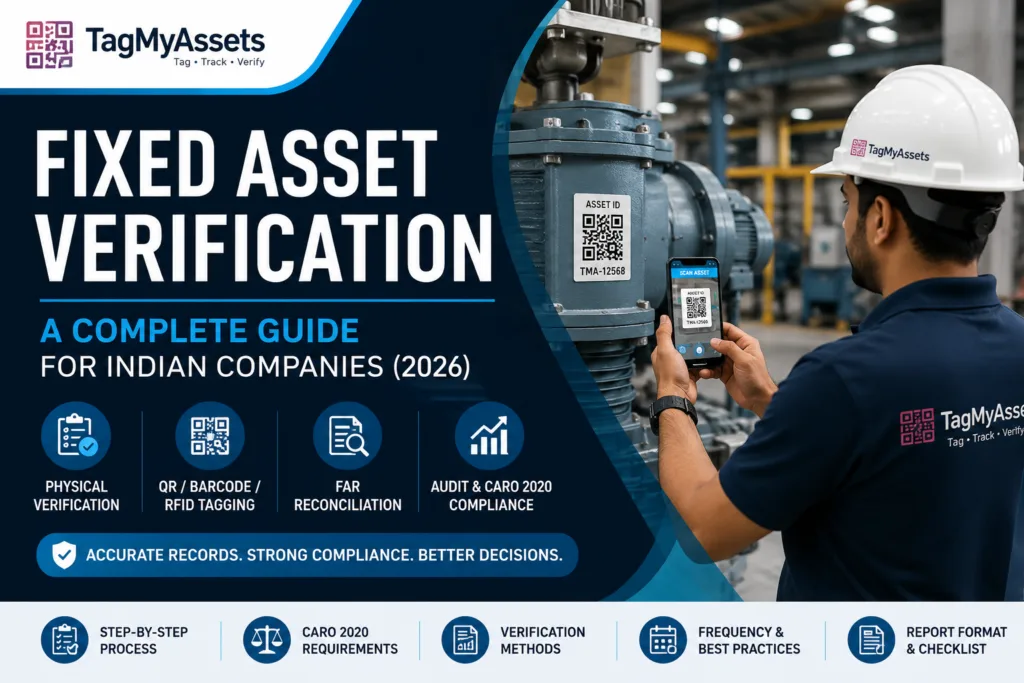
What Is Fixed Asset Verification?
Fixed asset verification is the systematic physical checking of an organisation’s fixed assets against its Fixed Asset Register to confirm existence, location, condition, ownership and identification. The output is a verified asset list together with an exception report of the differences found.
A verification exercise typically answers five questions for every asset in the register:
- Existence — does the asset physically exist?
- Location — is it where the register says it is?
- Condition — is it in use, idle, under repair or scrapped?
- Identification — does it carry an asset tag that links it to the register?
- Custodianship — who is responsible for it?
Verification on its own does not change the books. The differences it uncovers are resolved through FAR reconciliation, where each exception is investigated and the register is corrected with proper approvals.
Why Fixed Asset Verification Matters
Statutory audit and CARO 2020
For companies covered under CARO 2020, the statutory auditor reports whether the company maintains proper records of Property, Plant and Equipment and whether physical verification has been carried out by management at reasonable intervals. A recent, well-documented verification makes this reporting straightforward; the absence of one invites qualifications and audit observations.
Accurate financial reporting
Depreciation, net book value and impairment assessments are only meaningful when they are based on assets that actually exist. Verification identifies assets that are still being depreciated in the books even though they were scrapped, sold or lost years ago.
Internal financial controls
Under the Companies Act, 2013, auditors of many companies also report on the adequacy of internal financial controls. Periodic physical verification of assets is one of the standard controls expected in the fixed asset cycle.
Insurance and loss prevention
Insurance schedules based on unverified registers can leave real assets uninsured while premiums are paid on assets that no longer exist. Verification aligns the insured list with physical reality and helps detect misappropriation early.
Better operational decisions
Knowing what the organisation owns, where it is and what condition it is in supports procurement, maintenance planning, transfers and capital budgeting. Idle assets found at one location are often exactly what another location was about to purchase.
Fixed Asset Verification vs Physical Verification vs FAR Reconciliation
These three terms are often used interchangeably, but each has a distinct role:
| Activity | What it means | Primary output |
| Physical verification | The on-ground fieldwork: locating, counting and checking each asset | Verified asset data captured from the floor |
| Fixed asset verification | The full exercise: planning, fieldwork, comparison with the FAR and exception reporting | Verified asset list + exception report |
| FAR reconciliation | Investigating and resolving the differences, then correcting the register | Updated FAR with a documented audit trail |
In practice, physical verification is a stage inside fixed asset verification, and FAR reconciliation is what converts the findings into corrected books.
The Regulatory Framework in India
Several provisions make verification a compliance expectation rather than an optional exercise:
- CARO 2020, Clause 3(i): the auditor reports whether proper records of Property, Plant and Equipment are maintained, whether physical verification is conducted by management at reasonable intervals, and whether material discrepancies were properly dealt with in the books.
- Companies Act, 2013: Schedule II governs depreciation based on useful life, which assumes the underlying asset records are reliable. Section 143(3)(i) requires auditor reporting on internal financial controls for many companies.
- Accounting standards: AS 10 / Ind AS 16 (Property, Plant and Equipment) govern recognition, derecognition and depreciation — all of which depend on knowing which assets actually exist.
- Insurance and banking requirements: lenders and insurers frequently ask for recent verification reports as part of their own due diligence.
Neither CARO nor the Companies Act prescribes an exact frequency or method. “Reasonable intervals” is left to management’s judgement based on the size of the company, the nature of its assets and how frequently they move — which is why documenting your verification policy matters as much as performing the verification.
Before You Start: Preparing for a Verification Exercise
Verification projects succeed or struggle in the preparation stage. Before the field team arrives, a few essentials make the difference between a clean exercise and weeks of follow-up:
- Freeze the FAR as on the cut-off date, so the field data and the register describe the same moment in time.
- Pause asset transfers between departments and locations for the duration of the count, or route them through a single coordinator.
- Nominate a coordinator at each location who knows the premises and can arrange access.
- Identify inaccessible areas in advance — locked rooms, restricted zones, heights — and plan access or note exclusions.
- Plan around operations: machine shutdown windows, shift timings and areas that cannot be disturbed during production.
- Arrange practical support where needed — ladders, forklifts for high racking, safety gear for plant areas.
Documents to keep ready
The field team and the finance team will both work faster if these are available on day one: the Fixed Asset Register (ERP dump as on the cut-off date), the additions and disposal registers for recent years, inter-unit transfer records, floor plans or location layouts, the department and cost-centre master, and the location master used in the ERP.
The 8-Step Fixed Asset Verification Process
A structured verification exercise typically moves through eight stages. For a hands-on walkthrough of the tagging and verification fieldwork itself, see our detailed process article.
Step 1: Define scope and plan
Decide which locations, asset categories and value thresholds are covered, whether the count will be full or sample-based, and who will perform it. Fix a cut-off date so that additions and disposals during the exercise are handled cleanly.
Step 2: Obtain the Fixed Asset Register
Extract the FAR from the accounting system or ERP as on the cut-off date, with asset codes, descriptions, locations, capitalisation dates, gross block and net book values.
Step 3: Sanitise the data
Before anyone walks the floor, the register itself is cleaned: obvious duplicates flagged, generic descriptions (“machinery — various”) identified, grouped entries noted, and location codes mapped to actual physical areas. Poor register quality is the single biggest cause of slow, inconclusive verifications.
Step 4: Conduct the floor work — in both directions
Effective verification works in two directions:
- Sheet-to-floor: start from the register and physically locate each recorded asset. This tests existence — it finds ghost assets.
- Floor-to-sheet: start from the physical assets and trace each one back to the register. This tests completeness — it finds unrecorded assets.
Verifying in only one direction gives a one-sided picture. An exercise that only does sheet-to-floor can miss an entire category of assets that were never capitalised.
Step 5: Tag assets that are not identifiable
Assets found without any identification are tagged during the exercise itself — typically with barcode, QR or RFID labels — so that this verification becomes the baseline for every future one. See our fixed asset tagging services page for how tagging technologies are selected for different environments.
Step 6: Capture condition, user and custodian
For each asset, the field team records working condition (in use, idle, under repair, scrapped), the department or user, and photographs where required. This data is what turns a count into a management tool.
Step 7: Compare and prepare the exception report
The verified data is matched against the FAR. Every difference is classified: assets in books but not found, assets found but not in books, location mismatches, condition issues and identification gaps.
Step 8: Reconcile and update the register
Each exception is investigated — was the asset transferred, scrapped, sold, or never recorded? — and the FAR is corrected with management approval and a documented trail. This stage is FAR reconciliation, and it is where the financial statements actually improve.
The process at a glance
ERP FAR extract → Data sanitisation → Sheet-to-floor → Floor-to-sheet → Tagging → Condition mapping → Exception report → FAR reconciliation → Updated FAR
Technology Used in Modern Verification
Manual, register-and-clipboard verification still exists, but most serious exercises now run on a technology stack that removes transcription errors and creates evidence as the work happens: barcode and QR code labels scanned through mobile apps, RFID tags for high-volume or hard-to-reach assets, photo capture of each asset as visual evidence, serial number capture for IT equipment, and offline scanning for plants and warehouses with poor connectivity. The choice between barcode, QR and RFID depends on asset type, environment and budget — our fixed asset tagging services page explains how the technology is selected, and our RFID tagging cost guide covers what each option costs in India.
Verification Methods: Full Count, Sampling and Cyclical
- Full count: every asset in scope is physically verified. Preferred for the first-ever verification, before ERP migrations, and for high-value or movable asset categories.
- Sample-based: a defined portion of assets is verified, selected by value, category or location risk. Common in interim years for companies with stable, low-movement assets.
- Cyclical (rolling): the asset base is divided so that every asset is covered over a defined cycle — for example, one-third of locations each year. Practical for organisations with many branches.
The right method depends on asset mobility, value concentration and what was agreed with the statutory auditors. Whichever method is chosen, it should be written into the fixed asset policy so the “reasonable intervals” question under CARO has a documented answer.
Common Issues Found During Verification
Across industries, verification exercises tend to surface the same patterns:
- Ghost assets: assets appearing in the books that cannot be physically found — often scrapped, sold or lost without an accounting entry, yet still being depreciated and insured.
- Unrecorded assets: assets physically in use but absent from the register, frequently arising from project purchases, donations or inter-unit transfers that were never capitalised.
- Untagged and unidentifiable assets: without tags, the same asset may be counted twice or matched to the wrong register entry.
- Location mismatches: assets transferred between departments, floors or cities without the register being updated.
- Generic and grouped entries: single register lines such as “computers — 50 nos.” that cannot be matched to individual physical assets.
- Disposals not derecognised: assets sold or scrapped years ago that continue to appear in gross block.
- Capitalised repairs and mixed entries: expense items capitalised in error, or one invoice split across unclear asset lines.
- Duplicate asset IDs: the same code issued twice, or the same asset entered twice under different codes — both of which distort gross block.
- Capital work-in-progress sitting in the FAR: project costs appearing as completed assets even though the asset was never commissioned.
- Capitalised but not commissioned: assets recorded and depreciating in the books while still lying in stores or awaiting installation.
None of these findings is unusual, and their presence is not a reflection on any one team — they accumulate naturally wherever assets move faster than paperwork. The purpose of verification is to surface them while they are still easy to fix.
Field Challenges During Physical Verification
The exceptions above appear in the data. A separate set of challenges appears on the ground, and planning for them is part of a professional exercise:
- Locked and restricted areas — server rooms, clean rooms, cash vaults and security zones that need advance access approval.
- Running machinery — assets that can only be safely approached during shutdown windows or shift changes.
- Outdoor and installed assets — transformers, pipelines, towers and rooftop equipment where tags weather quickly and access needs equipment.
- Remote and small branches — locations with a handful of assets each, where travel planning matters more than counting effort.
- Shared and mobile assets — laptops with field staff, vehicles on routes, tools that move between sites daily.
- Unlabelled look-alike assets — rows of identical furniture or machines where, without tags, one cannot be told from another.
Each of these has a workable answer — shutdown-window scheduling, photo evidence, custodian confirmation for mobile assets — but only if it is anticipated during planning rather than discovered mid-count.
How Often Should Fixed Assets Be Verified?
CARO 2020 requires verification at “reasonable intervals” without defining them. In practice, frequency is set by asset mobility and risk. Common approaches include:
| Asset profile | Commonly adopted frequency |
| Movable, high-turnover assets (IT equipment, laptops, instruments) | Annual verification |
| Plant and machinery at fixed installations | Once every 2–3 years, often on a cyclical plan |
| Furniture, fixtures and office equipment | Once every 2–3 years |
| Multi-location organisations (branches, retail, hospitals) | Rolling cycle so every location is covered within the cycle period |
| Before ERP migration, merger, demerger or major audit | Full verification regardless of the regular cycle |
These are prevailing practices, not statutory prescriptions — the frequency your company adopts should be recorded in its fixed asset policy and shared with the statutory auditors.
What Does a Fixed Asset Verification Cost?
Verification is priced per asset, and the rate depends on four things: how many assets are in scope, how many locations they sit across, whether tagging is included, and the state of the existing register.
A clean register with accurate locations verifies quickly. A register with generic descriptions, grouped entries and outdated locations takes longer per asset, because the field team is identifying assets rather than confirming them.
Where tagging is included, the tag type affects cost as well — standard labels for office assets, on-metal tags for machinery, and rugged variants for outdoor or harsh environments. Our RFID tagging cost guide sets out current per-tag rates in India.
Multi-location work adds travel and mobilisation, which is usually quoted per location rather than per asset. Ask for a fully loaded cost rather than a per-asset rate alone.
Should You Run Verification In-House or Engage a Firm?
The decision usually comes down to three things: whether your team can absorb the fieldwork alongside their normal responsibilities, whether independence from asset custodians matters for your auditor, and whether the exercise is a first-time baseline or a routine annual cycle.
A small annual count at a single location is generally manageable in-house. A first-time baseline, a multi-location count, or an exercise driven by an audit deadline usually is not — not because internal teams lack the capability, but because the work competes with month-end, and verification that runs alongside other duties tends to stretch.
What a Fixed Asset Verification Report Contains
A verification report that stands up to audit scrutiny generally includes:
- Scope, methodology and cut-off date — what was covered, how, and as on which date
- Summary of assets verified — counts and values by category and location
- Exception report — assets not found, assets found but unrecorded, location and condition mismatches
- Tagging summary — assets newly tagged and the identification scheme used
- Condition assessment — idle, damaged and scrapped assets flagged for management action
- Reconciliation recommendations — proposed treatment for each exception category
- Supporting evidence — photographs, signed location sheets and verifier details
The exception report is the heart of the document: it is what the finance team acts on and what the auditor reviews.
Where Fixed Asset Verification Is Most Common
Verification requirements cut across sectors, but the drivers differ. Manufacturing plants verify because machinery and dies move between shops and units. Hospitals and laboratories verify because medical and diagnostic equipment is high-value, moves between departments and is insurance-sensitive. Hotels and educational institutions carry thousands of near-identical furniture and equipment items across floors and campuses. Retail chains and warehouses deal with assets spread across dozens or hundreds of small locations. Banks and NBFCs verify branch assets as part of internal control frameworks. Power and infrastructure companies deal with installed and outdoor assets where records and reality drift apart quickly. Corporate offices verify around IT assets, where movement is constant and individual custody matters. The process in this guide applies to all of these — what changes is the tagging technology, the access planning and the verification frequency.
In-House vs Outsourced Verification
Companies can verify assets using their own staff or engage an independent agency. Both models work; the trade-offs are worth understanding.
| Factor | In-house verification | Outsourced verification |
| Direct cost | Lower cash outflow; hidden cost is staff time diverted from regular work | Engagement fee, typically scoped by locations and asset count |
| Independence | Limited — teams often verify assets in their own custody | Independent of asset custodians, which carries weight with auditors |
| Methodology | Varies between locations and coordinators | Standardised process, formats and tagging across all sites |
| Speed and manpower | Constrained by day-to-day responsibilities | Dedicated trained teams; large or multi-site counts finish faster |
| Equipment | Usually manual or basic scanning | Scanners, tagging stock and mobile verification apps brought in |
| Best suited for | Small annual cycles at a single location | First-time baselines, multi-location counts, audit-driven timelines |
Many organisations use a hybrid: internal teams handle small annual cycles, while an independent agency conducts the periodic full verification. If you are evaluating the outsourced route, the questions worth asking are how the firm sizes the team against your asset count and locations, who reviews the field data while the count is running, and what the exception report looks like before it reaches your auditor.
Key Takeaways
- Fixed asset verification confirms existence, location, condition, identification and custodianship of assets against the FAR.
- CARO 2020 makes verification at reasonable intervals an audit reporting matter for covered companies.
- Effective verification works in both directions — sheet-to-floor for existence, floor-to-sheet for completeness.
- Verification without FAR reconciliation leaves the books unchanged; the two must go together.
- Frequency should match asset mobility and be documented in the fixed asset policy.
- Tagging assets during verification turns a one-time count into a repeatable, auditable system.
Frequently Asked Questions
What is fixed asset verification?
Fixed asset verification is the physical checking of a company’s fixed assets against its Fixed Asset Register to confirm that each recorded asset exists, is in the stated location, is in usable condition and carries proper identification. The outcome is a verified asset list and an exception report of differences.
Is fixed asset verification mandatory in India?
CARO 2020 requires statutory auditors of covered companies to report whether management has physically verified Property, Plant and Equipment at reasonable intervals and whether material discrepancies were properly dealt with in the accounts. While the law does not prescribe a method or exact frequency, a company that cannot demonstrate periodic verification risks adverse audit reporting.
How often should fixed assets be verified?
There is no statutory frequency. In practice, movable assets such as IT equipment are commonly verified annually, while plant and machinery are often covered once every two to three years or on a rolling cycle across locations. The chosen frequency should be documented in the company’s fixed asset policy.
What is the difference between fixed asset verification and FAR reconciliation?
Verification establishes the facts on the ground and produces an exception report. FAR reconciliation is the next step: investigating each exception and correcting the Fixed Asset Register with proper approvals. Verification without reconciliation leaves the books exactly as they were.
Who conducts fixed asset verification?
Management is responsible for verification; it may be performed by internal teams or by an independent agency engaged for the purpose. Statutory auditors do not conduct the verification themselves — they evaluate and report on the verification performed by or on behalf of management.
What happens if discrepancies are found during verification?
Each discrepancy is investigated to establish the cause — transfer, disposal, loss or a recording error. Based on the findings, the register is corrected: ghost assets are derecognised, unrecorded assets are capitalised where appropriate, and locations and custodians are updated, all with a documented approval trail that auditors can review.
Planning a Verification Exercise?
TagMyAssets conducts fixed asset verification, tagging and FAR reconciliation across India, with experience spanning 395+ projects, 1500+ locations and over 10 lakh assets. To discuss scope, methodology or timelines for your locations, tell us your asset count, the number of locations and whether the register is current. Write to connect@tagmyassets.com or call +91 96500 03293.