What Are Asset Tagging Services?
Asset tagging services help organizations uniquely identify and track physical assets using QR codes, barcodes, or RFID tags. Each asset receives a unique identification label linked to a digital asset register.
This allows companies to monitor asset location, ownership, maintenance history, and lifecycle. Professional asset tagging ensures accurate fixed asset registers and simplifies physical verification during audits.
Industries like manufacturing plants, hospitals, IT companies, warehouses, retail chains, and corporate offices rely on asset tagging services to maintain control over their physical infrastructure.
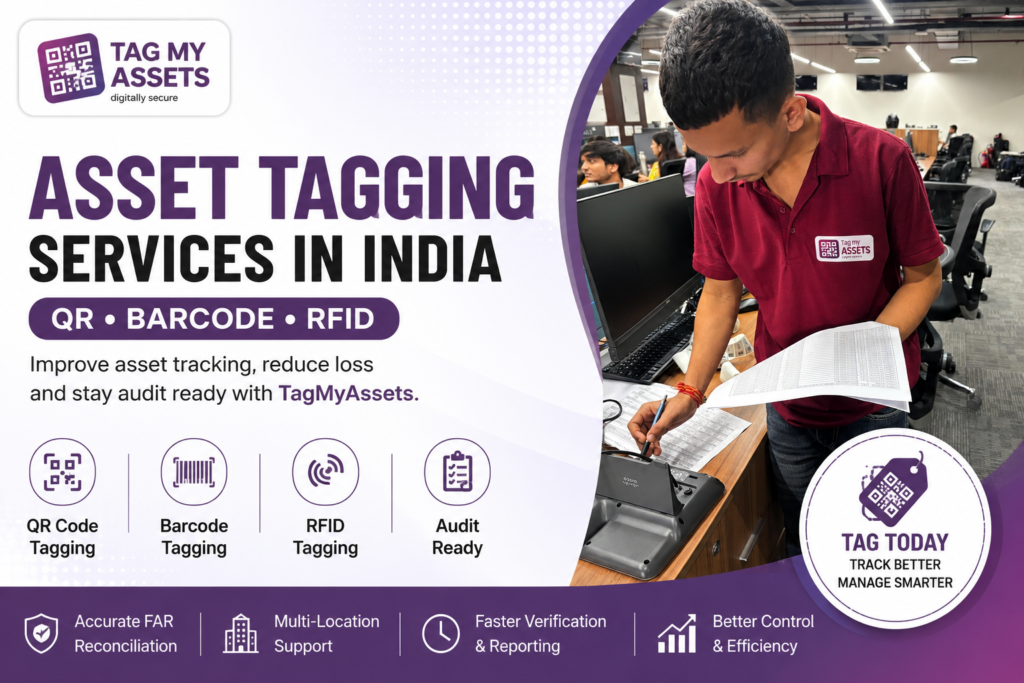
Professional asset tagging services using QR code, barcode, and RFID technology for physical asset verification and FAR reconciliation.
Types of Asset Tags Used
Asset tagging can be implemented using different technologies depending on asset type and environment.
QR Code Asset Tags
QR codes allow quick scanning using mobile devices and asset management apps.
Barcode Asset Tags
Barcodes are widely used for inventory and asset tracking in offices and warehouses.
RFID Asset Tags
RFID tags enable automated tracking of assets without direct scanning and are commonly used in large facilities.
QR Code vs Barcode vs RFID Asset Tags
Different asset tagging technologies are used depending on business requirements, asset type, and budget.
| Technology | Best Use | Benefits |
|---|---|---|
| QR Code Tags | Offices, retail stores, schools | Low cost, easy mobile scanning |
| Barcode Tags | Inventory and warehouse assets | Simple implementation and fast scanning |
| RFID Tags | Manufacturing plants and large enterprises | Bulk scanning, automation, no direct visibility required |
QR code asset tagging is ideal for most companies looking for cost-effective asset management, while RFID asset tagging is preferred for large-scale automation and high-speed tracking environments.
How Asset Tagging Helps During Audits
Professional asset tagging significantly improves audit accuracy and FAR reliability.
Benefits during audits include:
- Faster physical asset verification
- Accurate Fixed Asset Register (FAR)
- Improved traceability of assets
- Reduction in duplicate or ghost assets
- Easier depreciation mapping
- Better compliance with CARO 2020 and internal audit requirements
- Improved accountability for movable assets
Tagged assets help auditors quickly identify, verify, and reconcile assets during statutory audits and internal reviews.
Common Challenges in Asset Tagging Projects
Large-scale asset tagging projects often face operational and reconciliation challenges.
Inconsistent FAR Descriptions
Asset names in FAR may not match physically available assets.
Missing Assets
Some assets may be shifted, disposed, or unavailable during physical verification.
Non-Taggable Assets
Certain assets such as civil work, glass items, or very small assets may not be suitable for tagging.
Duplicate Asset Entries
Old FAR records may contain duplicate entries or incorrect capitalization.
Asset Location Mismatch
Assets are often physically found in locations different from their FAR mapping.
Damaged or Old Tags
Existing tags may become unreadable due to heat, dust, cleaning chemicals, or operational wear and tear.
Professional asset tagging companies use standardized verification methodologies and mobile-based scanning systems to overcome these challenges efficiently.
Benefits of Asset Tagging Services
Professional asset tagging provides multiple operational and financial benefits:
• Accurate Fixed Asset Register (FAR)
• Faster physical verification during audits
• Reduced asset loss and theft
• Improved maintenance tracking
• Better compliance with financial regulations
• Real-time asset visibility
Companies that implement asset tagging often experience improved operational efficiency and better asset control.
Industries That Use Asset Tagging
Asset tagging is widely used across industries:
• Manufacturing Plants
• Hospitals and Healthcare Facilities
• Corporate Offices
• Warehouses and Logistics Companies
• Retail Chains and Stores
• Educational Institutions
Each industry benefits from improved asset visibility and faster verification.
Asset Tagging Process Followed by Professional Service Providers
A professional asset tagging project usually follows a structured process to ensure accurate asset identification and reporting.
1. Asset Identification
All physical assets at the client location are identified and mapped with the fixed asset register or inventory list.
2. Asset Data Collection
Important details such as asset name, serial number, location, department, and user details are collected and verified during the tagging process.
3. Tag Printing and Application
Unique QR code, barcode, or RFID asset tags are printed and physically affixed to each asset. Industrial-grade labels are used to ensure durability.
4. Asset Scanning and Verification
Each tagged asset is scanned using asset management software or mobile applications to link the physical asset with the digital asset register.
5. Asset Register Creation
After tagging and verification, a structured asset register is created containing asset ID, location, ownership details, and tagging information.
6. Audit and Compliance Reporting
Organizations receive detailed asset verification reports that help in statutory audits, internal audits, and compliance reviews.
This systematic approach ensures that companies maintain an accurate asset database and improve visibility of physical assets across locations.
Industries That Benefit Most from Asset Tagging
Asset tagging services are especially valuable for organizations managing large volumes of equipment and infrastructure.
Industries that frequently implement asset tagging include manufacturing plants, hospitals, corporate offices, warehouses, logistics companies, retail chains, educational institutions, and IT companies.
These industries depend on accurate asset data for financial reporting, asset maintenance, and operational planning.
With proper tagging and verification, organizations can maintain a reliable asset register and reduce operational risks associated with missing or untracked assets.
Why Choose Professional Asset Tagging Services?
Professional asset tagging companies provide:
• Durable asset labels (QR, barcode, RFID)
• On-site asset verification and tagging
• Digital asset register creation
• Asset management dashboards
• Audit-ready asset reports
These services ensure organizations maintain complete control over their assets while improving compliance and reporting accuracy.
5️⃣ FAQ
What is asset tagging?
Asset tagging is the process of attaching identification labels such as QR codes, barcodes, or RFID tags to physical assets to track and manage them.
Why is asset tagging important for businesses?
Asset tagging helps organizations maintain accurate asset records, reduce asset loss, simplify audits, and improve operational efficiency.
Which industries require asset tagging services?
Industries such as manufacturing, hospitals, corporate offices, warehouses, retail chains, and educational institutions commonly use asset tagging.
What types of asset tags are available?
Asset tags can include QR code labels, barcode labels, RFID tags, and metal asset tags for industrial environments.
What is the difference between QR code and RFID asset tagging?
QR codes require manual scanning using mobile devices, while RFID tags enable automated bulk scanning without direct visibility.
How long does an asset tagging project take?
Project timelines depend on asset quantity, number of locations, and FAR quality. Large multi-location projects may take several weeks.
Can asset tagging help during statutory audits?
Yes. Asset tagging improves physical verification efficiency, FAR reconciliation, and audit traceability during statutory and internal audits.
What information is captured during asset tagging?
Typical details include asset name, asset ID, tag number, location, department, photographs, GPS coordinates, and asset condition.
How much do asset tagging services cost in India?
Asset tagging cost depends on tag type, asset quantity, project locations, FAR quality, and technology used such as QR code or RFID.
Many organizations rely on asset verification services India to maintain accurate financial and physical records.
Conclusion
Asset tagging services help organizations improve asset visibility, simplify audits, strengthen FAR accuracy, and reduce asset loss. Whether using QR code, barcode, or RFID technology, professional asset tagging solutions improve operational control and support long-term asset management across multiple locations.
Companies across manufacturing, retail, healthcare, education, warehousing, and corporate sectors are increasingly adopting digital asset tagging services to improve compliance, traceability, and business efficiency.