
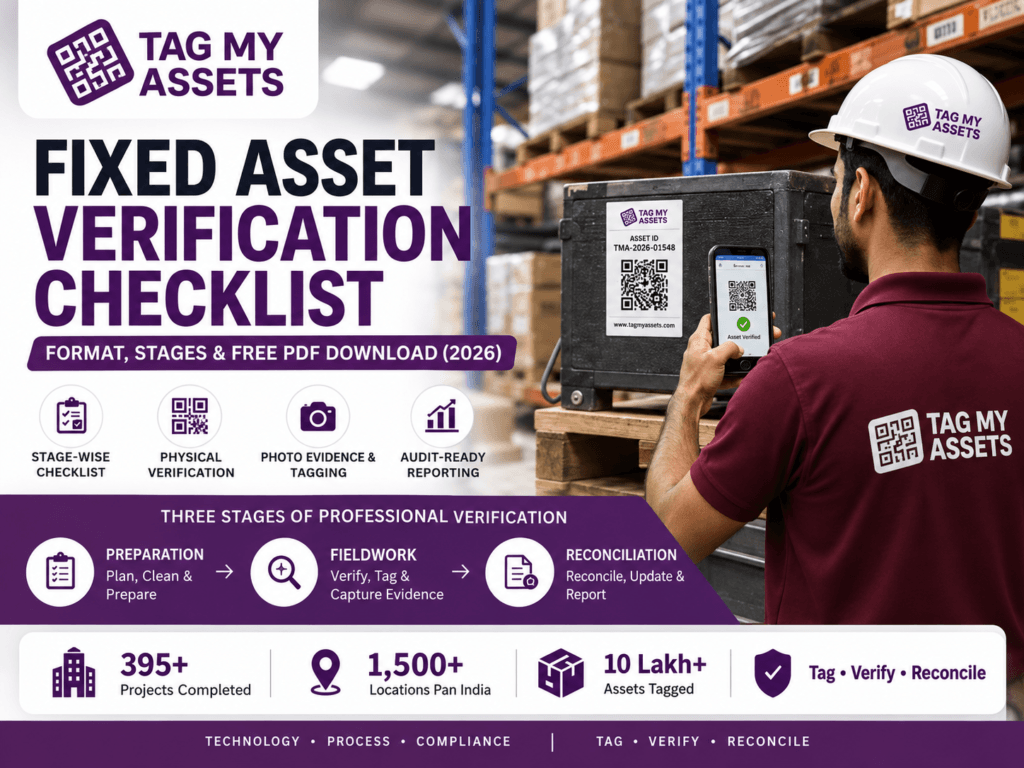
A fixed asset verification checklist — also called a fixed asset audit checklist — is a stage-wise list of the actions a company completes before, during and after physically verifying its fixed assets against the Fixed Asset Register (FAR). A good checklist covers three stages — preparation, fieldwork and reconciliation — and gives auditors documented evidence that verification was carried out systematically rather than as a year-end scramble.
The checklist below is written against CARO 2020, since that is the reporting framework for Indian companies. The verification steps themselves — cut-off, both-directions counting, exception classification, evidence retention — are the same wherever the register has to stand up to an auditor.
On this page you will find the full checklist used in professional verification exercises, organised by stage, along with a free downloadable PDF version you can print and use on the floor. It reflects the working approach we follow across verification engagements in India — 395+ projects, 1,500+ locations and over 10 lakh assets — and is suitable for statutory audit preparation under CARO 2020, internal audits and management reviews.
If you are new to the subject, read our complete guide to fixed asset verification first — it explains the process, methods and regulatory framework that this checklist operationalises.
Quick checklist
What a fixed asset audit checklist should include
Documents required before verification
Stage A: Preparation
Stage B: Fieldwork
Stage C: Reconciliation and reporting
Common issues found during verification
Download the checklist (free PDF)
Typical verification team size
Frequently asked questions
Quick Fixed Asset Verification Checklist
If you’re looking for a quick overview before reading the detailed stages, use this summary checklist.
☐ Verification scope finalised
☐ Cut-off date approved
☐ Fixed Asset Register extracted
☐ FAR cleaned and reviewed
☐ Site coordinators assigned
☐ Asset tags and scanners ready
☐ Sheet-to-floor verification completed
☐ Floor-to-sheet verification completed
☐ Photos captured for exception items
☐ Reconciliation completed
☐ FAR updated
☐ Final report issued
What a Fixed Asset Audit Checklist Should Include
Verification exercises fail for predictable reasons: the register was not cleaned before the count, transfers continued mid-exercise, field teams recorded data inconsistently, or exceptions were never reconciled into the books. A complete checklist prevents each of these by covering three stages:
- Stage A — Preparation: everything done before the field team arrives, from freezing the FAR to arranging site access.
- Stage B — Fieldwork: the physical verification itself, in both directions (sheet-to-floor and floor-to-sheet), with evidence capture.
- Stage C — Reconciliation and reporting: reconciliation of exceptions, approvals, FAR updates and the verification report.
The sections below list every item. Tick them off in order — the sequence matters.
Documents Required Before Fixed Asset Verification
| Document | Purpose |
|---|---|
| Fixed Asset Register (FAR) | Primary asset database |
| Asset Addition Register | Verify recent capitalisation |
| Asset Disposal Register | Confirm retired assets |
| Asset Transfer Register | Track movement between departments |
| Department Master | Verify custodian allocation |
| Location Master | Confirm physical locations |
| Floor Plans (if available) | Faster identification |
| Previous Verification Report | Compare earlier discrepancies |
Stage A: Preparation Checklist (Before the Field Team Arrives)
- Define the scope: locations, asset categories and any value threshold covered
- Fix the cut-off date for the exercise
- Extract the Fixed Asset Register from the ERP as on the cut-off date
- Freeze asset additions and disposals in the books for the exercise window
- Pause inter-unit and inter-department transfers, or route them through one coordinator
- Clean the FAR: flag duplicates, generic descriptions and grouped entries
- Map ERP location codes to actual physical areas (building / floor / room)
- Nominate a coordinator at every location
- Keep documents ready: additions and disposal registers, transfer records, floor plans, department and location masters
- Identify locked, restricted or inaccessible areas and arrange access approvals in advance
- Plan around operations: shutdown windows, shift timings and no-disturbance zones
- Arrange practical support: ladders, forklifts for high racking, safety gear for plant areas
- Decide the method — full count, sampling or cyclical — and record it in the fixed asset policy
- Prepare tagging stock (barcode / QR / RFID labels) and printers if untagged assets will be tagged
- Set up the mobile scanning application and test offline mode for low-connectivity areas
- Brief the field teams on formats, evidence requirements and escalation contacts
In our experience, weak preparation — especially an uncleaned register and unplanned access — is the most common reason verification exercises overrun their timelines.
Stage B: Fieldwork Checklist (During Physical Verification)
- Sheet-to-floor: physically locate every asset listed in the FAR — this tests existence
- Floor-to-sheet: trace every physical asset back to a FAR entry — this tests completeness
- Scan or record the asset tag number for each asset verified
- Tag assets found without identification, on the spot
- Photograph assets as evidence (at minimum, high-value and exception items)
- Capture serial numbers for IT and serialised equipment
- Record condition: in use / idle / under repair / scrapped
- Record the custodian, user or department for each asset
- Record the precise location: building, floor, room or bay
- Flag look-alike and grouped assets for finance review rather than guessing a match
- Confirm mobile and shared assets (laptops, vehicles, tools) through custodian confirmation
- Log inaccessible assets with the reason and supporting evidence
- Have each location sheet signed by the location coordinator
- Sync field data daily and track coverage against the plan
Verifying in both directions is what separates a complete verification from a simple count — the reasoning is explained in our physical verification of assets article.
Common Issues Found During Fixed Asset Verification
| Observation | Meaning | Recommended Action |
|---|---|---|
| Asset not found | Listed in FAR but physically unavailable | Investigate before writing off |
| Unrecorded asset | Found physically but absent in FAR | Verify purchase and capitalise if appropriate |
| Wrong location | Asset shifted without record | Update FAR location |
| Wrong custodian | User has changed | Update responsibility records |
| Missing asset tag | Asset exists but cannot be uniquely identified | Affix a new barcode, QR code or RFID tag |
| Duplicate FAR entry | Same asset recorded more than once | Review and correct the register |
Stage C: Reconciliation and Reporting Checklist
- Consolidate all field data into one dataset
- Match the verified data against the FAR line by line
- Classify every exception: not found / unrecorded / location mismatch / condition issue / identification gap
- Investigate each exception with supporting documents (invoices, transfer notes, disposal approvals)
- Propose treatment for each category: derecognise, capitalise, or update records
- Obtain management approval for all proposed adjustments
- Update the FAR with a documented audit trail
- Prepare the verification report: scope, methodology, summary, exceptions and evidence
- Share the report and reconciliation with the statutory or internal auditors
- Set the frequency for the next cycle and record it in the fixed asset policy
Stage C is where the books actually improve. The mechanics of resolving each exception category are covered in our FAR reconciliation guide.
Why This Checklist Works
A fixed asset verification exercise is only effective when every stage is completed in sequence. Proper preparation reduces delays during fieldwork, consistent verification improves data quality, and structured reconciliation ensures that discrepancies are resolved before updating the Fixed Asset Register. Following a documented checklist also provides stronger audit evidence for statutory auditors, internal auditors and management reviews.
Download the Checklist (Free PDF)
The complete checklist above is available as a printable, tick-box PDF for use during fieldwork. Print one copy per location, have the coordinator sign each completed sheet, and retain them as evidence for the audit file.
How to Use This Checklist
- Adapt the scope items (Stage A) to your company — a single office needs less planning than a ten-plant manufacturer.
- Assign an owner to every item; unowned checklist items are the ones that get skipped.
- Keep evidence as you go — signed sheets, photographs, exception logs. Auditors rely on evidence, not assurances.
- Do not skip Stage C. A count without reconciliation leaves the register exactly as inaccurate as before.
Checklist Format: PDF, Excel or Mobile App?
For small, single-location exercises, a printed PDF or an Excel version of this checklist works well. For multi-location or high-volume counts, mobile scanning applications replace paper: they capture the tag scan, photo, condition and location in one step and sync to a central dashboard, which shortens Stage C. The checklist stages remain the same regardless of format — the technology only changes how the data is captured.
Typical Verification Team Size
| Approximate Assets | Typical Team |
|---|---|
| Up to 500 | 2–3 verifiers |
| 500–2,000 | 3–6 verifiers |
| 2,000–10,000 | 5–15 verifiers |
| Above 10,000 | Scoped to locations |
*Team sizes assume these productivity rates — office furniture 100–150 assets per person per day, laptops and IT equipment 100–120, plant and machinery 80–100. Actual timelines depend on asset type, number of locations, accessibility and tagging status.
Frequently Asked Questions
What is a fixed asset verification checklist?
It is a stage-wise list of actions for physically verifying fixed assets against the Fixed Asset Register — covering preparation (scope, FAR freeze, access planning), fieldwork (two-directional verification, tagging, evidence capture) and closing (exception reconciliation, approvals and reporting).
What should a fixed asset verification checklist include?
At minimum: scope and cut-off definition, FAR extraction and cleaning, transfer freeze, sheet-to-floor and floor-to-sheet verification, tagging of unidentified assets, condition and custodian capture, exception classification, management-approved FAR updates and a final verification report.
Is there a prescribed checklist format under CARO 2020?
No. CARO 2020, clause 3(i)(b), requires auditors to report whether management verified Property, Plant and Equipment at reasonable intervals and dealt with material discrepancies — it does not prescribe a format. A documented, stage-wise checklist with signed evidence is how companies demonstrate that the requirement was met systematically.
How often should the verification checklist be used?
Each time a verification cycle runs. Movable assets such as IT equipment are commonly verified annually, while plant and machinery are often covered every two to three years or on a rolling location-wise cycle. The frequency should be recorded in the fixed asset policy.
Can I use Excel instead of a PDF checklist?
Yes. The stages and items are identical — Excel simply makes consolidation easier for small exercises. For large or multi-location counts, mobile scanning applications are generally used instead of both, because they capture scans, photos and locations in a single step.
Can fixed asset verification be performed without asset tags?
Yes. Physical verification can be performed without barcode, QR code or RFID tags, but identification becomes slower and more prone to errors, particularly where similar assets exist. Asset tags improve traceability, reduce duplicate records and make future verification exercises faster.
TagMyAssets conducts fixed asset verification, tagging and FAR reconciliation across India — 395+ projects, 1,500+ locations and 10 lakh+ assets across manufacturing, laboratories, retail, warehousing, education and corporate offices. To discuss a verification exercise, write to connect@tagmyassets.com. For the regulatory background, see our CARO 2020 fixed asset verification requirements article.