
The FAR reconciliation process is an essential step for organisations that want to maintain accurate asset records and ensure audit compliance. However, many organisations face discrepancies between their asset records and the actual assets available on site.
To resolve these issues, companies conduct a FAR reconciliation process, which involves matching the Fixed Asset Register with physically verified assets.
This process helps organisations identify missing assets, duplicate records, incorrect locations, and outdated asset information.
Need this done by professionals? TagMyAssets executes FAR reconciliation across India — field verification, tagging and audit-ready reconciled registers. Explore our professional FAR reconciliation services
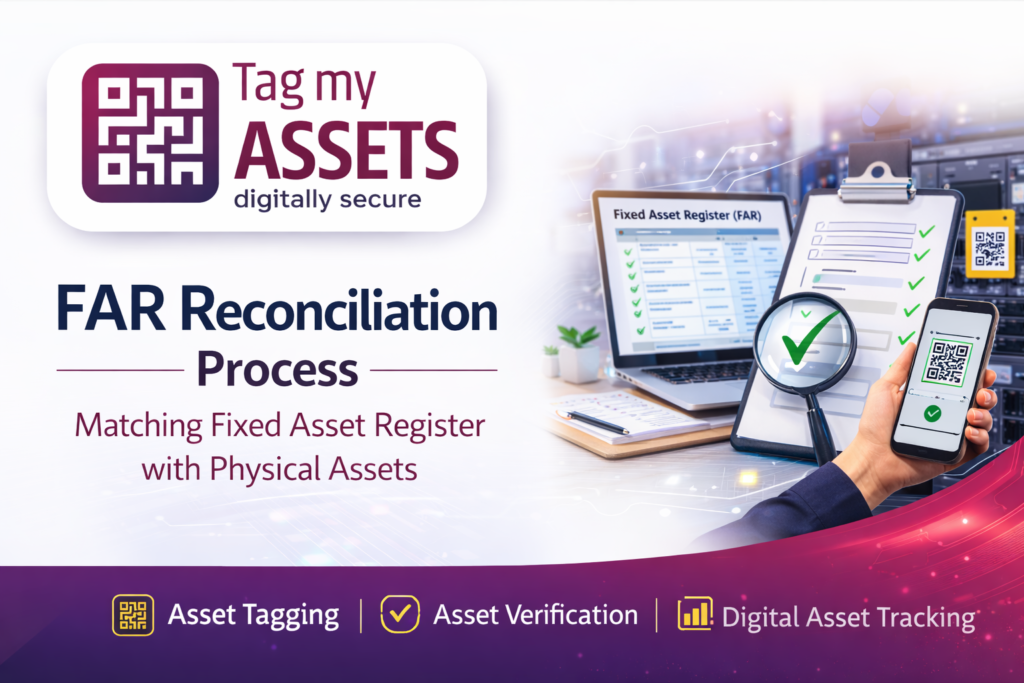
FAR reconciliation matches the Fixed Asset Register against physically available assets. For the full concept — why registers drift, common causes and compliance context — see our complete FAR reconciliation guide. This article focuses on how the process actually works, step by step.
During the FAR reconciliation process, organisations typically discover several discrepancies.
These may include:
- Assets recorded in FAR but not physically available
- Assets present physically but missing in FAR
- Incorrect asset locations
- Duplicate asset entries
- Obsolete or damaged assets still recorded as active
Identifying these discrepancies helps organisations clean up their asset records.
Common FAR Issues We Identify During Reconciliation
During reconciliation exercises, we most frequently identify:
- Unrecorded Assets
- Ghost Assets
- Duplicate Assets
- Incorrect Asset Locations
- Parent-Child Mapping Issues
- Incorrect Asset Descriptions
- Missing Assets
TagMyAssets FAR Reconciliation Methodology
1. FAR Collection & Data Review
Review existing FAR, asset descriptions, locations, categories, quantities, and historical records.
2. FAR Sanitization & Asset Classification
Classify assets into:
- Taggable Assets
- Countable Assets
- Non-Taggable Assets
- Non-Auditable Assets
3. Physical Verification (Sheet-to-Floor / Floor-to-Sheet)
Verify assets physically across all locations and capture actual asset details.
4. Asset Tagging & Identification
Apply QR Code, Barcode, or RFID tags where required.
5. FAR Reconciliation & Variance Analysis
Identify:
- Ghost Assets
- Missing Assets
- Additional Assets
- Duplicate Assets
- Incorrect Locations
- Parent-Child Mapping Issues
6. FAR Updation & Data Correction
Update asset records based on verified information.
7. Audit-Ready Reporting & Management MIS
Submit:
- Reconciled FAR
- Variance Report
- Additional Asset Report
- Missing Asset Report
- Executive Summary
Role of Asset Tagging in FAR Reconciliation
Asset tagging plays an important role in simplifying the FAR reconciliation process.
Using QR codes, barcodes, or RFID tags, organisations can easily identify assets during verification and maintain accurate asset records.
Digital asset management systems allow companies to update asset information instantly during the reconciliation process.
Common Challenges in FAR Reconciliation Projects
Many organisations face practical challenges while conducting FAR reconciliation exercises, especially when assets are spread across multiple locations.
1. Incomplete Fixed Asset Registers
Many FARs contain incomplete asset descriptions, missing serial numbers, incorrect locations, or outdated asset categories, making reconciliation difficult.
2. Large Asset Volumes
Manufacturing plants, hospitals, retail chains, and corporate offices may have thousands of assets spread across multiple departments and locations.
3. Asset Movement Without Documentation
Assets are frequently transferred between departments, branches, or locations without proper updates in the Fixed Asset Register.
4. Parent–Child Asset Mapping Issues
Complex assets consisting of multiple components often create reconciliation challenges when parent and child assets are not properly recorded.
5. Duplicate Capitalisation
The same asset may sometimes be capitalised more than once due to data migration errors or inadequate controls.
6. Legacy Asset Records
Older assets may remain in the register despite being disposed of, scrapped, or replaced years earlier.
A structured FAR reconciliation process supported by physical verification and asset tagging helps organisations overcome these challenges and maintain accurate asset records.
Conclusion
The FAR reconciliation process is an essential step for organisations that want to maintain accurate asset records and ensure audit compliance.
By combining physical verification, asset tagging, and digital asset management systems, companies can resolve discrepancies and improve asset control. Learn more about how companies implement
asset verification services India for accurate asset tracking and reporting.
For end-to-end execution — verification, tagging and reconciled reporting — see our asset reconciliation services.Frequently Asked Questions (FAQs)
What is the difference between FAR Reconciliation and Asset Tagging?
Asset Tagging involves assigning a unique identification number to each asset using QR codes, barcodes, or RFID tags. FAR Reconciliation involves matching physically verified assets with the Fixed Asset Register and correcting discrepancies between records and actual assets.
How often should FAR Reconciliation be performed?
Most organizations should conduct FAR Reconciliation at least once a year. Companies with multiple locations, large asset bases, or frequent asset movements may benefit from more frequent reconciliation exercises.
What are Ghost Assets in a Fixed Asset Register?
Ghost Assets are assets that continue to appear in the Fixed Asset Register even though they are no longer physically available due to disposal, transfer, loss, obsolescence, or record-keeping errors. These assets can lead to inaccurate financial reporting and audit observations.
What documents are required for FAR Reconciliation?
Typically, the following documents are required:
Fixed Asset Register (FAR)
Asset purchase records
Asset transfer records
Disposal records
Location-wise asset lists
Previous asset verification reports (if available)
Can QR Code or RFID Asset Tagging improve FAR accuracy?
Yes. QR Code and RFID Asset Tagging improve asset traceability and identification, making it easier to conduct physical verification, track asset movement, and maintain an accurate Fixed Asset Register.
What are the common discrepancies found during FAR Reconciliation?
Some of the most common discrepancies include:
Ghost Assets
Missing Assets
Duplicate Asset Records
Incorrect Asset Locations
Incorrect Asset Descriptions
Parent-Child Mapping Issues
Unrecorded Capitalized Assets
Quantity Mismatches
Which industries require FAR Reconciliation services?
FAR Reconciliation services are commonly required by manufacturing companies, retail chains, hospitals, educational institutions, warehouses, logistics companies, IT organizations, financial institutions, and multi-location businesses.
What are the deliverables of a FAR Reconciliation project?
Typical deliverables include:
Reconciled Fixed Asset Register
Variance Report
Missing Asset Report
Additional Asset Report
Asset Tagging Report
Location-wise Asset Register
Management Information Summary (MIS)
Audit-Ready Documentation