
Asset tagging for insurance claims helps companies prove asset existence, ownership, location, and value during fire, theft, flood, or damage events. With verified asset registers, businesses can speed up insurance settlements and reduce claim disputes. Asset tagging for insurance claims helps companies maintain verified asset registers that insurers can quickly validate during damage assessment or claim verification.
When companies suffer losses due to fire, theft, flood, equipment failure, or natural disasters, the biggest challenge is often proving the existence and value of damaged assets to the insurance company.
Many organizations struggle to provide accurate documentation during insurance claims because their asset records are incomplete, outdated, or missing altogether.
This is where asset tagging and verified asset registers become extremely important.To understand asset tagging in detail, read our complete guide on asset tagging.
With QR code asset tagging, barcode tagging, or RFID tagging, companies can maintain a verified digital record of all assets, which significantly speeds up insurance claim processing and settlement.
Guidelines issued by the Institute of Chartered Accountants of India also emphasize the importance of maintaining accurate fixed asset registers and proper documentation for audit, compliance, and financial reporting purposes.
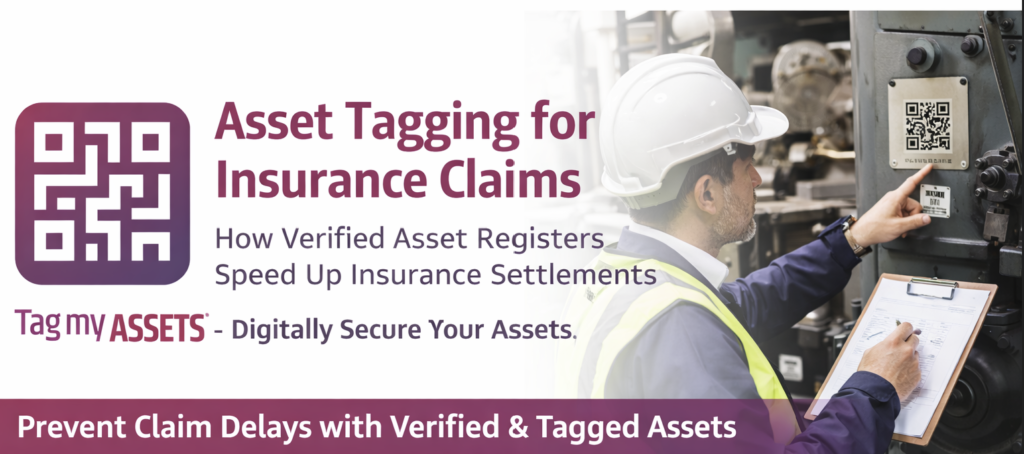
Why Asset Tagging for Insurance Claims Matters
Insurance companies require clear evidence of asset ownership, value, and existence before approving claims.
However, many businesses face the following problems:
• Missing asset records
• Incomplete fixed asset register (FAR)
• Lack of purchase details
• No proof of asset location
• Difficulty identifying damaged assets
• Disputes over asset quantity or valuation
Without a verified asset register, insurance companies may delay or even reject claims. Asset tagging for insurance claims gives insurers, auditors, and surveyors a clear and verified record of tagged assets, which helps speed up claim validation and settlement.
Without asset tagging for insurance claims, many organizations struggle to prove asset ownership, purchase value, and location during insurance investigations.
What is Asset Tagging?
Asset tagging is the process of attaching a unique identification label to each asset in an organization.
These tags may include:
• QR Code Tags
• Barcode Labels
• RFID Tags
• Metal Asset Tags for heavy equipment
Each asset tag is linked to a centralized digital asset database containing important information such as:
• Asset Name
• Serial Number
• Purchase Date
• Asset Location
• Department / Employee
• Asset Value
• Photographic Evidence
This creates a verified and traceable asset register.
Why Asset Tagging for Insurance Claims Is Important
1. Proof of Asset Existence
Insurance companies need confirmation that the asset actually existed before the loss event.
Tagged assets provide:
• Unique asset ID
• Physical tag attached to equipment
• Digital records in the asset register
This acts as strong proof during claim verification.
2. Accurate Asset Valuation
Asset registers maintain purchase value and depreciation records, which help determine the insured value of assets.
This prevents disputes between the insured company and the insurance provider.
3. Faster Asset Identification After Damage
After events like fire or flooding, identifying damaged assets becomes difficult.
However, QR or metal asset tags often survive, making it easier to:
• Identify equipment
• Verify asset ownership
• Match assets with register records
This significantly speeds up claim assessments.
4. Easier Documentation for Insurance Surveyors
Insurance surveyors require detailed asset documentation during claim investigation.
With a digitally maintained asset register, companies can instantly provide:
• Asset lists
• Location details
• Asset photographs
• Purchase invoices
• Depreciation records
This reduces manual paperwork and delays.
5. Reduced Fraud and Disputes
Insurance companies are cautious about fraudulent claims.
Asset tagging ensures:
• Each asset has a unique identity
• Records are verified during physical verification
• Assets are traceable to their location
This increases transparency and trust during insurance settlements.
Industries Where Asset Tagging Helps in Insurance Claims
Asset tagging is especially useful in industries with high-value physical assets, such as:
• Manufacturing Plants
• Corporate Offices
• Hospitals and Medical Equipment Facilities
• Warehouses and Logistics Centers
• Hotels and Hospitality Industry
• Retail Chains and Showrooms
• Data Centers and IT Infrastructure
In these industries, accurate asset records are essential for insurance compliance.
Role of Physical Asset Verification
Asset tagging alone is not enough.
Organizations must also conduct periodic physical verification of fixed assets to ensure the asset register remains accurate.
Physical verification helps:
• Identify missing assets
• Update asset location changes
• Verify asset condition
• Maintain audit-ready asset registers
This makes the insurance claim process much smoother.
How TagMyAssets Helps Companies Maintain Insurance-Ready Asset Registers
TagMyAssets provides end-to-end asset tagging and verification services across India.
Our services include:
• QR Code and Barcode Asset Tagging
• Metal Tags for Industrial Assets
• RFID Asset Tracking Solutions
• Fixed Asset Physical Verification
• Digital Asset Register Creation
• Asset Tracking Mobile Applications
With accurate asset records and digital verification, companies can maintain insurance-ready asset registers at all times.
For companies managing machinery, IT assets, furniture, medical equipment, and plant assets, asset tagging for insurance claims is a practical way to improve documentation and reduce claim delays.
Conclusion
Insurance claims can become complicated and time-consuming when asset records are incomplete or unverified.
By implementing asset tagging and maintaining a verified asset register, organizations can:
• Prove asset ownership easily
• Provide accurate documentation
• Reduce claim disputes
• Speed up insurance settlement
For businesses managing thousands of assets, asset tagging is not just an operational tool — it is a critical risk management strategy.
FAQs
Why is asset tagging important for insurance claims?
Asset tagging provides proof of asset existence, identification, and valuation, which helps insurance companies process claims faster.
Can QR code asset tags survive fire or damage?
Metal QR tags or industrial asset tags are designed to withstand harsh environments and may remain identifiable even after damage.
What information should an asset register contain for insurance purposes?
An insurance-ready asset register should include asset name, tag number, purchase details, value, location, department, and photographs.
How often should asset verification be conducted?
Most companies conduct physical verification once a year or once every two years to maintain accurate asset registers.
How does asset tagging help insurance claims?
Asset tagging for insurance claims ensures every asset has a unique identification tag, location record, and documented value, which helps insurance surveyors verify claims faster.