
Introduction
Asset tagging implementation plan for multi-location companies is essential for organizations operating across plants, warehouses, retail stores, or offices. Without a structured approach, companies face asset loss, audit issues, and inaccurate records.
Without a structured approach, companies face:
- Asset duplication or missing records
- Audit discrepancies
- Poor asset visibility
- Financial losses due to asset leakage
This is where a well-defined asset tagging implementation plan becomes critical. A proper asset tagging implementation plan for multi-location companies ensures consistency.
In this guide, we provide a step-by-step asset tagging implementation plan for multi-location companies, based on real execution experience across India.
Why Every Company Needs an Asset Tagging Implementation Plan for Multi-Location Companies
An asset tagging implementation plan for multi-location companies is not just an operational requirement—it is a strategic necessity for organizations managing assets across multiple sites. Without a structured plan, companies often struggle with inconsistent data, asset misplacement, and audit discrepancies.
In multi-location environments such as manufacturing plants, retail chains, warehouses, and corporate offices, maintaining a centralized and accurate Fixed Asset Register (FAR) becomes extremely challenging. Each location may follow different processes, leading to duplication, missing assets, or incorrect reporting.
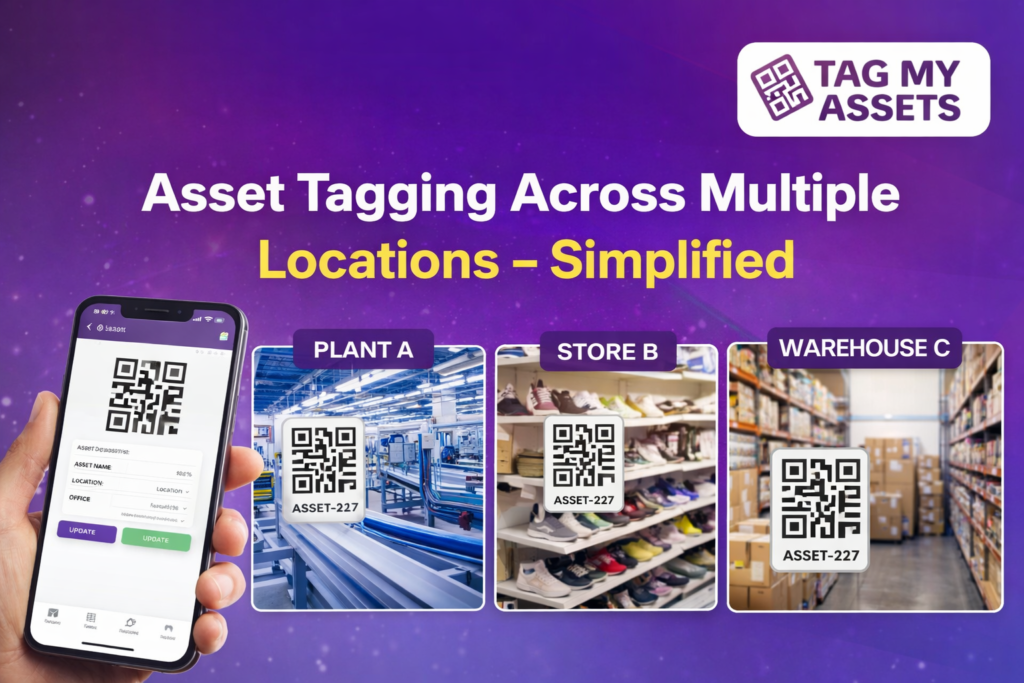
A well-defined asset tagging implementation plan for multi-location companies ensures that all locations follow standardized procedures for asset identification, tagging, and tracking. It enables real-time visibility of assets, improves accountability, and significantly reduces the risk of asset leakage.
Moreover, such a plan helps organizations streamline audits by providing accurate, location-wise asset data. With the integration of technologies like QR codes and mobile-based tracking systems, companies can monitor assets efficiently without relying on manual or Excel-based processes.
Ultimately, implementing a structured asset tagging implementation plan for multi-location companies leads to better financial control, improved operational efficiency, and stronger compliance with audit and regulatory requirements.
Why Asset Tagging Fails in Multi-Location Companies
Before jumping into implementation, it’s important to understand common failures:
- ❌ No standardized tagging format across locations
- ❌ Inconsistent FAR data
- ❌ Lack of centralized monitoring
- ❌ Manual processes (Excel-based tracking)
- ❌ No pilot testing before full rollout
👉 Result: Even after tagging, data remains unreliable.
Step 1: FAR Cleanup Before Tagging (Critical Step)
The biggest mistake companies make is starting tagging without cleaning their FAR.
What to do:
- Remove duplicate assets
- Identify non-taggable items (e.g., consumables, loose tools)
- Standardize asset naming conventions
- Map assets location-wise
👉 This ensures:
- Faster tagging
- Accurate reconciliation
- Reduced project cost
🔗 Recommended Read:
https://tagmyassets.com/pre-tagging-data-cleanup-far-asset-tagging/
Step 2: Define Tagging Scope & Standardization
In multi-location environments, standardization is everything.
Define:
- Tag format (QR / Barcode / RFID)
- Tag size & material (Polyester, Metal, RFID tags)
- Asset categories to be tagged
- Data fields to capture
👉 Example:
- Asset Name
- Location
- Department
- Serial Number
- Asset Category
Consistency across all locations is non-negotiable.
Step 3: Pilot Execution (Highly Recommended)
Never start with all locations.
Start with:
- 1 plant / 1 warehouse / 2–3 retail stores
Why pilot is important:
- Identify process gaps
- Test manpower planning
- Validate FAR accuracy
- Optimize tagging speed
👉 This is a game-changing step most companies ignore.
Step 4: Technology Setup (Mobile App + Cloud System)
Modern asset tagging is not just about stickers.
Essential technology stack:
- Mobile-based scanning application
- QR code tagging system
- Cloud-based database
- Real-time reporting dashboard
Key features:
- Scan & update asset details
- Capture images
- Geo-tagging (location tracking)
- Live sync across locations
👉 Avoid:
- Excel-based tracking ❌
- Manual entry ❌
Step 5: Manpower Planning & Execution Strategy
Multi-location projects require structured deployment.
Planning factors:
- Number of assets per location
- Tagging speed (100–150 assets per person per day for office furniture, 100–120 for laptops and IT equipment, 80–100 for plant and machinery)
- Travel & logistics
- Store/plant working hours
Best practice:
- Deploy parallel teams across locations
- Cluster nearby locations
👉 Example:
- 10-member team → 5 locations simultaneously
Step 6: Centralized Monitoring & Control
Without central monitoring, multi-location projects fail.
What you need:
- Daily progress tracking
- Location-wise dashboards
- Exception reporting
- Real-time issue resolution
👉 Head office should track:
- Assets tagged
- Pending assets
- Not found assets
- Data mismatches
Step 7: Reconciliation & Final Reporting
This is where actual value is created.
Final deliverables:
- Updated Fixed Asset Register (FAR)
- Tag-wise asset database
- Location mapping report
- Exception report:
- Not found assets
- Excess assets
- Assets at different locations
👉 This becomes audit-ready documentation
Centralized vs Decentralized Execution – What Works Best?
| Approach | Result |
|---|---|
| Decentralized (each location independent) | ❌ Inconsistent data |
| Centralized control with local execution | ✅ Best results |
👉 Always follow:
Centralized strategy + Local execution
Common Mistakes to Avoid
- Starting tagging without FAR cleanup
- Tagging everything (including non-taggable items)
- No pilot execution
- Lack of technology integration
- No centralized reporting
Real-Life Insight (From Multi-Location Projects)
In large-scale projects:
- 20–30% assets are often non-taggable
- FAR inaccuracies can go up to 15–25%
- Without pilot → project delays increase by 30%+
👉 Proper planning saves time, cost, and audit risk. Asset tagging implementation plan for multi-location companies helps standardize processes.
Asset Tagging Timeline for Multi-Location Companies
Typical timeline:
- Small projects (1–2 locations): 1–2 weeks
- Medium (5–10 locations): 3–6 weeks
- Large (50+ locations): 2–3 months
Depends on:
- Asset volume
- Team size
- Travel logistics
How TagMyAssets Helps Multi-Location Companies
At TagMyAssets, we specialize in large-scale asset tagging projects across India.
Our approach:
- FAR Cleanup (Sheet-to-Floor / Floor-to-Sheet)
- Pilot-based implementation
- Mobile app-based data capture
- Real-time dashboard tracking
- QR & RFID tagging solutions
Key advantage:
- No dependency on Excel
- Fully digital, audit-ready system
Conclusion
Implementing asset tagging across multiple locations is complex — but with the right plan, it becomes structured, scalable, and highly effective. This asset tagging implementation plan for multi-location companies is essential for any organization aiming for scalability and audit readiness.
👉 The key is:
- Preparation
- Standardization
- Technology
- Centralized control
A well-executed implementation not only improves asset visibility but also strengthens financial accuracy and audit readiness.
Without a defined asset tagging implementation plan for multi-location companies, execution fails.
FAQs
1. What is the best method for multi-location asset tagging?
A centralized approach with mobile-based technology and standardized tagging formats works best.
2. Should we tag all assets?
No, only taggable and high-value assets should be included.
3. How long does multi-location tagging take?
It depends on asset volume and number of locations, typically 2–12 weeks.
4. Is Excel sufficient for asset tracking?
No, Excel-based systems fail in multi-location environments.