
FAR reconciliation is the process of matching the physical findings from an asset verification exercise against the entries in the Fixed Asset Register to identify discrepancies — missing assets, unrecorded additions, ghost assets, and valuation mismatches. It is the step that turns a physical count into an actionable audit input. TagMyAssets provides asset reconciliation services that match your physically available assets with the Fixed Asset Register (FAR), identify ghost, missing, unrecorded and duplicate assets, and deliver a clean, audit-ready reconciled register. Our field teams conduct sheet-to-floor and floor-to-sheet verification, asset tagging and exception analysis across India — 395+ projects, 1500+ locations, and 10 lakh+ assets tagged.
Fixed asset reconciliation services in India help companies detect ghost assets, fix Fixed Asset Register (FAR) errors, and give management the evidence to respond to audit observations.
Suppose your Fixed Asset Register says you own 3,200 assets — and your auditor can only find 2,800.
That gap is not just an accounting problem. It is costing your company depreciation calculated on assets that no longer exist, insurance premiums paid on scrapped machinery, and audit observations that delay closure for weeks.
Many Indian organizations discover during statutory audit, CARO review, ERP migration, merger integration, insurance renewal, or internal control assessments that their Fixed Asset Register (FAR) no longer reflects physical reality.
Assets appearing in books cannot be located, disposed assets continue depreciating, transferred assets remain mapped to old locations, and ERP migrations carry duplicate records forward for years.
These discrepancies create:
- Wrong depreciation
- Inflated gross block
- Insurance valuation gaps
- Weak asset controls
- Audit observations
- Delayed audit closure
- Overstated asset values
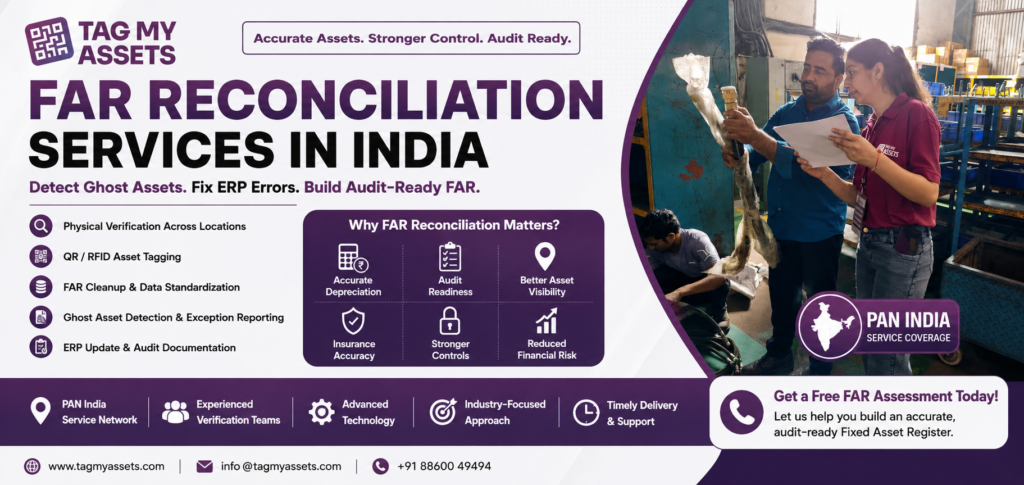
What Our Asset Reconciliation Services Include
Every TagMyAssets reconciliation engagement covers:
✓ FAR extraction from ERP systems
✓ Data cleanup and standardization
✓ Physical verification across locations
✓ QR / RFID tagging where required
✓ Exception reporting and management review
✓ Corrected FAR data prepared for ERP upload
✓ Audit documentation
The outcome is simple: a register your auditors, insurers and finance team can rely on — backed by physical evidence for every line.
Common FAR Problems We Find in the Field
| Challenge | Symptom | Audit / Financial Risk |
|---|---|---|
| Ghost assets | Assets in FAR cannot be located | Inflated balance sheet |
| Missing assets | Physical assets absent from FAR | Insurance gaps |
| Duplicate records | Same asset repeated | Excess depreciation |
| ERP mismatch | Legacy inconsistency | Audit observations |
| Wrong location | Transfers not updated | Weak controls |
| Misclassification | Wrong useful life | Depreciation errors |
| Unverified assets | No evidence | Open audit issues |
What Ghost Assets Actually Cost Your Company
Most finance teams think ghost assets are just an accounting issue. They are not. Here is the real financial impact:
| Cost Area | How Ghost Assets Hurt You |
|---|---|
| Depreciation | You calculate and report depreciation on assets that no longer exist, overstating expenses |
| Insurance | You pay premiums on scrapped or missing assets, inflating your annual insurance cost |
| Tax | Incorrect depreciation affects your taxable income and deferred tax calculations |
| Audit | Auditors flag PPE discrepancies under CARO 2020, leading to observations and delays |
| Capital Planning | Management makes replacement decisions based on incorrect asset data |
Fixed Asset Reconciliation Services and Audit Compliance
FAR reconciliation is not merely an operational exercise; it directly supports compliance with accounting standards, statutory audit requirements, and government asset documentation expectations.
Under CARO 2020 Clause 3(i), auditors assess whether organizations maintain proper Property, Plant and Equipment (PPE) records, conduct physical verification at reasonable intervals, and address material discrepancies.
Weak FAR quality often increases:
- Auditor queries
- Exception reporting
- Audit closure delays
- Additional management explanations
Similarly, Ind AS 16 requires derecognition of PPE when future economic benefit is no longer expected. Ghost assets continuing in FAR despite disposal or non-existence therefore create compliance concerns.
Where FAR errors are material and relate to prior periods, Ind AS 8 may require restatement, carrying broader financial reporting implications.
For government organizations and PSUs, GFR 2017 emphasizes periodic physical verification and reconciliation with account books.
Accurate FAR records supported by physical evidence reduce audit risk and improve confidence in asset reporting.
How We Reconcile Your Assets
Every engagement follows the same structured method: FAR extraction from your ERP (SAP, Oracle, Tally, Dynamics or others), data cleanup and standardisation, sheet-to-floor and floor-to-sheet physical verification, QR/RFID tagging where required, exception classification, and a management-approved reconciled register with supporting evidence.
For the complete step-by-step walkthrough — what happens at each stage, the documents required, and the discrepancy types each step uncovers — see our detailed FAR reconciliation process guide.
Typical Fixed Asset Reconciliation Deliverables
Clients generally receive:
- ✓ Verified asset register
- ✓ Ghost asset report
- ✓ Missing asset report
- ✓ Exception report
- ✓ Updated FAR
- ✓ Tagged asset database
- ✓ Audit documentation
- ✓ Photographic evidence
- ✓ Management approval trail
Fixed Asset Reconciliation After ERP Migration
ERP migration is among the most common causes of FAR inaccuracies.
Common issues:
- Duplicate records
- Wrong useful life
- Missing locations
- Test entries
- Legacy mapping errors
Examples:
Legacy ERP → SAP
SAP → Oracle
Oracle → Dynamics
Structured FAR reconciliation prevents these issues from compounding.
Example Engagement
In a multi-location manufacturing engagement, client anonymised, our teams reconciled a Fixed Asset Register of 19,134 recorded assets, physically verified 10,112 assets across locations, and identified variances exceeding ₹10.5 lakh — documented in exception reports for management review and action.
The earlier FAR reconciliation is done, the lower the cost of correction.
Industries and Their FAR Challenges
Manufacturing
Manufacturing organizations with multi-plant operations face FAR challenges driven by machinery transfers, shutdown assets, and duplicate capitalization. FAR reconciliation often involves verification across plants, maintenance yards, and tool stores.
Retail Chains
Store closures, renovations, and fixture transfers create ghost assets and wrong-location records. FAR reconciliation improves asset visibility across the retail estate.
Laboratories
Laboratory equipment such as HPLC systems, spectrometers, incubators, centrifuges and cold storage units requires careful FAR matching, with serial numbers and calibration records verified against the register.
Warehousing & Logistics
Warehousing operations involve forklifts, scanners, racks, and handling equipment that frequently move across facilities. FAR reconciliation improves location tracking and reduces verification effort.
Organizations operating multiple warehouses benefit from stronger asset visibility and reduced ghost asset risk.
Public Sector Undertakings (PSUs)
PSUs operate under GFR 2017, requiring periodic physical verification and stronger documentation standards. FAR reconciliation improves compliance, documentation quality, and audit readiness.
Corporate Offices
Corporate office environments manage laptops, desktops, servers, printers, furniture, and IT infrastructure that frequently move between departments or employees.
Hybrid work arrangements and employee exits have increased the challenge of maintaining accurate asset records.
FAR reconciliation improves accountability by identifying assets that are incorrectly mapped, no longer available, or require disposal.
Why Companies Choose TagMyAssets for FAR Reconciliation Services
TagMyAssets supports PAN India FAR reconciliation projects across manufacturing plants, retail chains, warehouses, PSUs, and corporate offices.
Our teams combine:
✓ Physical verification
✓ QR / RFID tagging
✓ FAR cleanup
✓ ERP reconciliation
✓ Audit documentation
✓ Multi-location execution
Supported ERP environments:
SAP | Oracle | Tally | Dynamics | Custom ERP
Projects range from single-location verification to multi-state engagements covering thousands of assets, depending on FAR quality and complexity.
Our approach emphasizes:
✓ Physical evidence
✓ Exception reporting
✓ Management approvals
✓ Audit readiness
✓ Future verification support
Frequently Asked Questions
What Are Fixed Asset Reconciliation Services?
Fixed asset reconciliation services are typically engaged before statutory audits, after ERP migrations, or during mergers — the service covers FAR extraction, physical verification, matching, and variance resolution with management approvals
How often should Fixed Asset reconciliation be performed?
Annual FAR reconciliation is common and generally aligns with expectations around periodic physical verification.
Additional reconciliation cycles are recommended after:
- ERP migration
- Mergers
- Restructuring
- Plant expansion
- Long periods without verification
Organizations delaying reconciliation often discover larger discrepancies.
Will Fixed Asset reconciliation improve audit readiness?
Yes. FAR reconciliation improves audit readiness by ensuring accounting records accurately reflect physical assets available within the organization.
Evidence-backed FAR reduces auditor queries and accelerates audit closure.
Is RFID tagging necessary?
Not always. QR code tagging is sufficient for many office, retail, hospital, and corporate environments and is generally more economical.
RFID becomes useful where asset movement and verification speed matter.
What happens after ERP migration?
ERP migration frequently introduces duplicate records, inactive asset IDs, missing location codes, and incorrect categorization.
Structured FAR reconciliation identifies and corrects these discrepancies before they accumulate.
What is the difference between Fixed Asset reconciliation and physical verification?
Physical verification confirms whether assets exist physically.
FAR reconciliation compares physical findings against accounting records and resolves discrepancies required to create an accurate, audit-ready FAR.
How much do asset reconciliation services cost in India?
Pricing depends on the number of assets, locations and scope (verification only, or verification plus tagging and reconciliation). Most engagements are priced per asset or per location. Share your FAR size and location count and we will come back with a scoped estimate.
Conclusion: Why Fixed Asset Reconciliation Services Matter
Before you begin, share a sample of 50–100 FAR lines (asset ID, description, location, category, capitalisation date). We will review the data structure and flag likely reconciliation challenges before any field deployment.
An inaccurate FAR can trigger:
- Audit observations • Wrong depreciation • Insurance gaps • Weak controls
Need support with:
→ FAR reconciliation
→ Fixed asset verification
→ RFID tagging
→ ERP cleanup
Contact TagMyAssets before your next audit cycle.
Related Services
→ Fixed Asset Verification Services
→ Asset Tagging Services in India
→ Physical Verification of Fixed Assets
→ Inventory Verification Services
→ FAR Reconciliation Using RFID