
Does CARO require asset tagging? This is one of the most common questions finance professionals ask before a statutory audit.
The short answer is No.
CARO 2020 does not require companies to use QR codes, barcodes or RFID tags on their fixed assets.
What it does require is something much more important: a reliable physical verification process.
Understanding this distinction can help finance teams focus on what really matters and avoid treating asset tagging as a compliance requirement when it is actually a management tool.
CARO requires physical verification—not QR codes. Asset tagging supports verification; it is not a statutory requirement.
Short Answer
No. CARO 2020 does not require companies to use QR codes, barcodes or RFID tags. It requires management to establish a reasonable physical verification process and ensure that any material discrepancies identified during verification are properly dealt with in the books of account. Asset tagging supports this process, but it is not a statutory requirement.
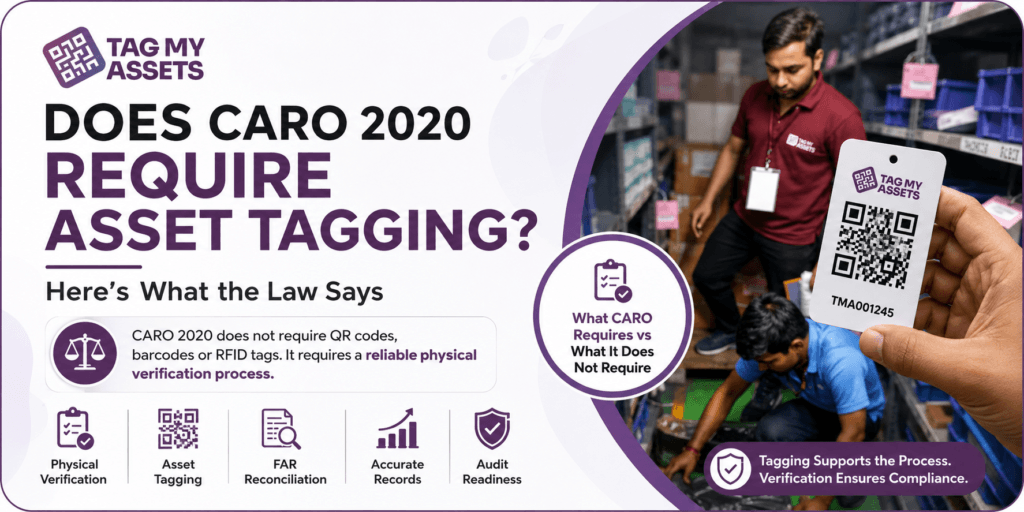
Does CARO Require Asset Tagging?
Clause 3(i)(b) of the Companies (Auditor’s Report) Order, 2020 (CARO 2020) requires the auditor to comment on:
- Whether Property, Plant and Equipment (PPE) have been physically verified by the management at reasonable intervals.
- Whether the frequency of verification is reasonable considering the size of the company and the nature of its assets.
- Whether any material discrepancies noticed during verification have been properly dealt with in the books of account.
Notice what CARO focuses on.
It does not ask whether assets have QR codes, RFID tags or barcode labels.
Instead, it focuses on whether the company has a reasonable and reliable physical verification process.
Why Do So Many Companies Think Asset Tagging Is Mandatory?
Because asset tagging and physical verification are often carried out together.
Many organisations introduce QR codes or RFID tags before a verification exercise because unique identification makes the process much easier.
Over time, this has created the misconception that asset tagging itself is a legal requirement.
It isn’t.
The law is concerned with verification.
Asset tagging is simply one of the tools that helps management perform that verification more efficiently.
Asset Tagging Is a Tool, Not Compliance
Applying a QR code to an asset does not automatically improve the quality of your Fixed Asset Register (FAR).
Imagine your register already contains:
- Assets that no longer exist.
- Duplicate asset records.
- Incorrect locations.
- Wrong departments.
- Missing serial numbers.
- Assets that have already been disposed of.
Adding QR codes to these records doesn’t correct the underlying problem.
It simply gives every incorrect record a unique label.
The accuracy of the register remains exactly the same.
Physical Verification Is What Creates Reliable Records
A structured physical verification exercise answers questions that no QR code can answer on its own.
For example:
- Does the asset physically exist?
- Is it located where the Fixed Asset Register says it is?
- Does the make, model and serial number match?
- Has the asset been transferred without updating the records?
- Are there assets on the floor that do not appear in the register?
- Are there assets in the register that cannot be located?
These are the questions that improve the quality of the Fixed Asset Register.
Why Companies Still Invest in Asset Tagging
If CARO does not require asset tagging, why do so many organisations implement it?
Because once an asset has been physically verified, it needs a permanent identity.
Without unique identification, future verification exercises become more difficult.
Identical laptops, office chairs, air conditioners or production equipment can easily be confused, especially in large organisations operating across multiple locations.
A properly designed QR code, barcode or RFID tag helps ensure that the same asset can be identified quickly and accurately during future verification exercises.
Physical Verification Gives Meaning to Asset Tags
This is an important distinction.
A QR code does not prove that an asset exists.
It only identifies an asset.
Its real value comes after physical verification confirms:
- The asset exists.
- The location is correct.
- The description matches.
- The serial number is accurate.
- The custodian or department is correct.
Only then does the tag become part of reliable audit evidence.
Without verification, a QR code is simply a sticker.
Why Do Companies Tag Assets If CARO Doesn’t Require It?
There are several practical reasons.
A properly implemented asset tagging system can help organisations:
- Complete future physical verification more quickly.
- Improve asset identification.
- Reduce manual errors.
- Track asset movements more effectively.
- Support better Fixed Asset Register (FAR) maintenance.
- Strengthen internal controls.
These are operational and governance benefits—not statutory requirements.
Asset Verification, Asset Tagging and FAR Reconciliation Work Together
These activities should never be viewed in isolation.
A good fixed asset management process usually follows four steps.
Step 1 – Physical Verification
Confirm what actually exists.
Step 2 – Asset Tagging
Assign a unique identity to each verified asset.
Step 3 – FAR Reconciliation
Compare physical findings with the Fixed Asset Register and identify differences.
Step 4 – Management Action
Review the discrepancies and update records wherever appropriate.
Together, these steps help organisations build a more accurate and reliable Fixed Asset Register.
CARO Requires a Process—Not a Technology
CARO 2020 does not prescribe how physical verification should be carried out.
It does not require manual verification.
It does not require QR codes.
It does not require RFID.
It does not require barcode labels.
The choice of technology is entirely a management decision.
What matters is whether the process adopted enables the company to identify assets accurately, detect material discrepancies and maintain reliable records.
Technology makes the process more efficient.
It does not replace the process itself.
CARO Requires vs CARO Does Not Require
| CARO Requires | CARO Does Not Require |
|---|---|
| Physical verification at reasonable intervals | QR Codes |
| Reasonable frequency of verification | RFID Tags |
| Material discrepancies to be dealt with in the books | Barcode Labels |
| A reliable verification process | Any specific technology |
Many finance professionals still ask, “Does CARO require asset tagging?” The answer remains the same—CARO focuses on physical verification, while asset tagging supports that verification process.
Frequently Asked Questions
Does CARO require asset tagging under CARO 2020?
No. CARO requires a reasonable physical verification process. It does not mandate QR codes, RFID tags or barcode labels.
Does QR tagging make a company CARO compliant?
No. QR tagging improves identification and supports physical verification, but compliance depends on the overall verification process adopted by management.
Can physical verification be done without asset tagging?
Yes. However, unique asset identification becomes more difficult, particularly for organisations with a large number of similar assets or multiple locations.
Why do companies implement QR or RFID tagging?
To improve asset identification, speed up future verification exercises, strengthen internal controls and maintain a more reliable Fixed Asset Register.
Conclusion
One of the most common misconceptions about CARO 2020 is that companies need to tag every fixed asset to comply with the law.
They don’t.
CARO 2020 does not require QR codes, barcodes or RFID tags. What it requires is a reasonable physical verification process and that any material discrepancies identified during verification are appropriately dealt with in the books of account.
Asset tagging should therefore be viewed as a management tool, not a compliance requirement. It makes future physical verification faster, improves asset identification and supports a more reliable Fixed Asset Register (FAR).
So, does CARO require asset tagging? No. It requires a verification process that management can rely upon and an auditor can evaluate with confidence.
Technology supports the process. Physical verification strengthens the records. Together, they help organisations build accurate, reliable and audit-ready Fixed Asset Registers.
Related Resources
- Physical Verification of Fixed Assets
- Fixed Asset Register (FAR) Reconciliation Services
- Asset Tagging Services
- Common CARO 2020 Observations on Fixed Assets
- CARO 2020 Physical Verification Requirements Explained
About TagMyAssets
TagMyAssets helps organisations across India improve fixed asset governance through Physical Verification of Fixed Assets, QR Code Asset Tagging, Barcode Tagging, RFID Asset Tagging and Fixed Asset Register (FAR) Reconciliation. Our objective is not just to apply asset tags, but to help organisations build accurate, reliable and audit-ready fixed asset records.