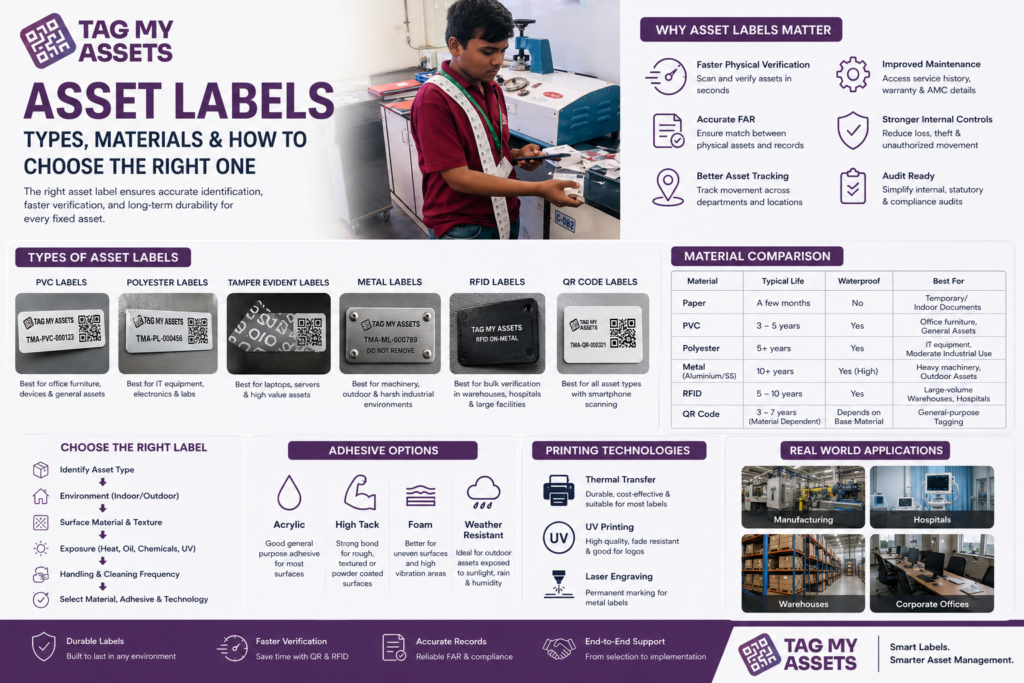
Whether you’re managing a corporate office with a few hundred laptops or a manufacturing plant with thousands of machines, one thing remains constant—every fixed asset needs to be identified accurately throughout its lifecycle.
That’s where asset labels play an important role.
At first glance, an asset label may appear to be nothing more than a sticker carrying a barcode or QR code. In reality, it is one of the most important components of an asset management system. A well-designed asset label allows organizations to identify assets instantly, perform faster physical verification, maintain an accurate Fixed Asset Register (FAR), improve maintenance tracking, reduce asset loss, and simplify statutory audits.
Unfortunately, many businesses underestimate the importance of choosing the right label. They select the least expensive option without considering where the label will be installed, how frequently the asset will be handled, or the environmental conditions it will face. The result is predictable—labels peel off, fade, crack, or become unreadable within months, forcing organizations to spend additional time and money on re-tagging.
Over the years, our team at Tag My Assets has completed asset tagging and physical verification projects across manufacturing plants, hospitals, retail stores, corporate offices, warehouses, educational institutions, hotels, and financial institutions throughout India. One lesson has remained consistent across every project:
The success of an asset tagging project depends as much on selecting the right label as it does on selecting the right software.
This guide explains everything you need to know about asset labels—from materials and adhesives to QR codes, RFID, durability, industry-specific recommendations, and best practices—helping you make an informed decision before starting your next asset tagging project.
What Are Asset Labels?
Asset labels are durable identification labels attached to fixed assets to uniquely identify and track them throughout their lifecycle. Every label contains a unique identifier that connects the physical asset to its digital record in an asset management system or Fixed Asset Register (FAR).
Depending on the organization’s requirements, an asset label may include:
- Asset Number
- Asset Description
- Company Logo
- Barcode
- QR Code
- RFID Tag
- Serial Number
- Department Name
- Location Code
When scanned using a smartphone, barcode scanner, or RFID reader, the label provides instant access to information such as:
- Asset details
- Purchase information
- Department
- Current location
- Custodian
- Maintenance history
- Warranty details
- Verification status
Instead of manually searching through spreadsheets during audits or inventory checks, auditors and asset managers can retrieve complete information within seconds.
Why Asset Labels Are Important
Many organizations consider asset labels only as identification stickers. In reality, they support almost every stage of asset management.
Faster Physical Verification
Physical verification becomes significantly easier when every asset carries a unique identification label.
Instead of manually comparing serial numbers, auditors simply scan the label and instantly confirm whether the asset exists, where it is located, and whether it matches the Fixed Asset Register.
For organizations with thousands of assets spread across multiple locations, this can reduce verification time dramatically.
Accurate Fixed Asset Register (FAR)
An accurate FAR depends on accurate asset identification.
Without proper labels, auditors often struggle to determine whether a machine or laptop corresponds to a particular asset record, especially when manufacturer labels have faded or become unreadable.
Unique asset labels reduce this confusion by creating a permanent link between the physical asset and the FAR.
Better Asset Tracking
Assets frequently move between departments, branches, employees, and project sites.
A properly implemented asset tagging system enables organizations to record every movement, helping maintain accurate location records while reducing the chances of misplaced or lost assets.
Improved Maintenance Management
Maintenance teams can scan an asset label to view service history, maintenance schedules, warranty information, and previous repair records.
This reduces paperwork and improves preventive maintenance planning.
Stronger Internal Controls
Unique asset identification discourages unauthorized asset movement and simplifies investigations whenever assets are missing.
Tamper-evident labels further strengthen internal controls by clearly indicating whether someone has attempted to remove or replace the label.
Better Audit Readiness
Statutory audits and internal audits often require physical verification of fixed assets.
Clearly labelled assets help organizations complete verification faster while reducing disputes during reconciliation between physical assets and accounting records.
Choosing the Right Asset Label Is More Than Selecting a Material
One of the biggest misconceptions is that choosing an asset label simply means selecting PVC, polyester, or metal.
In reality, several factors determine whether a label will continue performing throughout the life of the asset.
Before selecting a label, organizations should consider:
- Indoor or outdoor installation
- Temperature exposure
- Moisture and humidity
- Oil and grease
- Chemicals
- UV exposure
- Cleaning frequency
- Surface material
- Flat or curved surface
- Expected asset life
- Scanning method
- Adhesive quality
A laminated PVC label may perform perfectly on office furniture but fail quickly on equipment exposed to oil, chemicals, or extreme heat. Similarly, a standard adhesive that works well indoors may peel off within months when exposed to sunlight or moisture.
Selecting the right combination of material, adhesive, and printing technology ensures that the label remains attached, readable, and scannable throughout the asset’s useful life.
Types of Asset Labels
Although hundreds of label variations are available, most fixed asset tagging projects use one of the following categories.
Paper Asset Labels
Paper labels are the most economical option available.
They are easy to print and suitable for temporary identification where durability is not important.
Advantages
- Lowest cost
- Easy to print
- Suitable for temporary use
Limitations
- Poor moisture resistance
- Easily torn
- Low durability
- Not suitable for industrial environments
Recommended Applications
- Temporary inventory
- Files
- Documents
- Short-term identification
Paper labels are generally not recommended for fixed assets that remain in service for several years.
PVC Asset Labels
PVC labels are among the most widely used materials for office asset tagging.
They offer an excellent balance between cost and durability and perform well under normal indoor conditions.
They are commonly used for:
- Office furniture
- Computers
- Monitors
- Printers
- Air conditioners
- Conference room equipment
Laminated PVC labels provide additional protection against scratches and cleaning, making them suitable for most corporate environments.
Polyester Asset Labels
Polyester labels offer higher durability than PVC while remaining flexible and cost-effective.
Their resistance to abrasion, chemicals, and regular cleaning makes them ideal for:
- Laptops
- Networking equipment
- Servers
- Laboratory equipment
- Medical devices
- Industrial electronics
Many organizations choose polyester labels for IT assets because they maintain readability even after years of daily handling.
Tamper-Evident Asset Labels
Unlike standard labels, tamper-evident labels are designed to show visible signs of removal.
If someone attempts to peel the label from the asset, it leaves behind a “VOID” pattern or breaks into small pieces, preventing it from being transferred to another asset.
These labels are particularly suitable for:
- Laptops
- Desktops
- Mobile devices
- High-value electronics
- Network equipment
For organizations concerned about asset theft or unauthorized movement, tamper-evident labels provide an additional layer of security while simplifying audit verification.
Metal Asset Labels
When durability is the highest priority, metal asset labels are often the best choice.
Unlike paper, PVC, or polyester labels that rely on printed surfaces, metal labels are usually laser engraved or chemically etched. The information becomes part of the metal itself, making it extremely resistant to abrasion, chemicals, UV exposure, moisture, and harsh industrial environments.
Metal labels are commonly used on:
- Manufacturing machinery
- Industrial equipment
- Power plants
- Oil & Gas facilities
- Mining equipment
- Outdoor electrical installations
- DG Sets
- Compressors
- Boilers
- Pumps
- Transformers
These assets are often exposed to conditions where ordinary labels simply cannot survive.
Aluminium Asset Labels
Aluminium asset labels are lightweight, economical, and suitable for most industrial applications.
They provide excellent corrosion resistance and can last for many years when properly installed.
Ideal applications include:
- Manufacturing plants
- Warehouses
- Outdoor machinery
- Engineering equipment
- Material handling equipment
Stainless Steel 304 Labels
Stainless Steel 304 provides greater strength than aluminium while offering excellent resistance against corrosion and weather.
They are widely used in:
- Food processing plants
- Manufacturing facilities
- Pharmaceutical companies
- Outdoor installations
Stainless Steel 316 Labels
Where chemicals, salt water, or aggressive industrial environments exist, SS316 becomes the preferred choice.
Typical applications include:
- Chemical plants
- Marine industries
- Oil & Gas facilities
- Fertilizer plants
- Coastal installations
Although more expensive, SS316 labels can easily last throughout the useful life of the equipment.
Advantages of Metal Labels
- Extremely durable
- Waterproof
- Chemical resistant
- UV resistant
- Heat resistant
- Difficult to tamper with
- Long service life
- Professional appearance
For heavy industrial assets expected to operate for ten years or more, metal asset labels usually provide the lowest lifetime cost despite their higher initial investment.
QR Code Asset Labels
Today, QR Code asset labels have become the preferred choice for fixed asset tagging across most industries.
Unlike traditional numbering systems, QR codes can store significantly more information while remaining compact and easy to scan using any modern smartphone.
Instead of manually typing asset numbers, users simply point the camera at the QR code to retrieve asset information instantly.
Depending on the asset management software, scanning a QR code can display:
- Asset Number
- Asset Description
- Department
- Cost Centre
- Location
- Purchase Date
- Warranty Details
- AMC Information
- Verification History
- Photographs
- Asset Status
This makes physical verification considerably faster than traditional manual methods.
Advantages of QR Code Labels
- Low implementation cost
- Easy smartphone scanning
- No dedicated scanner required
- Fast deployment
- High data capacity
- Easy integration with asset management software
For small and medium-sized organizations, QR code labels often provide the best balance between functionality and cost.
RFID Asset Labels
While QR codes require the user to scan each asset individually, RFID technology allows multiple assets to be identified simultaneously without direct line of sight.
This makes RFID especially valuable where thousands of assets must be verified within limited time.
Instead of scanning one asset at a time, an RFID reader automatically detects nearby RFID tags as the user walks through the facility.
Large organizations often use RFID for:
- Manufacturing plants
- Hospitals
- Warehouses
- Educational institutions
- Data centres
- Corporate campuses
- Retail stores
Passive RFID
Passive RFID tags contain no battery.
They receive power from the RFID reader itself, making them economical and maintenance-free.
Most fixed asset tagging projects use passive RFID.
Active RFID
Active RFID tags contain their own battery and offer much longer read ranges.
These are generally used for specialized applications involving high-value movable equipment rather than routine fixed asset tagging.
On-Metal RFID Tags
Standard RFID tags do not perform well when attached directly to metal.
For machinery, electrical panels, racks, pipelines, and industrial equipment, specially designed on-metal RFID tags are used to maintain reliable reading performance.
Choosing the correct RFID tag is therefore just as important as choosing the correct RFID reader.
QR Code or RFID — Which One Should You Choose?
One of the most common questions organizations ask is whether they should implement QR codes or RFID.
The answer depends on operational requirements rather than technology alone.
Choose QR Code Labels when:
- Assets are verified periodically.
- Budgets are limited.
- Smartphone-based verification is sufficient.
- Individual asset scanning is acceptable.
- The organization has a moderate number of assets.
Choose RFID Labels when:
- Thousands of assets require frequent verification.
- Verification speed is critical.
- Assets are spread across large facilities.
- Dedicated RFID readers are available.
- The organization is looking for maximum automation.
Neither technology is universally superior. The right choice depends on the asset volume, verification frequency, available budget, and operational objectives.
Choosing the Right Adhesive
Even the highest-quality asset label will fail if the adhesive is not suitable for the surface.
Surprisingly, adhesive selection causes more failures than poor label materials.
When selecting an adhesive, consider:
- Surface texture
- Temperature
- Moisture
- Chemical exposure
- Paint finish
- Cleaning process
- Indoor or outdoor installation
Acrylic Adhesive
Acrylic adhesive offers an excellent balance between durability and cost.
It performs well across most indoor office environments and many industrial applications.
High-Tack Adhesive
Some assets have textured, rough, or powder-coated surfaces where ordinary adhesives struggle to bond.
High-tack adhesive provides significantly better grip on these difficult surfaces.
Foam Adhesive
Machinery subjected to continuous vibration may require foam adhesive to improve bonding and absorb minor surface irregularities.
Weather-Resistant Adhesive
Outdoor assets require adhesives capable of withstanding rain, sunlight, humidity, and seasonal temperature changes without peeling.
Selecting the correct adhesive often determines whether a label lasts five years or fails within six months.
Printing Technologies Used for Asset Labels
The durability of an asset label depends not only on the material but also on how the information is printed.
Thermal Transfer Printing
Thermal transfer printing is one of the most widely used methods for producing barcode and QR code asset labels.
It offers excellent durability and produces sharp, highly readable prints suitable for everyday business applications.
UV Printing
UV printing creates vibrant, fade-resistant labels with excellent image quality.
It is commonly used when organizations require branded labels containing logos or coloured graphics.
Laser Engraving
Metal asset labels are generally laser engraved rather than printed.
Since the information is permanently etched into the metal, it cannot fade, scratch off, or wear away during normal operation.
Laser engraving is widely preferred for machinery operating in harsh industrial environments.
Common Asset Label Sizes
There is no universal asset label size.
The correct size depends on the available surface area, the amount of information to be displayed, and the scanning distance.
Some commonly used sizes include:
| Label Size | Typical Application |
|---|---|
| 20 × 10 mm | Small accessories and tools |
| 30 × 15 mm | Laptops and IT assets |
| 38 × 19 mm | Desktop computers and printers |
| 50 × 25 mm | Furniture and office equipment |
| 75 × 25 mm | Industrial equipment |
| 100 × 50 mm | Heavy machinery and outdoor installations |
Choosing a label that is too small can make scanning difficult, while an oversized label may not fit properly on compact equipment.
How Long Do Asset Labels Last?
Asset label life depends on four major factors:
- Label material
- Adhesive quality
- Installation quality
- Operating environment
Typical service life is shown below.
| Label Type | Expected Life* |
|---|---|
| Paper Labels | Up to 6 months |
| PVC Labels | 3–5 years |
| Polyester Labels | 5–7 years |
| Metal Labels | 10+ years |
| RFID Labels | 5–10 years |
*Actual life depends on heat, moisture, chemicals, UV exposure, cleaning frequency, and physical handling.
Regular inspection during physical verification helps identify damaged labels before they create reconciliation issues or audit observations.
Common Mistakes When Selecting Asset Labels
Many asset tagging projects fail because organizations focus only on label price instead of long-term performance.
Some of the most common mistakes include:
- Selecting one label material for every type of asset.
- Ignoring environmental conditions before choosing labels.
- Using indoor labels on outdoor assets.
- Choosing standard adhesive for rough or oily surfaces.
- Selecting ordinary labels for machinery exposed to high temperatures.
- Purchasing labels without considering future verification methods.
- Failing to test labels before bulk procurement.
Spending slightly more on the correct material during implementation usually saves significant time and money by avoiding repeated replacement and re-tagging exercises.
Asset Labels by Industry, Selection Process & Best Practices
Asset Labels by Industry
No single asset label is suitable for every business.
The environment in which an asset operates plays the biggest role in determining the ideal label material, adhesive, and identification technology. A label that performs perfectly in a corporate office may fail within weeks inside a manufacturing plant or outdoor installation.
Below are our recommendations based on practical asset tagging projects across different industries.
Manufacturing Industry
Manufacturing facilities present some of the toughest conditions for asset labels. Equipment is frequently exposed to heat, dust, vibration, oil, grease, chemicals, and regular cleaning.
Typical assets include:
- CNC Machines
- Production Equipment
- Compressors
- Pumps
- Motors
- Electrical Panels
- Conveyors
- Material Handling Equipment
- DG Sets
Recommended Labels
- Aluminium Asset Labels
- Stainless Steel Labels
- On-Metal RFID Tags (where RFID is required)
- Industrial-grade Polyester Labels for control panels
For machinery operating continuously, durability is more important than initial cost. Selecting industrial-grade labels during implementation usually avoids repeated replacement during future verification cycles.
Hospitals and Healthcare
Hospitals contain thousands of movable medical assets that are regularly shifted between departments.
Examples include:
- Patient Monitors
- Infusion Pumps
- Wheelchairs
- ICU Equipment
- ECG Machines
- Ultrasound Systems
- Ventilators
- Laboratory Equipment
Since these assets are cleaned frequently using disinfectants, the labels must resist chemicals and repeated wiping.
Recommended Labels
- Polyester Labels
- QR Code Labels
- Tamper-Evident Labels for portable equipment
Labels should remain readable throughout repeated cleaning and routine maintenance.
Corporate Offices
Corporate offices usually have a large number of IT assets and office furniture spread across multiple departments and locations.
Common assets include:
- Laptops
- Desktops
- Printers
- Conference Equipment
- Chairs
- Tables
- Cabinets
- Projectors
Recommended Labels
- PVC Labels
- Polyester Labels
- Tamper-Evident Labels for laptops
For most offices, QR code-based asset tagging provides an excellent balance between simplicity and functionality.
Warehouses and Logistics
Warehouses often contain thousands of racks, material handling equipment, storage bins, and operational assets that require regular verification.
Speed is usually the highest priority.
Recommended Labels
- RFID Labels
- QR Code Labels
- Polyester Labels
Where asset counts are high and frequent verification is required, RFID can significantly reduce verification time.
Retail Stores
Retail environments involve frequent movement of fixtures, POS equipment, and operational assets.
Examples include:
- Billing Counters
- POS Machines
- Display Fixtures
- Shelving
- IT Equipment
- Store Furniture
Recommended Labels
- QR Code Labels
- Polyester Labels
- PVC Labels
QR codes work particularly well because store staff can scan assets using smartphones without investing in dedicated hardware.
Hotels and Hospitality
Hotels contain thousands of distributed assets across guest rooms, kitchens, restaurants, conference halls, and engineering departments.
Common assets include:
- Furniture
- Kitchen Equipment
- Housekeeping Equipment
- Air Conditioners
- TVs
- Refrigerators
- Laundry Equipment
Recommended Labels
- PVC Labels
- Polyester Labels
- Metal Labels for kitchen equipment exposed to heat
The label material should be selected according to the operating environment rather than applying the same specification throughout the property.
Educational Institutions
Schools, colleges, and universities manage large numbers of assets spread across classrooms, laboratories, libraries, hostels, and administrative offices.
Recommended Labels
- PVC Labels
- Polyester Labels
- QR Code Labels
A properly labelled asset base simplifies annual physical verification and improves accountability across departments.
Banking and Financial Institutions
Banks generally require durable labels that provide both identification and tamper resistance.
Assets include:
- ATMs
- Currency Counting Machines
- Servers
- Desktop Systems
- Office Furniture
- Network Equipment
Recommended Labels
- Polyester Labels
- Tamper-Evident Labels
- QR Code Labels
These labels improve asset traceability while supporting audit and compliance requirements.
How We Select the Right Asset Label
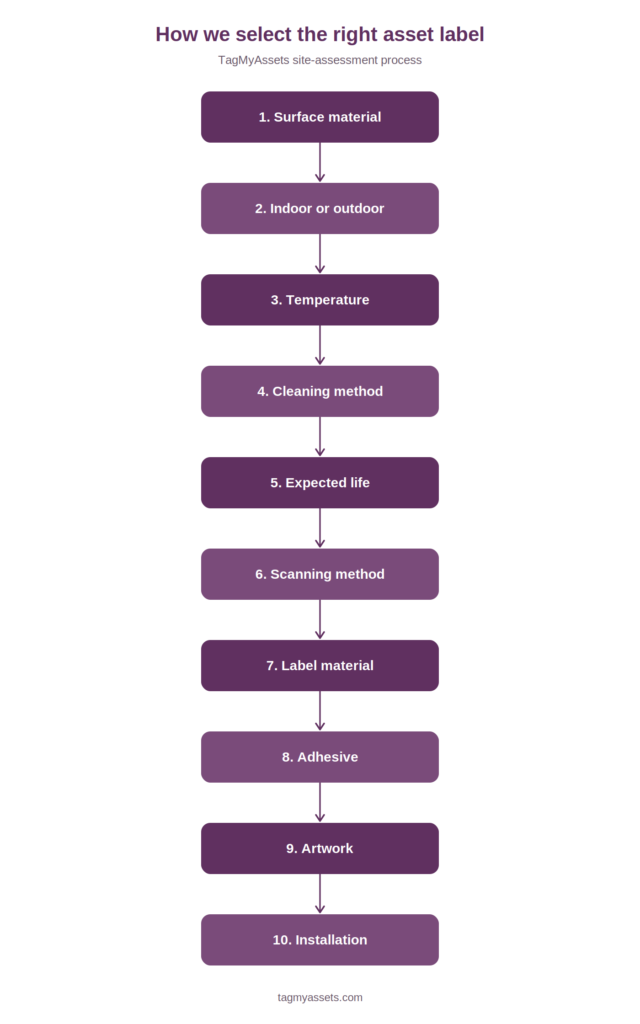
At Tag My Assets, selecting an asset label is not simply a matter of choosing PVC or metal from a catalogue.
Every project begins with understanding the asset, the operating environment, and the client’s verification requirements.
Our selection process follows these steps:
- Study the asset category.
- Identify the installation surface.
- Assess indoor or outdoor conditions.
- Evaluate heat, chemicals, moisture, and UV exposure.
- Determine cleaning frequency.
- Decide whether QR code or RFID is appropriate.
- Select the most suitable label material.
- Choose the correct adhesive.
- Finalize artwork and asset numbering.
- Conduct sample testing before full-scale implementation.
This structured approach helps ensure that labels remain attached, readable, and scannable throughout the asset’s useful life.
Why Sample Testing Is Important
One of the biggest mistakes organizations make is ordering thousands of labels without testing them in the actual operating environment.
A label that performs well during installation may behave very differently after several weeks of exposure to:
- High temperatures
- Cleaning chemicals
- Direct sunlight
- Moisture
- Industrial vibration
- Outdoor weather
For this reason, we recommend installing sample labels on representative assets before proceeding with full-scale production.
A small pilot helps validate:
- Material performance
- Adhesive strength
- Print quality
- Scanning reliability
- Durability
Testing a few labels today can prevent replacing thousands tomorrow.
Common Mistakes During Asset Label Installation
Even high-quality labels can fail if they are installed incorrectly.
Some common installation mistakes include:
- Applying labels on dusty or oily surfaces
- Fixing labels on moving machine parts
- Installing labels over sharp edges
- Applying labels on rough surfaces without suitable adhesive
- Placing labels where operators frequently touch them
- Installing labels too close to heat sources
- Using metal labels where flexible labels are required
Proper surface preparation is just as important as selecting the correct material.
Cleaning the surface before installation significantly improves adhesive performance.
Asset Label Maintenance
Asset labels should not be forgotten after installation.
As part of routine physical verification, organizations should inspect labels for:
- Peeling
- Fading
- Scratches
- Damage
- Missing labels
- Poor readability
Replacing damaged labels before they become unreadable helps maintain an accurate Fixed Asset Register and reduces reconciliation issues during audits.
Periodic inspections also ensure that labels continue supporting maintenance, warranty tracking, and asset identification throughout their lifecycle.
Future Trends in Asset Labelling
Asset identification technology continues to evolve.
Modern organizations are increasingly adopting:
- QR Code-based asset management
- RFID-enabled physical verification
- Mobile asset verification applications
- Cloud-based asset registers
- Digital maintenance records
- Real-time asset tracking
- AI-assisted asset identification
While label materials continue to improve, the biggest transformation is happening in the software connected to those labels. Organizations are moving beyond simple identification toward complete digital asset lifecycle management.
Why Choose Tag My Assets?
Choosing the right asset label is only one part of a successful asset tagging project.
Equally important are the planning, implementation, verification, and reconciliation processes that ensure every physical asset matches your Fixed Asset Register.
At Tag My Assets, we combine practical field experience with technology-driven solutions to deliver end-to-end asset tagging services across India. From selecting the appropriate label material to implementing QR code or RFID solutions and conducting physical verification, our team helps organizations build an accurate and reliable asset management system.
Whether you’re tagging a few hundred office assets or managing a multi-location project involving thousands of assets, selecting the right label from the beginning helps reduce future replacement costs, improves verification efficiency, and supports better asset governance.
Part 4 – Frequently Asked Questions, Conclusion & Next Steps
Frequently Asked Questions (FAQs)
1. What are asset labels?
Asset labels are identification labels attached to fixed assets such as machinery, furniture, IT equipment, medical devices, and office assets. They usually contain a unique asset number along with a QR code or RFID tag that links the physical asset to its digital record in an asset management system.
2. Why are asset labels important?
Asset labels make it easier to identify, track, verify, and manage assets throughout their lifecycle. They improve physical verification, support Fixed Asset Register (FAR) reconciliation, simplify maintenance management, reduce asset loss, and strengthen internal controls.
3. Which material is best for asset labels?
There is no single material suitable for every asset. The best choice depends on the operating environment.
- Paper labels – Temporary applications
- PVC labels – Office furniture and general indoor assets
- Polyester labels – IT assets and electronics
- Metal labels – Industrial machinery and outdoor equipment
- RFID labels – High-volume asset verification
Selecting the correct material helps maximize label life and reduce replacement costs.
4. How long do asset labels last?
The lifespan depends on the material, adhesive, environmental conditions, and maintenance practices.
Typical lifespan:
- Paper – Up to 6 months
- PVC – 3 to 5 years
- Polyester – 5 to 7 years
- Metal – 10 years or more
- RFID – 5 to 10 years
Regular inspections help identify damaged labels before they affect asset identification or audit accuracy.
5. Are QR code asset labels better than traditional numbering?
Yes. QR code labels provide faster identification because users can scan them using a smartphone to instantly access asset information. Unlike manual numbering, QR codes reduce data entry errors and improve the efficiency of physical verification.
6. Should I choose QR code or RFID asset labels?
Both technologies have their advantages.
QR code labels are ideal for most organizations because they are affordable, easy to implement, and compatible with smartphones.
RFID is better suited for organizations with thousands of assets that require frequent, high-speed verification using RFID readers.
The right choice depends on your asset volume, operational requirements, and budget.
7. Which asset labels are suitable for manufacturing plants?
Manufacturing environments often require durable labels capable of withstanding heat, oil, dust, vibration, and chemicals.
Aluminium, stainless steel, industrial polyester, or on-metal RFID labels are generally the preferred options.
8. Can asset labels be customized?
Yes.
Most organizations customize asset labels with:
- Company Logo
- Asset Number
- QR Code
- RFID
- Department
- Location
- Serial Number
- Contact Information
- Corporate Branding
Customized labels improve identification while maintaining a professional appearance.
9. Can asset labels be removed and reused?
Standard labels can often be removed if handled carefully.
However, tamper-evident labels are specifically designed to prevent reuse. They display a visible “VOID” message or break apart when someone attempts to remove them, making unauthorized transfer immediately noticeable.
10. Do asset labels support statutory audits?
Yes.
Proper asset identification significantly improves physical verification and supports reconciliation between the Fixed Asset Register and physical assets during statutory audits, internal audits, and management reviews.
11. Can asset labels be used outdoors?
Yes, provided the correct material is selected.
Outdoor installations generally require weather-resistant polyester or metal labels with industrial-grade adhesives capable of withstanding sunlight, moisture, and temperature variations.
12. Which adhesive should I choose?
The adhesive depends on:
- Surface material
- Temperature
- Moisture
- Chemicals
- UV exposure
- Surface texture
Selecting the correct adhesive is just as important as selecting the correct label material because even premium labels can fail if the adhesive is unsuitable.
13. How often should asset labels be inspected?
Asset labels should be checked whenever physical verification or preventive maintenance is carried out.
Inspecting labels regularly helps identify fading, peeling, or damage before it creates reconciliation issues or delays during audits.
14. What information should an asset label contain?
A well-designed asset label typically includes:
- Company Name or Logo
- Unique Asset Number
- QR Code or RFID
- Asset Description (optional)
- Department or Location (optional)
The exact information depends on the organization’s asset management policy.
15. Can one organization use different types of asset labels?
Absolutely.
Most organizations use multiple label types based on asset category and operating conditions.
For example:
- PVC labels for office furniture
- Polyester labels for laptops
- Metal labels for machinery
- RFID labels for warehouse assets
Using the right label for each asset category improves durability, reduces maintenance, and enhances verification efficiency.
Final Thoughts
Choosing the right asset label is about much more than selecting a sticker with a QR code or RFID tag. The material, adhesive, printing technology, installation method, and operating environment all influence how well a label performs throughout the life of the asset.
A well-planned asset tagging program improves asset visibility, speeds up physical verification, simplifies audits, supports maintenance activities, and helps organizations maintain an accurate Fixed Asset Register.
Whether you’re managing a corporate office, manufacturing plant, hospital, warehouse, retail chain, hotel, or educational institution, selecting the right asset label at the beginning of the project can significantly reduce replacement costs and improve long-term asset management.
Why Organizations Choose Tag My Assets
At Tag My Assets, we provide complete asset tagging and verification solutions tailored to different industries and operating environments.
Our services include:
- Asset Label Selection
- QR Code Asset Tagging
- RFID Asset Tagging
- Physical Verification of Fixed Assets
- Fixed Asset Register (FAR) Reconciliation
- Inventory Verification
- Asset Management Consulting
- Pan-India Asset Tagging Services
Instead of recommending a single label for every project, we assess your assets, operating conditions, verification requirements, and long-term objectives before suggesting the most suitable solution.
From a single office to multi-location enterprises with thousands of assets, our team helps organizations build accurate, reliable, and audit-ready asset management systems.
Related Resources
If you’re planning an asset tagging or physical verification project, you may also find these guides useful:
- Fixed Asset Tagging Services
- RFID Asset Tagging Services
- Physical Verification of Fixed Assets
- Inventory Verification Services
- Fixed Asset Register (FAR) Reconciliation
- Asset Tagging Preparation Guide
- QR Code Asset Tagging System
- RFID vs QR Code for Asset Tagging
- CARO 2020 Physical Verification Guide