
What a First Verification Found
This case study sets out what a first structured verification found — not projected savings, but actual counts from the engagement. Most companies treat asset tagging as a compliance activity, something required for audits rather than something that changes what they actually know about their own assets.
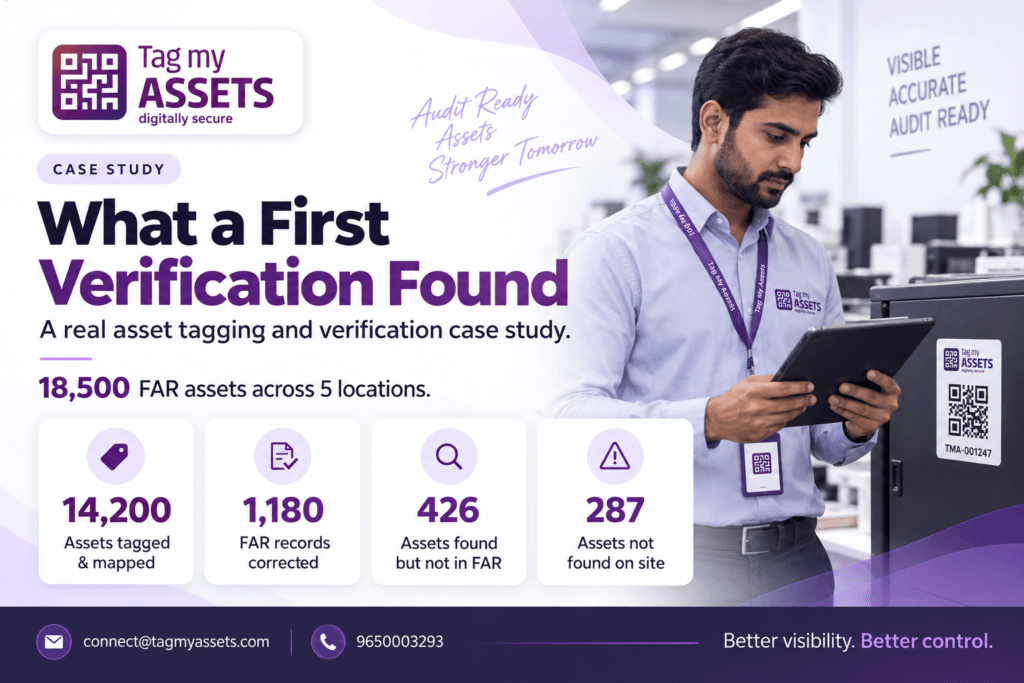
The business was multi-location: 18,500 assets in the Fixed Asset Register across five locations, 14,200 of them taggable. The exercise found 14,200 assets tagged and mapped to location, department, and custodian; 1,180 FAR records corrected; 426 assets found physically but not recorded in the FAR; and 287 assets recorded in the FAR but not found on site.
These figures are counts from the engagement, not projected savings. The financial effect of each finding depends on the asset values and purchase patterns of the company concerned — it isn’t a fixed number that transfers from one business to another.
Why This Matters
Most organisations underestimate the financial impact of poor asset visibility. Without proper tagging and verification, assets get purchased again despite already being available, FAR records stay inaccurate, audit cycles run longer and cost more, asset movement goes untracked, and accountability stays weak across departments. This case shows what correcting those gaps actually surfaces.
Project Overview
A mid-sized company in India with multi-location operations: 18,500 total assets in the FAR, 14,200 taggable, across five locations. Key problems going in: no asset tagging system, duplicate asset records, asset movement without tracking, long audit timelines, and poor FAR accuracy.
The project covered physical verification of fixed assets, asset identification and standardisation, QR/barcode tagging, department and location mapping, FAR reconciliation, and exception reporting for missing, excess, scrapped, and shifted assets.
What the Verification Found
14,200 assets tagged and digitally mapped. Every identified asset was tagged and mapped to location, department, asset category, and custodian — moving the company from description-based tracking to asset-level control, and cutting confusion between similar assets.
1,180 FAR records corrected. Issues included duplicate asset descriptions, incorrect locations, merged entries, and outdated records. A cleaner FAR improved audit readiness, financial reporting accuracy, insurance documentation, and internal controls.
426 assets found physically but not recorded in the FAR. These were assets on site with no corresponding entry — typically purchases capitalised under a different description, or assets transferred in without a record ever being created.
287 assets missing. Assets not found during verification were reported clearly for management action, not buried in a summary line.
What This Shows
Asset tagging isn’t just a labelling activity. Done properly, it improves control over fixed assets, cleans inaccurate FAR records, identifies missing and excess assets, reduces audit time, avoids duplicate purchases, and increases accountability across departments.
How to Think About ROI for Your Own Company
Cost includes tagging services, tag material, travel and logistics, data reconciliation, and software support. Benefit includes avoided purchases, audit savings, improved utilisation, recovered assets, and reduced losses. The basic formula is straightforward: ROI = (Total Benefit − Total Cost) ÷ Total Cost × 100 — but every input in that formula is specific to your own asset base, not a figure that carries over from someone else’s engagement.
Conclusion
A first verification on a register that’s never been checked against the floor tends to surface the same pattern: unrecorded assets, missing assets, and a meaningful share of entries needing correction. Structured execution gets you a Fixed Asset Register that actually matches physical reality, faster audits because assets can be located and identified quickly, variances classified with a reason against each one rather than left as an unexplained gap, and a defensible basis for depreciation and insurance.
As per audit and record-keeping guidance from the Institute of Chartered Accountants of India, accurate, physically verified asset records are central to reliable financial reporting. Explore our fixed asset tagging services to see how a similar exercise would apply to your own register.
Frequently Asked Questions
What is the ROI of asset tagging?
ROI typically comes from avoided duplicate purchases, audit savings, improved asset utilisation, and better overall control — the exact figure depends entirely on the company’s own asset base and how large the gaps were beforehand.
Is asset tagging useful for Indian companies specifically?
Yes — particularly for manufacturing units, warehouses, hospitals, offices, and multi-location businesses, where assets are easiest to lose track of.
What does a first verification usually find?
Unrecorded assets, missing assets, duplicate entries, and location mismatches — the proportions vary with how long the register has gone unchecked, not a fixed ratio.
What’s included in an asset tagging project?
Physical verification, tagging, mapping, FAR reconciliation, and reporting — as one connected process, not separate steps done in isolation.
How quickly can ROI be achieved?
It depends heavily on scale and how large the existing control gaps are — there’s no single timeline that applies across companies of different sizes.