
Introduction
FAR management and reconciliation help companies maintain accurate fixed asset records, improve audit readiness, identify and remove ghost assets, and simplify physical asset verification across multiple locations.
A Fixed Asset Register (FAR) is one of the most critical financial and operational records maintained by any organization. Whether a company operates manufacturing plants, warehouses, retail stores, hospitals, IT offices, logistics hubs, or infrastructure projects, maintaining an accurate FAR is essential for audit readiness, financial accuracy, statutory compliance, and operational control.
Professional FAR management and reconciliation help organizations maintain accurate and audit-ready fixed asset records.
Unfortunately, many Indian companies struggle with incomplete FAR records, duplicate assets, ghost assets, missing locations, incorrect capitalization, outdated descriptions, and mismatch between physical assets and ERP records. These issues become major concerns during statutory audits, internal audits, CARO reporting, insurance claims, mergers, ERP migrations, and physical verification exercises.
This is where FAR management and FAR reconciliation become extremely important.
Modern FAR management is no longer limited to maintaining Excel sheets. Companies now use QR code asset tagging, barcode systems, RFID technology, mobile-based verification applications, geo-tagging, and digital audit workflows to maintain accurate and real-time asset records.
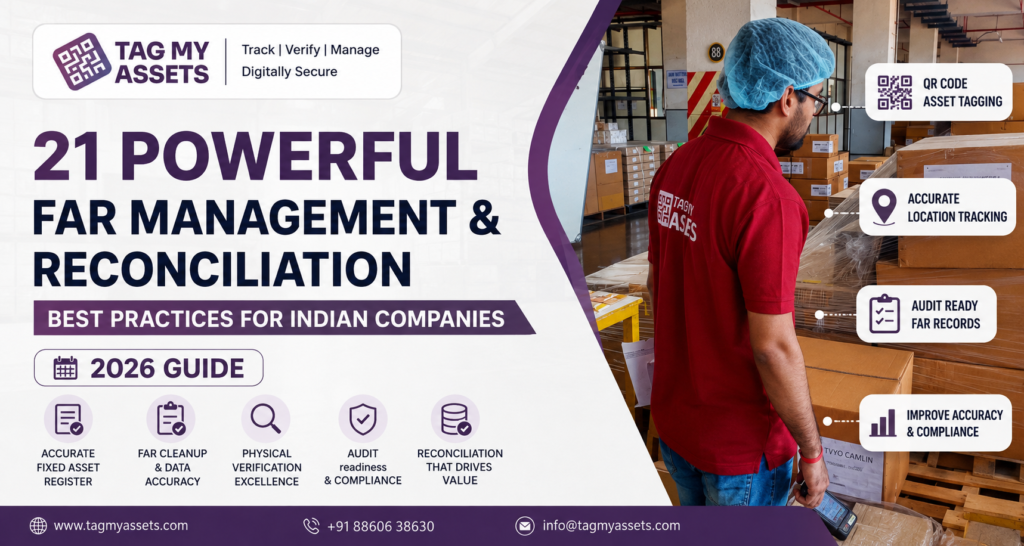
In this detailed guide, we explain 21 powerful FAR management and reconciliation best practices followed by professional asset verification companies and large enterprises across India.
1. Standardize Asset Naming Across the FAR
One of the biggest reasons FARs become unmanageable is inconsistent asset naming.
Examples:
- Office Chair
- Revolving Chair
- Executive Chair
- Black Chair
- Visitor Chair
All may refer to similar asset categories.
Standardized naming improves:
- audit clarity
- reconciliation speed
- ERP reporting
- depreciation accuracy
- physical verification efficiency
Companies should define approved naming conventions for:
- furniture
- IT assets
- machinery
- electrical equipment
- fixtures
- infrastructure assets
2. Remove Duplicate Asset Entries
Duplicate entries are extremely common in old FARs.
These usually happen because of:
- ERP migration
- manual entry errors
- capitalization mistakes
- branch-level data uploads
- acquisition/merger adjustments
Duplicate assets distort:
- net block value
- insurance reporting
- depreciation calculations
- audit accuracy
Regular FAR cleanup exercises help identify and eliminate duplicates before audits.
3. Conduct Regular Physical Asset Verification
FAR records should never be trusted blindly without physical verification.
Every company should conduct periodic:
- fixed asset verification
- asset existence checks
- location mapping
- tag validation
- condition assessment
Physical verification helps identify:
- missing assets
- excess assets
- shifted assets
- unrecorded assets
- damaged assets
Companies with multiple branches and warehouses should ideally perform annual verification exercises.
4. Implement QR Code or RFID Asset Tagging
Manual asset identification creates confusion during audits and reconciliation.
Modern companies use:
- QR code asset tags
- barcode labels
- RFID tags
- mobile scanning systems
Asset tagging helps maintain:
- unique identification
- faster verification
- accurate location tracking
- digital audit trails
- reconciliation efficiency
RFID tagging is especially useful for:
- warehouses
- hospitals
- airports
- manufacturing plants
- high-volume environments
5. Maintain Proper Asset Location Mapping
Many FARs contain assets without accurate location details.
For example:
- “Plant”
- “Office”
- “Warehouse”
These broad descriptions create major reconciliation issues.
Companies should maintain detailed mapping:
- city
- branch
- floor
- department
- zone
- workstation
- store code
Accurate location mapping significantly improves audit traceability.
6. Separate Taggable, Countable & Non-Verifiable Assets
A professional FAR management process should classify assets into:
Taggable Assets
Assets suitable for QR/RFID tagging.
Countable Assets
Assets counted during verification but not tagged.
Examples:
- CCTV cameras
- fire extinguishers
- promotion stands
Non-Verifiable Assets
Assets not physically auditable.
Examples:
- civil work
- software licenses
- installation charges
- electrical cabling inside walls
This classification simplifies reconciliation and audit reporting.
7. Identify Ghost Assets Before Audits
Ghost assets are assets appearing in FAR records but missing physically.
These create:
- inflated asset values
- audit qualifications
- insurance problems
- compliance risks
Ghost assets commonly arise because of:
- asset disposal without accounting update
- theft
- inter-branch transfers
- write-off delays
Professional FAR reconciliation exercises help identify ghost assets early.
8. Track Excess Assets Found During Verification
Sometimes physical assets exist but are missing in the FAR.
These are called excess assets.
Common reasons:
- capitalization omission
- manual procurement
- branch purchases
- donation assets
- transferred assets
Companies should create proper adjustment workflows for excess assets.
9. Use Mobile-Based Verification Applications
Paper-based audits are slow and error-prone.
Modern asset verification uses:
- mobile applications
- cloud synchronization
- GPS capture
- image upload
- real-time reporting
Benefits include:
- faster verification
- reduced human error
- digital audit evidence
- centralized monitoring
10. Maintain Parent-Child Asset Relationships
Complex assets often consist of multiple components.
Example:
- production line
- modular workstation
- server infrastructure
- HVAC systems
Maintaining parent-child structure improves:
- capitalization tracking
- component management
- replacement analysis
- depreciation handling
11. Perform FAR Reconciliation Before Statutory Audits
Waiting for auditors to identify FAR issues is risky.
Companies should conduct:
- pre-audit FAR reconciliation
- physical verification
- capitalization review
- tag validation
- location mapping
before statutory audit commencement.
This reduces audit observations and compliance risks.
12. Clean Old and Obsolete Asset Records
Many FARs contain:
- disposed assets
- scrapped equipment
- inactive assets
- transferred assets
- duplicate codes
Regular cleanup improves:
- FAR accuracy
- ERP performance
- reporting quality
- audit confidence
13. Maintain Proper Asset Categories
Incorrect asset categorization creates depreciation errors.
Companies should maintain structured categories such as:
- furniture & fixtures
- plant & machinery
- computers & IT assets
- electrical equipment
- office equipment
- leasehold improvements
Proper categorization simplifies financial reporting.
14. Capture Asset Photographs During Verification
Photographic evidence improves audit reliability.
Images help verify:
- existence
- condition
- asset type
- tag placement
- location accuracy
This is particularly useful for:
- insurance claims
- internal audits
- dispute resolution
15. Use Geo-Tagging for High-Value Assets
Geo-tagging improves traceability for:
- portable assets
- remote equipment
- infrastructure assets
- field equipment
GPS-enabled verification reduces asset leakage risks.
16. Maintain Disposal and Scrap Records Properly
Asset disposal processes should be tightly controlled.
Companies should maintain:
- disposal approvals
- scrap records
- buyer details
- asset photographs
- accounting entries
Weak disposal controls often lead to FAR inaccuracies.
17. Integrate FAR with ERP Systems
FAR records should align with:
- SAP
- Oracle
- Dynamics
- Tally
- ERPNext
Integration improves:
- automation
- reporting
- capitalization accuracy
- audit transparency
18. Train Internal Teams on FAR Discipline
FAR accuracy is not only an audit responsibility.
Admin teams, procurement departments, finance teams, and plant managers should understand:
- capitalization rules
- tagging processes
- transfer procedures
- disposal controls
Proper training reduces long-term FAR issues.
19. Conduct Zone-Wise or Branch-Wise Reconciliation
Large organizations should reconcile assets:
- branch-wise
- region-wise
- plant-wise
- warehouse-wise
This improves:
- reporting clarity
- accountability
- audit planning
- project execution
20. FAR Management and Reconciliation Documentation Best Practices
Proper documentation is one of the most critical parts of FAR management and reconciliation. During statutory audits, internal audits, insurance assessments, or due diligence reviews, companies must be able to provide complete supporting records for every major asset transaction.
Organizations should maintain:
- asset purchase invoices
- capitalization approvals
- vendor details
- warranty records
- installation reports
- asset transfer records
- disposal approvals
- depreciation workings
- asset tagging reports
- physical verification reports
- FAR reconciliation working papers
Companies with poor documentation often face:
- audit observations
- asset mismatches
- capitalization disputes
- depreciation errors
- insurance claim delays
- compliance risks
Modern FAR management and reconciliation processes should include digital document storage linked directly with the asset register or ERP system. This improves traceability, reduces manual searching, and helps finance teams respond quickly during audits.
Proper audit-ready documentation also supports:
- faster statutory audits
- better internal controls
- smoother FAR reconciliation
- accurate financial reporting
- stronger compliance management
- improved fixed asset governance
Businesses performing regular asset verification and reconciliation should standardize document formats and maintain centralized digital records for long-term control and audit readiness.
This creates strong audit evidence and improves compliance.
21. Partner with Professional FAR Management Companies
Large-scale FAR reconciliation projects require:
- trained manpower
- tagging expertise
- reconciliation methodology
- reporting systems
- mobile verification technology
Professional FAR management companies help businesses improve:
- audit readiness
- asset accuracy
- compliance
- operational efficiency
Conclusion
FAR management and reconciliation are essential for maintaining accurate fixed asset records, improving audit readiness, and reducing financial reporting risks in large organizations.
An effective FAR management and reconciliation process helps companies identify and remove ghost assets, improve capitalisation accuracy, strengthen internal controls, and simplify physical asset verification across multiple locations.
Modern FAR management and reconciliation practices combined with QR code tagging, RFID systems, geo-tagging, ERP integration, and mobile verification technology help businesses maintain reliable and audit-ready asset data.
As Indian businesses continue expanding across factories, warehouses, retail stores, hospitals, and corporate offices, professional FAR management and reconciliation practices will become increasingly important for operational efficiency and compliance management.
Organizations that invest in proper FAR management and reconciliation can significantly improve asset visibility, reduce audit observations, and strengthen long-term financial governance.
FAQ
What is FAR management and reconciliation?
FAR management and reconciliation is the process of maintaining accurate fixed asset register records and matching physical assets with accounting records to improve audit readiness, compliance, and asset control.