
Airports manage thousands of assets across terminals, security zones, baggage handling areas, administrative offices, and maintenance departments. These assets include security scanners, baggage handling systems, computers, communication devices, and operational equipment.
Managing these assets efficiently is essential to ensure smooth airport operations and maintain accurate asset records. Implementing asset tagging for airports helps airport authorities track equipment across multiple locations, improve asset visibility, and simplify asset verification.
Without proper asset management systems, airports may struggle to track large numbers of assets spread across terminals, departments, and operational zones.
To ensure audit readiness, companies prefer asset tagging and FAR reconciliation services.
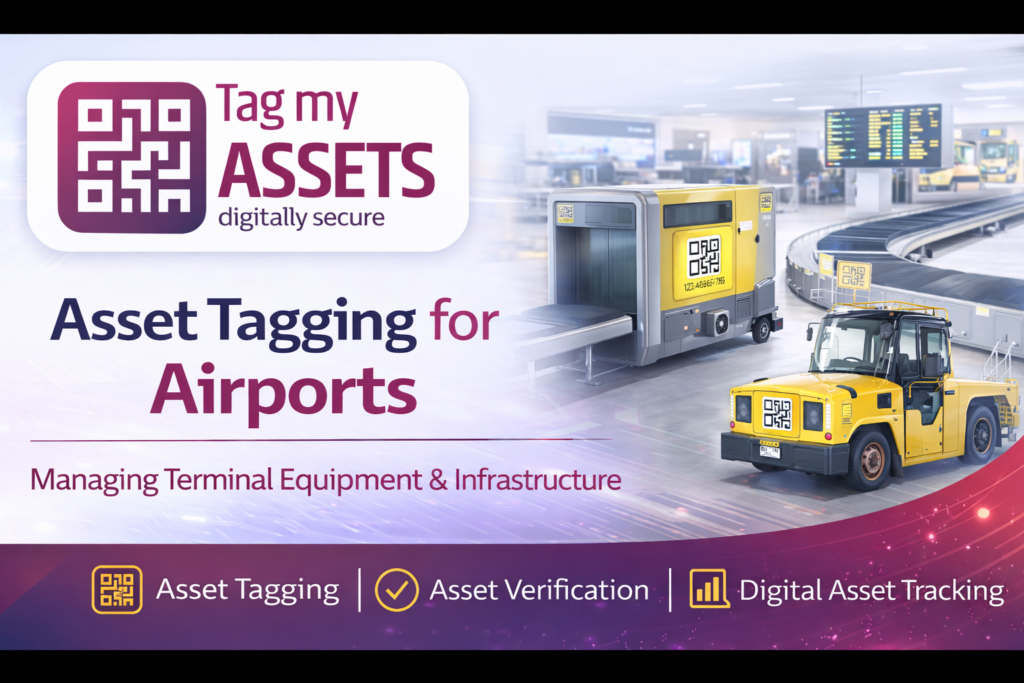
Why Asset Management is Critical for Airports
Airports operate in a highly regulated and security-sensitive environment where asset control is extremely important.
Common airport assets include:
- Baggage handling equipment
- Security scanners and surveillance systems
- IT infrastructure and networking devices
- Passenger boarding equipment
- Communication devices
- Ground support equipment
- Terminal furniture and digital displays
- Maintenance tools and technical equipment
Without proper tracking systems, airports may face challenges such as:
- Difficulty locating equipment
- Asset misplacement between terminals
- Inaccurate asset records
- Time-consuming asset verification
- Inefficient asset utilization
Implementing asset tagging for airports helps airport authorities maintain accurate asset records and improve operational efficiency.
What is Asset Tagging for Airports?
Asset tagging is the process of attaching identification labels such as QR codes, barcodes, or RFID tags to assets for easy tracking and management.
Each asset tag contains a unique identification number linked to a digital asset management system.
When the tag is scanned using a mobile device or scanner, the system can display information such as:
- Asset name
- Location or terminal
- Department
- Asset status
- Maintenance history
This allows airports to maintain a centralized asset tracking system.
Assets Commonly Tagged in Airports
Airports can tag a wide range of operational assets.
Examples include:
- Baggage conveyor systems
- Security screening machines
- Passenger boarding equipment
- CCTV cameras and surveillance systems
- Airport IT infrastructure
- Digital display systems
- Ground support equipment
- Maintenance tools and machines
By implementing asset tagging for airports, airport authorities can manage assets efficiently across multiple terminals and departments.
Benefits of Asset Tagging for Airports
Asset tagging offers several operational benefits for airport authorities.
Improved Asset Visibility
Tagged assets can be easily identified and tracked across terminals and departments.
Faster Asset Verification
Asset verification teams can quickly identify assets during inspections or audits.
Better Asset Control
Airport authorities can monitor asset movement between terminals and operational zones.
Accurate Asset Records
Asset tagging helps maintain updated and accurate asset registers.
Efficient Asset Audits
Tagged assets simplify verification during financial audits and operational inspections.
QR Code Asset Tagging for Airports
QR code asset tags are widely used because they allow quick scanning using smartphones and mobile asset management applications.
Advantages include:
- quick asset identification
- cost-effective tagging solution
- faster verification process
- mobile-based asset tracking
This makes QR code tagging ideal for large environments such as airports. Asset tagging for airports helps airport authorities maintain accurate asset records across terminals, security zones, and operational departments.
Role of Asset Tagging in Airport Asset Verification
Airports regularly conduct asset verification for:
- regulatory compliance
- financial audits
- internal inspections
- asset register reconciliation
With asset tagging for airports, verification teams can quickly identify assets and match them with asset records in the Fixed Asset
This significantly improves the accuracy and efficiency of asset verification. Airport infrastructure projects often involve complex asset tracking systems similar to large-scale logistics operations described by
ISO Asset Management Standards.
How TagMyAssets Helps Airports Manage Assets
TagMyAssets provides professional asset tagging solutions designed for large infrastructure environments such as airports.
Services include:
- QR code asset tagging
- barcode asset labeling
- RFID asset tracking
- physical asset verification
- digital asset register creation
These solutions help airport authorities maintain accurate asset records and improve operational asset management.
Conclusion
Airports operate complex infrastructure with thousands of assets distributed across terminals, security zones, and operational departments.
Implementing asset tagging for airports helps airport authorities improve asset visibility, simplify asset verification, and maintain accurate asset registers.
Asset tagging plays a critical role in improving asset management and operational efficiency in modern airport environments.To understand asset tagging in detail, read our complete guide on asset tagging.
Airports worldwide follow strict infrastructure and asset management standards recommended by the
International Air Transport Association (IATA).
FAQ
What is asset tagging for airports?
Asset tagging for airports is the process of attaching identification labels such as QR codes, barcodes, or RFID tags to airport equipment for easy tracking and management.
Why do airports need asset tagging?
Airports use asset tagging to track equipment across terminals, maintain accurate asset records, and simplify asset verification.
Which assets can be tagged in airports?
Assets such as security scanners, baggage systems, IT infrastructure, CCTV systems, and ground support equipment can be tagged.
Can QR codes be used for airport asset tagging?
Yes, QR codes are commonly used because they allow quick asset identification using mobile devices and scanners.
How does asset tagging help airport audits?
Asset tagging helps verification teams quickly identify assets and match them with asset records during audits.
Register.Asset tagging solutions are widely used across industries such as manufacturing and retail.
You can also read our guide on
fixed asset verification services.