
FAR reconciliation using RFID is transforming how Indian companies identify ghost assets, verify physical assets, improve audit compliance, and build accurate fixed asset registers. Instead of relying only on manual verification, RFID enables faster, audit-ready asset reconciliation.
Key facts at a glance
| Point | Practical relevance for CFOs and auditors |
| Primary compliance link | CARO 2020 Clause 3(i) requires reporting on PPE records, physical verification, material discrepancies, title deeds, revaluation and related matters. |
| Accounting review areas | Ind AS 16 for derecognition, Ind AS 36 for impairment indicators, and Ind AS 8 where legacy errors may be material. |
| RFID use case | Best suited for multi-location, high-volume, movable or frequently transferred assets where exception reporting matters. |
| India RFID compliance | UHF RFID reader selection should be checked against permitted Indian WPC/DoT frequency requirements before deployment. |
| Recommended rhythm | Annual verification for large enterprises, with rolling verification for high-risk locations, asset classes or recent ERP migrations. |
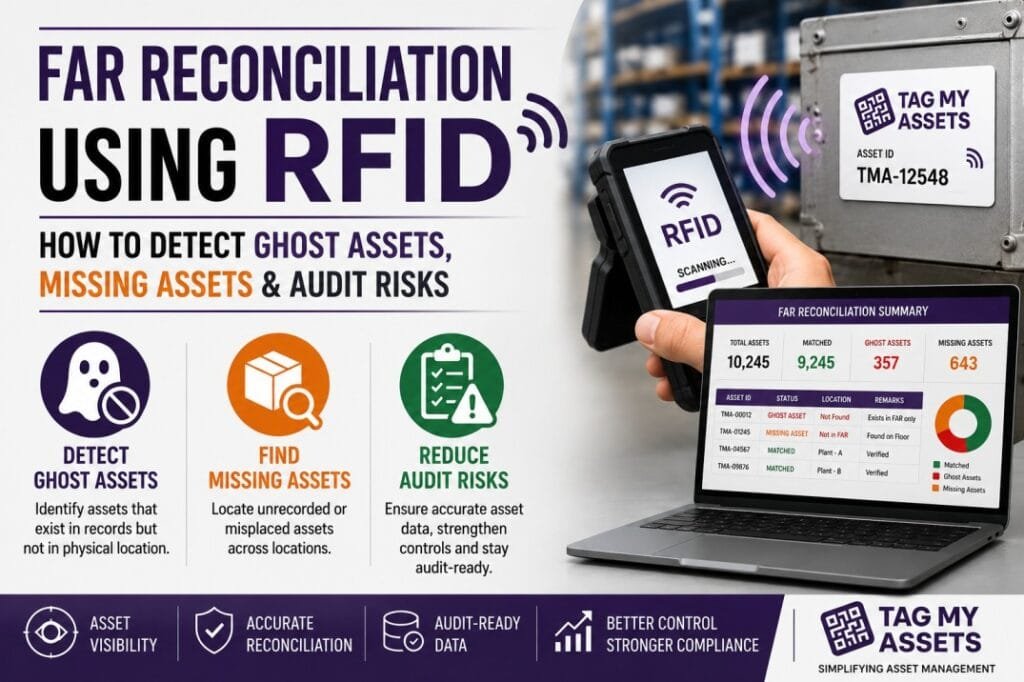
FAR reconciliation using RFID
A Fixed Asset Register (FAR) is expected to represent what the company owns, where it is located, how it is being used, and how much value remains in the books. In reality, many Indian companies discover during audits that the FAR is only partly aligned with the physical assets on the floor. Assets may have been transferred from one plant to another, scrapped locally, replaced by maintenance teams, shifted during expansion, or uploaded incorrectly during ERP migration. The accounting record continues, but the physical reality has changed.
This is where ghost assets, missing assets, duplicate assets, and misclassified assets become audit risks. A ghost asset is an asset appearing in the FAR but not available physically. A missing asset is physically found or operationally used but not properly recorded, tagged, or mapped in the FAR. Both situations distort depreciation, insurance coverage, location-level control, maintenance planning, and management reporting.
RFID-based FAR reconciliation gives finance, internal audit, and operations teams a practical way to clean the asset register at scale. Instead of relying only on manual tick marks and spreadsheet remarks, RFID creates a digital trail: asset ID, tag ID, location, scan date, auditor name, exception status, and supporting evidence. For companies preparing for statutory audit, CARO 2020 reporting, ERP cleanup, merger integration, or plant-level asset verification, RFID can turn a weak FAR into an audit-ready asset register.
| Key thesis: RFID does not merely identify assets faster. Its real value is in exception management – detecting what is in books but not on floor, what is on floor but not in books, and what is wrongly classified, duplicated, transferred, or depreciated. |
7 Warning Signs Your FAR Needs Cleanup
| Warning sign | What it indicates |
| Asset physically unavailable but still in FAR | The FAR shows the asset as active, but the plant, store, branch, or department cannot locate it during verification. This may indicate disposal without accounting, theft, transfer, or legacy migration error. |
| Duplicate asset IDs or similar descriptions | Multiple lines describe the same machine, furniture, computer, fixture, or equipment. Duplicate capitalization can overstate gross block and depreciation. |
| Depreciation continuing on disposed assets | The accounting system keeps charging depreciation even after the asset has been sold, scrapped, replaced, or abandoned. |
| ERP migration mismatch | Old codes are moved from legacy ERP to SAP, Oracle, Tally, or another system without proper location, serial number, or category mapping. |
| Unknown or generic locations | Assets are mapped to “HO”, “Plant”, “Store”, “Warehouse”, or “Admin” without a department, floor, room, cost centre, or custodian. |
| Abnormal depreciation or Net Block values | Assets showing negative or unexpectedly low net value may indicate incorrect depreciation, duplicate records, wrong useful life assumptions, or outdated FAR entries. |
| Assets not verified for more than two years | The longer the gap between physical verification cycles, the higher the probability of ghost assets, missing assets, and stale FAR data. |
The Three Asset Failure Modes
1. Ghost assets
Ghost assets are assets that appear in the FAR but cannot be found physically. In India, this often happens where plant maintenance teams scrap items without informing finance, branch teams shift assets without transfer documentation, or old ERP records are carried forward during migration. In retail and distributed locations, ghost assets also arise when store closures, renovations, or asset replacements are not updated in the central FAR.
The financial statement impact is direct. Gross block may be overstated, accumulated depreciation may be incorrect, and profit or loss may not reflect the disposal loss at the right time. If material discrepancies are not investigated and adjusted, the auditor may ask management to provide reconciliation, write-off approval, disposal documentation, or management representation.
Example: A company’s FAR shows air conditioners, computers, racks, or machines at a branch that was renovated two years ago. The branch confirms those assets were replaced, but no disposal entry was passed. These are ghost assets until management validates and accounts for the difference.
2. Missing assets
Missing assets are the opposite problem: the physical asset exists, but it is not properly available in the FAR. This may happen where assets are purchased directly by a location, capitalized under a wrong category, recorded as repair expense, imported from another branch without transfer entry, or installed as part of a project without item-level breakup.
The financial statement impact can include understatement of fixed assets, wrong capitalization, weak insurance coverage, and lack of control over movable assets. Missing assets are especially common where construction, leasehold improvement, retail fit-out, IT equipment, or plant installation costs are capitalized in bulk without item-wise tagging.
Example: During RFID scanning at a warehouse, auditors identify pallet racks, scanners, printers, and UPS units that are physically available but not mapped to specific FAR codes. These items need ownership validation, capitalization review, and tagging or adjustment.
3. Misclassified assets
Misclassification occurs when an asset exists physically and in the FAR but is recorded under the wrong class, location, cost centre, useful life, or ownership status. A machine may be recorded as office equipment, a leasehold improvement may be recorded as furniture, or a plant asset may remain mapped to head office after transfer.
The impact is not limited to reporting presentation. Depreciation rates, useful life, impairment assessment, tax block classification, insurance coverage, and location-wise controls may all be affected. In audit, misclassification creates questions around the reliability of the FAR and whether the verification process is capable of identifying material errors. In India, this can become material because different asset classes may carry different useful life assumptions under Schedule II or under company-specific Ind AS policies, affecting depreciation over several years.
Example: A server rack capitalized under furniture may follow a different useful life and maintenance trail than IT equipment. RFID scanning will identify the physical asset, but accounting review is required to correct the classification.
FAR Reconciliation Using RFID: Why Traditional Asset Verification Fails
Traditional fixed asset verification methods usually rely on manual counting, spreadsheets, physical checklists, and location-wise confirmations. While these methods may work for small asset bases, they often become inefficient and error-prone for companies operating across multiple plants, warehouses, retail stores, hospitals, or branch locations.
As businesses grow, assets are frequently transferred, replaced, scrapped, relocated, repaired, or capitalized under different categories. Over time, the Fixed Asset Register (FAR) may stop reflecting the actual physical assets available on the floor. This creates a gap between what exists in books and what exists physically.
Traditional asset verification commonly fails because:
1. Manual processes increase the risk of human error
Manual verification depends heavily on auditors recording asset details correctly. Wrong asset descriptions, missed entries, duplicate records, and inconsistent naming conventions often lead to inaccurate FAR records.
Example:
Asset in FAR → “Desktop Computer – Admin”
Physical asset → “Dell Optiplex – HR Department”
Without standardization, both may be treated differently despite referring to the same asset.
2. Ghost assets remain undetected
Ghost assets are assets appearing in the FAR but not physically available. Traditional verification methods often fail to identify these discrepancies quickly.
Common causes:
- Unrecorded disposals
- Asset transfers without documentation
- ERP migration errors
- Store closures or renovations
- Asset replacements without accounting updates
This may lead to:
✓ Overstated gross block
✓ Incorrect depreciation
✓ Audit observations
✓ Higher insurance cost
3. Missing assets are difficult to identify
Companies sometimes physically own assets that are not properly mapped to FAR records.
Examples:
- Warehouse equipment
- Printers
- UPS systems
- Furniture
- Tools and machinery
Traditional verification may identify these assets but fail to reconcile them with accounting records.
4. Multi-location verification becomes slow and expensive
For organizations with hundreds of locations, manual verification requires:
- Larger teams
- Longer timelines
- Higher travel cost
- Multiple verification cycles
This increases project cost and delays audit closure.
5. Asset movement tracking is weak
Assets frequently move between:
- Plants
- Branches
- Warehouses
- Departments
- Retail stores
Traditional methods struggle to maintain updated location records, increasing FAR mismatches.
6. Audit evidence remains limited
Manual verification often relies on:
- Signed sheets
- Excel files
- Photographs
RFID-based verification creates a stronger digital trail:
✓ Tag ID
✓ Scan date
✓ Asset location
✓ Verification history
✓ Auditor details
This improves audit readiness.
How FAR Reconciliation Using RFID Solves These Problems
Unlike traditional verification, FAR reconciliation using RFID creates a digital process where assets can be scanned, matched with FAR records, exceptions identified, and discrepancies resolved faster.
RFID helps organizations detect:
- Ghost assets
- Missing assets
- Duplicate records
- Wrong locations
- Misclassified assets
- Unverified assets
The real benefit of FAR reconciliation using RFID is not only faster scanning — it is creating an accurate, audit-ready Fixed Asset Register backed by verifiable evidence.
How RFID Physical Verification Actually Works
| RFID verification step | Detailed explanation and output |
| Step 1: FAR extraction and data hygiene | Finance exports the FAR from SAP, Oracle, Tally, Microsoft Dynamics, or another ERP. The data is cleaned before fieldwork: duplicate codes are marked, non-auditable items are excluded, taggable and countable assets are separated, location codes are standardized, and mandatory fields such as asset ID, description, quantity, gross block, accumulated depreciation, net block, location, and custodian are reviewed. Output: a verification-ready asset master. |
| Step 2: RFID tag assignment | Each taggable asset is mapped with a unique RFID tag number. For metal assets, suitable on-metal RFID tags are selected; for non-metal surfaces, paper or polyester RFID labels may be used. Artwork, tag size, adhesive, placement, and tag durability are agreed before field deployment. Output: tag mapping file and tagging plan. |
| Step 3: Physical tagging and scanning | The field team pastes RFID tags on assets and uses handheld RFID readers or RFID-enabled devices to scan assets in bulk. RFID is useful where assets are numerous, spread across racks, plant areas, warehouses, branches, stores, or departments. In India, UHF RFID deployments should use permitted WPC/DoT frequency bands and approved readers. Output: scan dump with tag ID, asset ID, scan location, date, and auditor details. |
| Step 4: Exception reporting | The scan dump is matched with the FAR. The system flags clean matches, ghost assets, missing assets, duplicate scans, wrong locations, wrong categories, damaged tags, and unverified assets. This is the most important stage because audit value comes from exceptions, not just from scanning. Output: exception report with recommended action. |
| Step 5: Management validation | Finance, operations, store teams, plant teams, and internal audit review exceptions. Some differences may be genuine transfers, pending capitalization, split assets, countable items, or assets under repair. Evidence is attached wherever available: photographs, disposal notes, transfer approvals, invoices, or user confirmations. Output: management-approved reconciliation file. |
| Step 6: ERP update and audit documentation | Approved corrections are posted in ERP. These may include location changes, asset class correction, disposal/write-off entries, capitalization review, duplicate merging, or tagging master update. Output: clean FAR, exception closure file, and audit-ready working papers. |
Note (RFID Compliance): For UHF RFID in India, companies should ensure that RFID readers and deployment design are aligned with permitted WPC/DoT bands. The commonly referenced Indian UHF RFID range is 865-867 MHz, while the 2021 low-power short-range device rules refer to 865-868 MHz for specified equipment. The practical point for CFOs is simple: do not import or deploy foreign-band RFID readers without checking India compliance.
For the tagging-side process, see our complete guide to RFID fixed asset verification.
Full Reconciliation Matrix: From Scan Result to Accounting Action
| Outcome | Meaning | Accounting/ERP action | Audit risk | Severity |
| Clean match | Asset exists in FAR and is scanned at the expected location. | Retain record. Update verification date and tag status. | Low risk. Keep scan report as audit evidence. | Low |
| Ghost asset | Asset exists in FAR but is not found physically. | Investigate. If confirmed disposed/lost, pass write-off or disposal entry with approval. | Potential overstatement of PPE and depreciation error. | High |
| Missing asset | Asset is physically found but not properly recorded in FAR. | Trace purchase, ownership, and capitalization. Add or map to FAR if valid. | Possible understatement of PPE or weak capitalization control. | High |
| Location mismatch | Asset exists and is scanned but at a different location. | Update location/cost centre after transfer approval. | Control weakness in asset movement documentation. | Medium |
| Condition mismatch | Asset exists but is damaged, obsolete, idle, or not usable. | Review impairment, repair, replacement, or disposal decision. | Potential impairment or useful life reassessment issue. | Medium to High |
| Duplicate asset | Same physical asset appears under multiple FAR codes or multiple tags. | Merge records, deactivate duplicate, and correct gross block/depreciation if needed. | Potential overstatement and duplicate depreciation. | High |
| Unverified asset | Asset could not be scanned due to access, shutdown, safety restriction, or missing tag. | Reschedule verification or obtain alternate evidence. | Open audit item until verified or explained. | Medium |
Manual Verification vs RFID Reconciliation
| Dimension | Manual verification | RFID reconciliation |
| Time taken | High for multi-location entities; depends heavily on manual tick marks and Excel consolidation. | Typically faster for large asset bases because RFID can scan multiple tags quickly; in planning, companies may treat RFID-led verification as several times faster than manual tick-marking once tagging and master data are ready. |
| Team size | Usually requires larger field teams and more supervision. | Can reduce repetitive manual checking, though trained manpower is still required for tagging and exception validation. |
| Accuracy | Prone to typing errors, missed items, duplicate remarks, and inconsistent descriptions. | Improves traceability through unique tag IDs, digital scan records, and exception reports. |
| Audit trail | Often limited to signed sheets and photographs. | Stronger audit trail with scan dump, date/time, tag ID, location, and user details. |
| Cost per asset | May appear low initially, but repeated manual cycles increase hidden cost. | Higher setup cost but better for recurring verification and multi-location controls. |
| Frequency feasibility | Difficult to repeat frequently for large companies. | More feasible for annual, half-yearly, or location-wise recurring verification. |
| Exception management | Manual reconciliation can become slow and subjective. | Exception categories can be standardized: ghost, missing, duplicate, location mismatch, and condition mismatch. |
CARO 2020 and Ind AS Audit Risk Table
For Indian companies covered by CARO 2020, fixed asset verification is not just an internal control exercise. Clause 3(i) requires auditors to report on records of Property, Plant and Equipment, physical verification at reasonable intervals, material discrepancies, title deed matters, revaluation, and proceedings relating to benami property where applicable. RFID-based FAR reconciliation supports management in producing evidence before the audit begins.
| Area | What auditor looks for | Risk observed during FAR reconciliation | Management response |
| CARO 2020 Clause 3(i)(a) | Proper records showing full particulars, quantitative details, and situation of PPE. | Missing location, vague descriptions, duplicate assets, and unmapped tags. | Maintain item-wise FAR with asset ID, tag ID, location, class, cost, accumulated depreciation, NBV, and custodian. |
| CARO 2020 Clause 3(i)(b) | Physical verification of PPE at reasonable intervals and treatment of material discrepancies. | Ghost assets, unverified assets, and unexplained differences. | Use RFID scan report, exception summary, management approval, and accounting adjustment notes. |
| CARO 2020 Clause 3(i)(c) | Title deeds of immovable properties in company name. | Land/building title mismatch is not solved by RFID, but FAR cleanup can flag ownership documentation gaps. | Maintain title deed reconciliation separately for immovable properties. |
| Ind AS 16 derecognition | Derecognise PPE on disposal or when no future economic benefits are expected. | Ghost assets may indicate that derecognition was not recorded at the right time. | Pass disposal/write-off entry after approval and evidence. |
| Ind AS 8 prior period considerations | Prior period errors may require evaluation if old ghost assets are material. | Large legacy errors discovered during cleanup. | Assess materiality and disclose/adjust as advised by auditor. |
| Internal financial controls | Asset movement, disposal, tagging, and custody controls. | Weak transfer approvals, local scrapping, missing approvals. | Implement maker-checker workflow and periodic verification calendar. |
| Ind AS 36 impairment indicators | Whether idle, damaged, obsolete or underperforming PPE indicates impairment. | Condition mismatch, idle equipment, damaged assets or assets no longer used in operations. | Assess impairment indicators, estimate recoverable amount where required, and document management conclusion. |
Example Auditor Observation Language
If discrepancies remain unresolved, audit comments may sound like this:
- “The company has not maintained proper records showing full particulars including quantitative details and situation of certain items of Property, Plant and Equipment.”
- “The Property, Plant and Equipment have not been physically verified by the management at reasonable intervals.”
- “Material discrepancies were noticed on physical verification and have not been properly dealt with in the books of account.”
- “The fixed asset register requires reconciliation with physical assets and location-wise records.”
Accounting Entry for Ghost Asset Write-off
When a ghost asset is confirmed as disposed, lost, scrapped, or no longer expected to generate future economic benefits, management should evaluate derecognition under Ind AS 16. The accounting treatment should be supported by approval notes, disposal evidence, physical verification report, and auditor review.
Illustration: A machine appears in FAR at original cost of Rs. 10,00,000. Accumulated depreciation is Rs. 7,50,000. Net carrying amount is Rs. 2,50,000. During RFID reconciliation, the machine is not found. Plant management confirms that it was scrapped in an earlier year but no entry was passed. After approval, the entry may be:
| Account | Amount (Rs.) | Purpose |
| Dr Accumulated Depreciation | 7,50,000 | To remove accumulated depreciation from books |
| Dr Loss on Disposal / Write-off | 2,50,000 | To recognise carrying amount not recovered |
| Cr Gross Block – Machinery | 10,00,000 | To derecognise original cost from FAR |
In the financial statements, the loss on disposal or write-off is normally presented in profit and loss under other expenses or a suitable line item based on materiality and presentation policy. It should not be treated as an exceptional item merely because it arose from FAR cleanup unless the amount and circumstances justify separate disclosure.
If the error relates to a prior period and is material, Ind AS 8 implications should be evaluated with the statutory auditor. If it is immaterial, companies generally process it through current period profit and loss with proper approval and disclosure judgment. For income tax, treatment should be evaluated under the block of assets mechanism under Section 32. Where the block continues to exist, individual asset write-off does not always result in a separate tax loss; the block WDV and sale/scrap proceeds, if any, need to be considered as per tax rules.
India-specific Landmines in RFID FAR Cleanup
1. ERP migration legacy errors
Many companies migrate from manual FAR, Excel, Tally, or legacy ERP systems to SAP, Oracle, or Microsoft Dynamics. During migration, old asset descriptions may be copied without accurate location, serial number, quantity, or useful life. RFID verification exposes these errors quickly because the physical scan demands a one-to-one link between the tag and the FAR code.
2. Inter-state GST and branch transfer implications
RFID reconciliation may reveal assets physically located in a different state from the FAR location. If the movement involved inter-state branch transfer, sale, or supply between GST registrations, finance should review whether GST documentation, e-way bill, tax invoice, delivery challan, or internal transfer records were required. Not every location mismatch creates GST liability, but every material mismatch should be reviewed. Where assets move between GST registrations of the same legal entity, finance should also examine whether the transaction could be treated as a supply between distinct persons, depending on facts and documentation.
3. ITC reversal and capital goods review
Where capital goods are lost, stolen, destroyed, written off, or disposed, GST and ITC implications should be reviewed under the relevant provisions. Rule 43 deals with ITC attribution/reversal for capital goods in specified cases, while Rule 44 is relevant in special circumstances such as credit reversal on inputs/capital goods held in stock. The exact treatment depends on facts, asset use, ITC availed, date of purchase, remaining useful life, and disposal mode.
4. GFR 2017 and PSU/government controls
For PSUs, government entities, and grant-funded projects, asset verification is often tied to stricter documentation, custody, disposal, and approval protocols. RFID helps by giving a stronger register of location, user department, tag number, and verification history. However, RFID does not replace required administrative approvals for disposal, transfer, or write-off.
5. Countable vs taggable assets
Not every asset can or should be RFID-tagged. Fire extinguishers, CCTV cameras, fixtures, artworks, small tools, fragile surfaces, and embedded assets may be better handled as countable assets or location-based verification items. A clean methodology should define taggable, countable, and non-auditable categories before fieldwork begins.
Industry-specific RFID FAR Reconciliation Challenges
| Industry | Common FAR reconciliation challenge |
| Manufacturing | Heavy machines, tools, moulds, dies, utilities, and plant spares may be difficult to access during production. Metal surfaces require suitable RFID tags and placement testing. |
| Retail chains | Store closures, renovations, fixtures, POS machines, display racks, and frequent transfers create high risk of ghost and missing assets. |
| Hospitals | Medical equipment, movable diagnostic devices, beds, monitors, and department transfers require strong custodian mapping and downtime planning. |
| Pharma | Clean rooms, controlled areas, validation equipment, and QA documentation make access and tagging protocol important. |
| Warehousing and logistics | Racks, scanners, forklifts, printers, pallets, and dock equipment move frequently and need location discipline. |
| IT and corporate offices | Laptops, servers, printers, network devices, and furniture require user-wise and department-wise mapping. |
| PSUs and government | Documentation, approvals, title records, disposal rules, and audit queries are often more formal and need robust evidence. |
| Real estate and construction | Capital work-in-progress transfers, project assets, site equipment, temporary structures, tools and bulk capitalization often create ghost assets or missing item-level FAR details after project completion. |
Implementation Roadmap
| Phase | Action |
| Phase 1: Data hygiene | Clean FAR, remove obvious duplicates, classify assets as taggable/countable/non-auditable, and standardize locations. |
| Phase 2: Pilot tagging | Test RFID tags on different surfaces: metal, plastic, wood, glass, machinery, racks, and office assets. |
| Phase 3: Full tagging and scanning | Deploy field teams with asset master, tag inventory, RFID readers, and escalation matrix. |
| Phase 4: Exception reporting | Generate ghost asset list, missing asset list, duplicate list, location mismatch list, and unverified list. |
| Phase 5: Management validation | Obtain approvals from finance, operations, plant/store heads, and internal audit. |
| Phase 6: ERP update | Post approved corrections: location updates, disposals, write-offs, classifications, and new asset mapping. |
| Phase 7: Audit file | Maintain final FAR, signed reports, exception closure, scan dump, photographs, and management representation. |
ROI Framing for CFOs and Audit Committees
The ROI of RFID-based FAR reconciliation should not be measured only by tag cost or scanning speed. The larger benefit is control improvement: fewer ghost assets, faster audit closure, stronger location-wise accountability, better insurance data, cleaner depreciation, and lower time spent by finance teams on repeated manual reconciliation. As a practical planning benchmark, management should not be surprised if a first-time FAR cleanup produces a meaningful exception list across location mismatches, duplicate records, unverified assets and capitalization gaps; the ROI comes from closing these exceptions, not from the tag alone.
In practice, this translates to:
- Reduces audit delays caused by unresolved physical verification differences.
- Improves confidence in gross block, accumulated depreciation, and location-wise PPE records.
- Creates a repeatable verification process for future periods.
- Helps management identify idle, obsolete, damaged, or unproductive assets.
- Supports faster ERP cleanup after merger, expansion, restructuring, or migration.
- Improves accountability by linking assets to location, department, custodian, and verification status.
Suggested Workflow Diagram
| Step | Workflow stage |
| 1 | ERP/FAR extraction |
| 2 | Data cleanup |
| 3 | RFID tag mapping |
| 4 | Physical tagging |
| 5 | RFID scanning |
| 6 | Exception report |
| 7 | Management validation |
| 8 | Accounting/ERP update |
| 9 | Audit-ready FAR |
FAQs
What are ghost assets in FAR?
Ghost assets are assets recorded in the Fixed Asset Register but not physically available during verification. They may arise because of unrecorded disposal, transfer, theft, scrapping, ERP migration errors, or weak location controls. If material, they can overstate fixed assets and distort depreciation.
Can RFID detect missing fixed assets?
Yes. RFID helps detect assets that are physically available but not properly mapped to the FAR. These may be untagged, wrongly capitalized, recorded under another location, or included in a bulk project cost. The final accounting action requires management validation.
Does RFID support CARO 2020 compliance?
RFID supports management evidence for CARO 2020 Clause 3(i), especially around physical verification of PPE, material discrepancies, and proper records. It does not replace auditor judgment, but it creates better working papers and exception trails.
How often should FAR reconciliation be performed?
Large companies should consider annual verification, with rolling verification for high-risk locations or asset classes. RFID makes recurring verification more practical because the tagging and master data foundation can be reused.
Is RFID better than QR code for fixed asset verification?
RFID is better where bulk scanning, speed, or non-line-of-sight scanning is required. QR codes are cost-effective and suitable where each asset can be scanned individually. Many companies use a hybrid model based on asset value, volume, and location.
What should be done when ghost assets are found?
Ghost assets should not be written off immediately without investigation. Finance should obtain location confirmation, disposal evidence, management approval, and auditor consultation where material. Only confirmed cases should be adjusted in books.
Can RFID solve all FAR problems?
No. RFID improves identification and traceability, but FAR cleanup also needs accounting judgment, ERP discipline, management approvals, and periodic controls. Technology identifies exceptions; management resolves them.
What documents should be kept for audit?
Keep the asset master, RFID tag mapping, scan dump, exception report, photographs where relevant, management approvals, accounting entries, ERP update logs, and final reconciliation summary.
What is the typical cost of RFID-based FAR reconciliation in India?
The cost depends on asset count, locations, RFID tag type, metal/non-metal surface mix, reader requirement, manpower days, travel, data cleanup complexity and audit documentation depth. For India, companies generally evaluate RFID FAR reconciliation as a project cost rather than only a per-tag cost, because exception reporting, management validation and ERP reconciliation are the real value drivers.
Will RFID provide enough operational, audit, and control benefits compared to the cost?
Yes — for companies with large asset bases, multiple locations, frequent asset movement, or recurring audit requirements, RFID often delivers value beyond tag cost through faster verification, improved FAR accuracy, stronger controls, and reduced audit effort. For smaller organizations with limited assets, QR codes or manual verification may sometimes be more cost-effective. The decision should focus on the cost of poor asset visibility and repeated manual verification, not only on RFID implementation cost.
Conclusion
A clean FAR is not only an accounting record; it is evidence that the company knows what it owns, where each asset is located, and whether the asset is still useful. RFID strengthens this evidence by converting physical verification into a repeatable, exception-based control process. For CFOs, internal auditors and plant or store heads, the real objective is not merely faster scanning, but a cleaner, audit-ready FAR backed by management-approved actions.
Need RFID-based FAR Reconciliation Support?
TagMyAssets helps companies convert scattered fixed asset data into an audit-ready FAR through RFID tagging, physical verification, ghost asset detection, missing asset reporting, FAR cleanup, ERP reconciliation, and exception-wise audit documentation.
If your company is preparing for statutory audit, CARO 2020 review, ERP migration, multi-location verification, or fixed asset cleanup, RFID-based FAR reconciliation can help you move from assumptions to evidence.
Why Companies Choose TagMyAssets for FAR Reconciliation Using RFID
TagMyAssets helps companies perform FAR reconciliation using RFID through fixed asset tagging, physical verification, ghost asset detection, FAR cleanup, ERP reconciliation, and audit-ready documentation.
Our teams support multi-location industries including manufacturing, retail, warehouses, PSUs, and corporate offices. By combining RFID technology with audit-focused asset verification processes, we help organizations improve asset visibility, reduce ghost assets, and strengthen compliance.
Services include:
ERP reconciliation and asset cleanup
physical verification of assets
audit support documentation