
What Is Physical Verification of Fixed Assets?
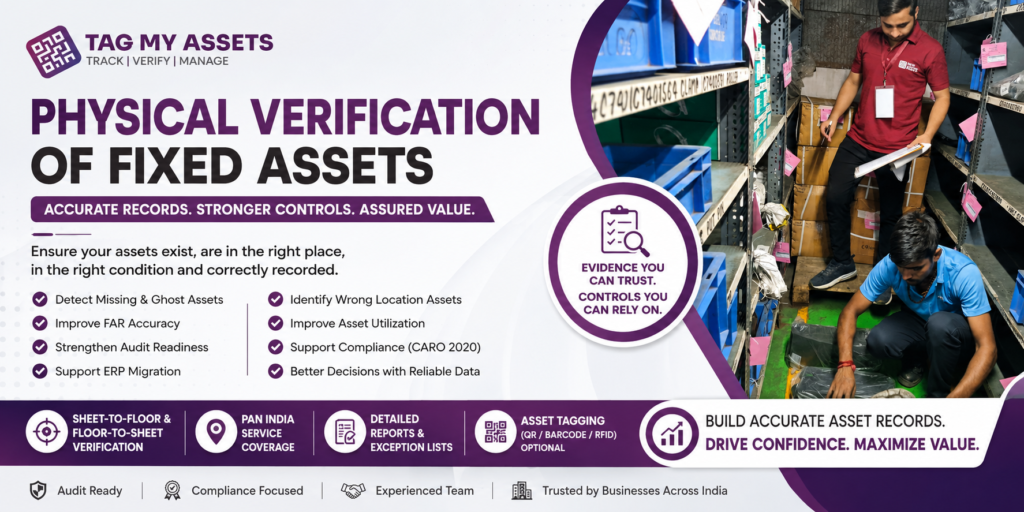
Physical verification of fixed assets is the process of confirming whether assets recorded in the Fixed Asset Register (FAR) physically exist, where they are located, who is responsible for them, and whether their condition matches organizational records.
Physical verification commonly identifies:
✓ Missing assets
✓ Ghost assets
✓ Wrong location assets
✓ Additional/unrecorded assets
✓ Duplicate records
✓ Damaged or obsolete assets
Organizations commonly conduct physical verification before:
- Statutory audits
- ERP migration
- Insurance renewal
- Mergers & acquisitions
- Asset tagging projects
- Internal control reviews
“Looking for professional fixed asset verification services in India? See how Tag My Assets delivers end-to-end verification →”
Why Is Physical Verification of Fixed Assets Important?
Many organizations assume their FAR accurately reflects reality.
Actual findings often differ.
| Challenge | Physical Observation | Business Risk |
|---|---|---|
| Ghost assets | Exists in FAR but not physically | Incorrect depreciation |
| Missing assets | Not traceable | Financial loss |
| Wrong location | Asset moved but records unchanged | Weak controls |
| Duplicate records | Same asset recorded multiple times | Overstated asset values |
| Unrecorded assets | Physical asset absent from FAR | Incomplete records |
| Obsolete assets | Exists but unusable | Impairment risk |
| Idle assets | Available but unused | Poor utilization |
Physical verification converts assumptions into evidence.
Physical Verification vs FAR Reconciliation: What Is the Difference?
Many organizations confuse these processes.
| Aspect | Physical Verification | FAR Reconciliation |
|---|---|---|
| Purpose | Confirm physical existence | Correct accounting records |
| Output | Verification report | Updated FAR |
| Focus | Existence, location, condition | Financial accuracy |
| Trigger | Audit / periodic review | Reconciliation need |
Physical verification generally becomes the starting point, while FAR reconciliation converts findings into accounting corrections.
Sheet-to-Floor vs Floor-to-Sheet Verification
Understanding both approaches for physical verification of fixed assets matters.
Sheet-to-Floor Verification
Start:
FAR → Physical Asset
Questions:
- Does recorded asset exist?
- Where is it?
- What is its condition?
This approach is most useful when validating whether recorded assets physically exist, making it common before statutory audits.
Useful for:
✓ Audit readiness
✓ FAR validation
✓ Existing record confirmation
Floor-to-Sheet Verification
Start:
Physical Asset → FAR
Questions:
- Is this asset recorded?
- Is capitalization correct?
- Is ownership documented?
This approach becomes valuable where historical capitalization practices were inconsistent or assets have accumulated over time without structured tracking.
Useful for:
✓ Unrecorded asset identification
✓ Legacy environments
✓ ERP migration preparation
Organizations with weak historical records often require both approaches simultaneously.
13 Powerful Benefits & Capabilities of Physical Verification of Fixed Assets
1. Detect Ghost Assets
Ghost assets appear in records but cannot be physically traced.
Reasons include:
- Unrecorded disposal
- Transfer errors
- Historical mismatch
- Incomplete FAR updates
Ghost assets may distort:
✓ Depreciation
✓ Insurance values
✓ Asset valuation
✓ Audit observations
Early identification improves FAR accuracy.
2. Improve FAR Accuracy
Verification identifies mismatch between physical assets and records.
This improves:
✓ FAR reliability
✓ Financial accuracy
✓ Management confidence
Organizations with inaccurate FAR often discover discrepancies only during audits or ERP migration.
3. Improve Audit Readiness
Periodic verification creates evidence supporting:
- Statutory audit
- Internal audit
- Management review
Verification reports frequently reduce unexplained discrepancies.
Auditors conducting reviews under CARO 2020 expectations often require evidence of periodic checks. Structured verification reports, exception lists, and updated FAR records provide such evidence directly.
4. Strengthen Asset Controls
Verification improves:
✓ Accountability
✓ Custodian mapping
✓ Transfer tracking
✓ Ownership clarity
Organizations with structured verification generally maintain stronger internal controls.
5. Identify Missing Assets Early
Missing assets may indicate:
- Theft
- Loss
- Weak controls
- Unrecorded disposal
Early identification reduces prolonged mismatch and improves accountability.
6. Detect Wrong Location Assets
Assets frequently move between departments, facilities, projects, or plants without corresponding updates.
Verification identifies such mismatch before audits and operational reviews.
7. Support ERP Migration
Legacy ERP migration frequently carries inaccurate asset records.
Asset data migrated without prior verification may transfer ghost assets, duplicate records, and incorrect locations into new systems — creating issues that become progressively harder to correct post migration.
8. Improve Insurance Accuracy
Insurance based on incorrect asset records may create exposure.
Verification improves alignment between insured value and actual asset base.
9. Support Impairment Assessment
Damaged, obsolete, or idle assets may indicate impairment considerations under Ind AS 36.
Verification provides evidence supporting evaluation.
10. Improve Asset Utilization
Verification frequently reveals underutilized assets.
Organizations often redeploy available assets before purchasing additional equipment, reducing avoidable expenditure.
11. Support Disposal Decisions
Verification commonly identifies obsolete or non-functional assets.
These findings support:
✓ Disposal planning
✓ Replacement decisions
✓ Impairment review
12. Improve Compliance Support
Periodic verification strengthens documentation available for:
✓ Audit
✓ Management review
✓ Compliance processes
Organizations with structured verification generally experience fewer unexplained FAR discrepancies.
13. Build Better Decision Making
Reliable records improve:
✓ Budgeting
✓ Procurement planning
✓ Capital allocation
✓ Replacement strategy
Management decisions improve when based on verified evidence.
Regulatory & Audit Context: Why Verification Matters
References below are for awareness only. Organizations should consult auditors or advisors regarding current requirements applicable to their circumstances.
CARO 2020
Periodic physical verification expectations for Property, Plant & Equipment.
Ind AS 16
Derecognition where assets no longer generate expected benefits.
Ind AS 36
Potential impairment indicators.
GFR 2017
Relevant for government and PSU environments.
General Financial Rules 2017 govern procurement and asset management practices applicable to many government entities and public sector organizations.
Income-tax Act Section 32
Incorrect records may influence depreciation treatment.
Accurate physical verification strengthens evidence available during audits.
7-Step Physical Verification Process
Step 1: FAR Review & Planning
Review:
- Asset categories
- Locations
- Historical records
- Verification scope
Defining scope upfront — which asset categories, locations, and methodology apply — prevents confusion and ensures correct deployment of resources.
Step 2: Data Cleanup
Identify:
✓ Duplicate records
✓ Legacy entries
✓ Obsolete assets
Skipping cleanup creates downstream mismatch.
Step 3: Physical Verification
Verify:
✓ Existence
✓ Condition
✓ Location
✓ Quantity
Step 4: Asset Tagging (If Required)
Deploy:
QR
Barcode
RFID
Tagging improves future traceability.
Step 5: Exception Identification
Identify:
✓ Missing assets
✓ Wrong locations
✓ Duplicate records
✓ Additional assets
Step 6: Reporting
Prepare:
✓ Verification report
✓ Exception report
✓ Supporting documentation
Step 7: Update Records
Update:
✓ FAR
✓ ERP
✓ Custodian mapping
✓ Location records
Which Industries Need Physical Verification Most?
Manufacturing
Manufacturing facilities frequently experience movement of machinery, tools, dies, spare equipment, and shutdown assets.
Physical verification helps identify:
✓ Wrong location assets
✓ Idle machinery
✓ Duplicate capitalization
✓ Missing equipment
Periodic verification improves traceability and strengthens operational control.
Retail Chains
Retail organizations often manage assets across multiple stores, cities, and regions.
Store transfers, renovations, and closures commonly create location mismatch.
Physical verification improves visibility across:
✓ Store fixtures
✓ POS systems
✓ Furniture
✓ Display units
✓ Equipment
Hospitals & Healthcare
Hospitals manage:
✓ Medical equipment
✓ Portable devices
✓ Diagnostic instruments
Frequent movement creates accountability challenges.
Verification improves traceability and supports utilization review.
Warehousing & Logistics
Warehouses often experience high asset movement.
Verification strengthens:
✓ Location accuracy
✓ Asset utilization
✓ Accountability
IT Companies
Hybrid work environments increase risk associated with:
✓ Laptops
✓ Accessories
✓ Portable equipment
Verification improves custodian accountability and recovery.
PSUs / Government Organizations
Periodic physical verification supports:
✓ Accountability
✓ Documentation
✓ GFR-related expectations
Government environments frequently require stronger supporting evidence.
Example Scenario: Typical Findings During Verification
A manufacturing organization managing 15,000+ assets across multiple facilities may discover:
✓ Missing assets
✓ Wrong locations
✓ Duplicate records
✓ Idle assets
✓ Obsolete equipment
✓ Unrecorded transfers
Actual findings vary depending on historical controls and FAR quality.
Common Physical Verification Mistakes
Avoid:
❌ Verifying without cleaning FAR first
❌ Ignoring transferred assets
❌ Missing supporting documentation
❌ No exception reporting
❌ Treating verification as a one-time exercise
Structured periodic verification generally produces stronger long-term controls.
How Often Should Physical Verification Be Performed?
Annual
Common for most organizations.
Supports CARO 2020 expectations regarding periodic verification at reasonable intervals.
Half-Yearly
Suitable for:
✓ Manufacturing
✓ Hospitals
✓ High-value environments
Quarterly
Suitable where:
✓ Asset movement is high
✓ Transfers are frequent
Before ERP Migration
Strongly recommended.
Before Merger / Acquisition
Helps validate asset records before transition.
How Long Does Physical Verification Take?
Depends on:
- Asset quantity
- Locations
- Complexity
- Historical record quality
- Building layout
Indicative timelines:
5,000 assets:
Approx 1–3 weeks
50,000+ assets:
Several weeks
Timelines vary significantly depending on complexity, environment, manpower availability, and record quality.
Deliverables After Physical Verification
Organizations commonly receive:
✓ Verification report
✓ Exception report
✓ Missing asset list
✓ Wrong location report
✓ Duplicate asset findings
✓ Summary findings
✓ Supporting documentation
✓ FAR update support
Deliverables vary depending on project scope.
Why Companies Choose Tag My Assets for Physical Verification
Tag My Assets follows a structured methodology separating verification, exception identification, reporting, and FAR support into distinct deliverables.
This approach helps organizations convert findings into actionable improvements rather than standalone reports.
Tag My Assets supports projects ranging from single-location facilities to multi-state operations across India, delivering structured, evidence-based verification.
Services commonly include:
✓ Physical verification
✓ Asset tagging
✓ FAR support
✓ Inventory verification
✓ Audit documentation
✓ PAN India execution
Frequently Asked Questions (FAQs)
What is physical verification of fixed assets?
Physical verification confirms whether assets recorded in the Fixed Asset Register physically exist, where they are located, their condition, and whether records match reality.
The process commonly identifies missing, duplicate, obsolete, damaged, or wrongly located assets while improving confidence in FAR accuracy.
How does physical verification help during statutory audits?
Physical verification generates evidence regarding asset existence, condition, and location.
This often reduces audit queries, strengthens confidence in FAR records, and improves documentation available during statutory and management review.
How often should physical verification be performed?
Frequency depends on:
- Industry
- Asset movement
- Risk profile
- Regulatory expectations
Annual verification is common, while manufacturing, healthcare, and high-movement environments may require more frequent cycles.
Is asset tagging mandatory for physical verification?
No.
Physical verification may occur without tagging.
However, QR or RFID tagging frequently improves traceability and efficiency for future verification cycles.
What is the difference between physical verification and asset tagging?
Physical verification confirms:
✓ Existence
✓ Condition
✓ Location
Asset tagging creates identification mechanisms such as:
✓ QR
✓ Barcode
✓ RFID
Organizations commonly combine both approaches.
What does physical verification of fixed assets cost?
Cost depends on:
- Asset quantity
- Locations
- Methodology
- Reporting requirements
- Inclusion of tagging
For indicative purposes, projects covering 5,000–10,000 assets commonly involve structured day-rate or per-asset pricing depending on scope, with costs varying significantly by complexity.
Organizations generally evaluate physical verification cost relative to:
✓ Audit risk reduction
✓ FAR accuracy improvement
✓ Control strengthening
Internal Links
FAR Reconciliation Services:
https://tagmyassets.com/far-reconciliation-services/
Fixed Asset Verification Services:
https://tagmyassets.com/fixed-asset-verification-services/
RFID Asset Tagging Services:
https://tagmyassets.com/rfid-asset-tagging-services/
Conclusion
Physical verification of fixed assets is not merely counting assets.
Its value lies in:
✓ Improving FAR accuracy
✓ Strengthening controls
✓ Supporting audits
✓ Identifying missing assets
✓ Improving accountability
✓ Supporting compliance
Organizations managing large asset bases increasingly treat physical verification as a continuous control process rather than a one-time audit exercise.
Structured verification improves confidence in records and supports better financial and operational decisions.
Want to understand how this works under CARO 2020? Read our Fixed Asset Physical Verification Guide.
“Need professional verification services? Contact Tag My Assets