
Large organizations managing thousands of fixed assets across factories, warehouses, offices, retail outlets, hospitals, and project locations often face challenges related to asset tracking, FAR accuracy, and audit readiness. QR code asset tagging for large companies helps businesses improve asset visibility, simplify physical verification, and maintain accurate fixed asset records across multiple locations.
Manual asset tracking methods are time-consuming and highly prone to errors. QR code-based asset tagging systems provide a faster, more accurate, and technology-driven solution for identifying, tracking, and verifying assets.
In this guide, we explain how QR code asset tagging improves operational efficiency, audit compliance, and financial controls for large enterprises.
What Is QR Code Asset Tagging?
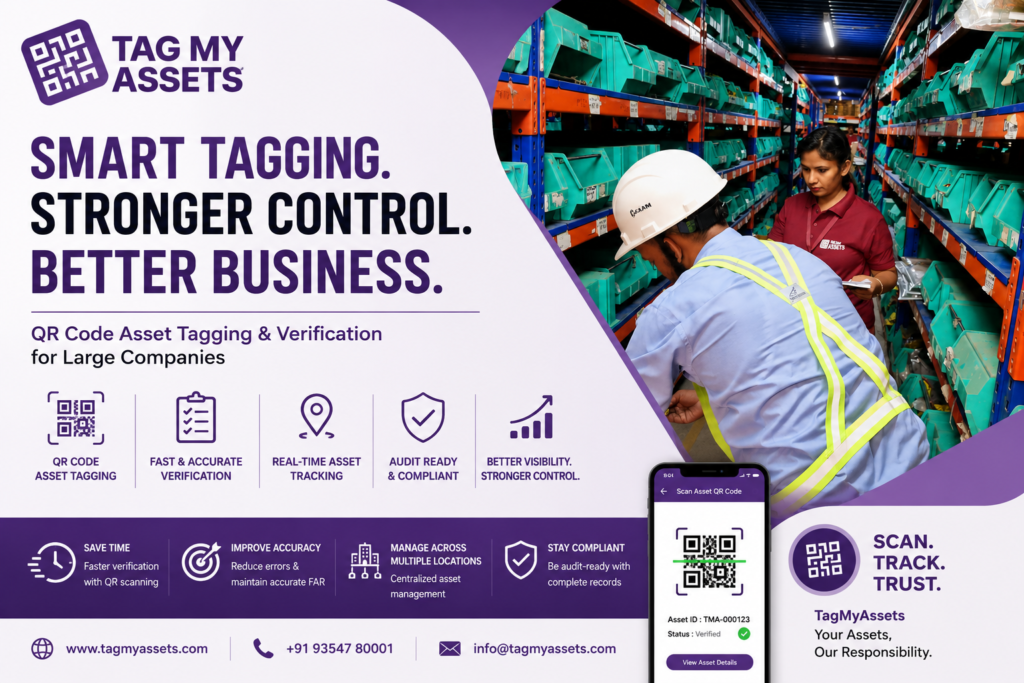
QR code asset tagging is the process of assigning a unique QR code label to every fixed asset for identification and tracking purposes.
Each QR code contains a unique asset ID linked with the company’s:
- Fixed Asset Register (FAR),
- asset management software,
- verification records,
- and asset details.
Using mobile applications or QR scanners, organizations can instantly scan and verify assets during audits and physical verification exercises.
QR code asset tagging is widely used for:
- machinery,
- office equipment,
- IT assets,
- warehouse inventory,
- tools,
- furniture,
- production equipment,
- and infrastructure assets.
QR Code asset tagging for large companies helps organizations improve asset visibility and maintain accurate audit-ready records across multiple locations.
Why Large Companies Need QR Code Asset Tagging
As organizations expand geographically, asset management becomes increasingly difficult.
Large enterprises often face issues such as:
- missing assets,
- duplicate records,
- outdated FAR records,
- incorrect asset locations,
- audit observations,
- and lack of asset visibility.
Managing assets manually across multiple locations creates operational inefficiencies and increases compliance risks.
QR code asset tagging helps organizations standardize asset identification and improve verification accuracy across all business locations.
Many manufacturing and retail businesses now use QR code asset tagging for large companies to simplify physical verification and FAR reconciliation.
13 Benefits of QR Code Asset Tagging for Large Companies
1. Faster Asset Identification
QR code labels allow instant identification of assets during audits and physical verification.
Instead of manually checking asset descriptions, verification teams can simply scan QR tags using mobile applications.
This significantly reduces verification time.
2. Improved FAR Accuracy
QR code asset tagging improves Fixed Asset Register (FAR) accuracy by linking physical assets with digital records.
It helps organizations:
- eliminate duplicate entries,
- identify missing assets,
- correct asset locations,
- and maintain updated asset information.
3. Faster Physical Verification
QR code scanning accelerates physical asset verification across factories, warehouses, offices, and retail stores.
Verification teams can scan hundreds of assets daily with greater efficiency compared to manual verification methods.
4. Better Audit Readiness
Statutory auditors often review whether physical assets exist and match FAR records.
QR code asset tagging improves audit readiness by providing:
- unique asset identification,
- digital verification records,
- asset location tracking,
- and verification history.
This helps reduce audit observations and compliance risks.
5. Real-Time Asset Tracking
QR code systems help organizations monitor asset movement across departments, branches, and project sites.
Companies can maintain updated records related to:
- asset transfers,
- asset custodians,
- current asset locations,
- and verification status.
6. Reduced Human Errors
Manual asset tracking frequently leads to:
- incorrect asset codes,
- duplicate entries,
- wrong quantities,
- and inaccurate reporting.
QR code scanning minimizes manual data entry errors and improves operational accuracy.
7. Better Internal Financial Controls
QR code asset tagging strengthens internal financial controls by improving transparency and accountability.
Organizations can better monitor:
- asset existence,
- asset ownership,
- utilization,
- and movement.
This reduces the risk of asset misplacement and unauthorized transfers.
8. Improved Compliance Management
Many organizations conduct periodic asset verification for compliance with:
- Companies Act requirements,
- internal audits,
- CARO reporting,
- insurance verification,
- and corporate governance policies.
QR code asset tagging helps maintain audit-ready records and digital verification evidence.
9. Easier FAR Reconciliation
During physical verification exercises, QR code systems simplify FAR reconciliation by matching physical assets with digital records.
Organizations can easily identify:
- matched assets,
- short assets,
- excess assets,
- and location mismatches.
10. Better Multi-Location Asset Management
Large companies operating across multiple plants, branches, warehouses, and retail outlets require centralized asset visibility.
QR code asset tagging enables organizations to manage assets efficiently across all operational locations.
This improves coordination and reporting accuracy.
11. Mobile App-Based Verification
One of the biggest advantages of QR code asset tagging is compatibility with mobile applications.
Verification teams can:
- scan assets,
- capture images,
- update asset locations,
- add remarks,
- and generate verification reports directly from mobile devices.
This significantly improves verification efficiency.
12. Cost-Effective Asset Management Solution
QR code asset tagging is highly cost-effective compared to many advanced tracking technologies.
QR labels are economical, easy to print, and simple to implement for large asset bases.
This makes QR code tagging suitable for organizations managing thousands of assets.
13. Better Decision-Making Through Accurate Data
Accurate asset records improve management reporting and operational planning.
Organizations can make better decisions related to:
- asset replacement,
- maintenance scheduling,
- procurement planning,
- asset utilization,
- and capital expenditure management.
Why QR Code Asset Tagging for Large Companies Is Important
QR code asset tagging for large companies is important because managing thousands of fixed assets across multiple plants, warehouses, offices, and project locations manually becomes difficult and error-prone. QR code-based asset tagging helps organizations improve asset visibility, maintain accurate FAR records, simplify physical verification, and strengthen audit readiness. Large enterprises also benefit from faster asset tracking, reduced human errors, improved compliance management, and better operational transparency through QR code-enabled asset management systems.
How QR Code Asset Tagging Improves FAR Accuracy
Fixed Asset Registers often contain inaccuracies due to:
- manual updates,
- outdated locations,
- duplicate entries,
- and unverified assets.
QR code asset tagging improves FAR accuracy through:
- periodic verification,
- digital asset identification,
- real-time updates,
- and systematic reconciliation processes.
This improves financial reporting quality and audit confidence.
QR Code asset tagging for large companies also improves internal financial controls and reduces operational errors during audits.
QR Code Asset Tagging vs Manual Asset Tracking
| Feature | Manual Tracking | QR Code Asset Tagging |
|---|---|---|
| Verification Speed | Slow | Fast |
| Accuracy | Moderate | High |
| Audit Readiness | Limited | Strong |
| Asset Visibility | Low | High |
| Multi-Location Management | Difficult | Efficient |
| Human Errors | High | Low |
Industries Using QR Code Asset Tagging
QR code asset tagging is widely used across industries including:
- manufacturing,
- engineering,
- automotive,
- healthcare,
- education,
- retail,
- logistics,
- warehousing,
- hospitality,
- and infrastructure sectors.
Organizations with large fixed asset bases benefit significantly from QR-based asset management systems.
Best Practices for QR Code Asset Management
Organizations implementing QR code asset tagging should:
- maintain standardized asset coding,
- conduct periodic physical verification,
- update FAR records regularly,
- use durable QR code labels,
- train verification teams,
- and maintain centralized asset databases.
Proper implementation ensures long-term operational and compliance benefits.
Conclusion
QR code asset tagging for large companies improves asset visibility, FAR accuracy, audit readiness, and operational transparency.
Organizations implementing QR code-based asset management systems benefit from:
- faster verification,
- improved reconciliation,
- reduced audit observations,
- stronger internal controls,
- and better compliance management.
As businesses continue expanding across multiple operational locations, QR code asset tagging has become an essential solution for maintaining accurate and audit-ready fixed asset records.
GS1 QR Code Standards – https://www.gs1.org/standards/gs1-qr-code
ISO 55001 Asset Management Standard – https://www.iso.org/iso-55001-asset-management.html
Ministry of Corporate Affairs (MCA) – https://www.mca.gov.in/