
Physical verification of fixed assets across India — confirm existence, assess condition, identify ghost assets, and prepare for statutory audit.
- Verify 500 to 50,000+ assets across single or multi-location operations
- Identify ghost assets, idle machinery, and custodian mismatches
- Receive audit-ready reports with photographs and exception logs
- Covering Delhi NCR, Mumbai, Bangalore, Pune, Hyderabad and PAN India
Request a free site assessment or call +91 96500 03293
Organizations invest heavily in machinery, IT assets, furniture, equipment, vehicles, infrastructure, and production systems. Yet many companies struggle to answer critical questions:
- Do these assets physically exist?
- Are they operational or idle?
- Who currently uses them?
- Are damaged assets still carried at full value?
- Are transferred assets reflected correctly?
These questions become increasingly important during statutory audits, insurance renewal, ERP migration, mergers, restructuring, or internal control reviews.
Unlike FAR reconciliation, which focuses on correcting accounting records, fixed asset verification focuses on confirming physical existence, utilization status, condition, custodian accountability, and operational readiness.
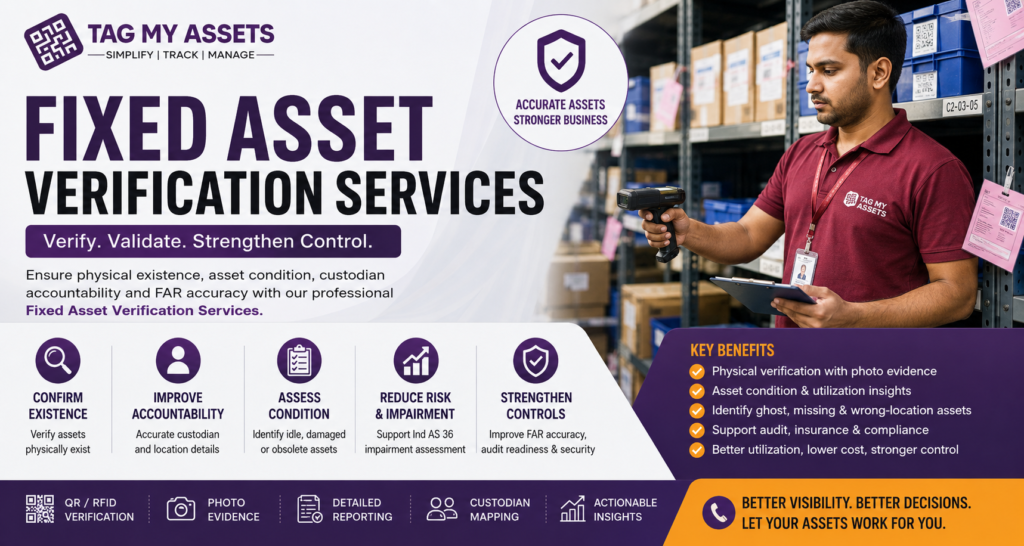
Companies generally seek fixed asset verification services before statutory audits, ERP migration, insurance renewal, mergers, asset tagging projects, or internal control reviews. Professional fixed asset verification services help organizations confirm physical existence, assess asset condition, improve FAR accuracy, and strengthen audit readiness.
What Are Fixed Asset Verification Services?
Fixed asset verification services involve physically checking assets against FAR records to confirm:
✓ Existence
✓ Location
✓ Custodian
✓ Condition
✓ Operational status
✓ Asset identification
✓ Tag availability
The process helps organizations improve FAR accuracy, identify damaged or idle assets, strengthen audit readiness, and support future reconciliation.
Why Fixed Asset Verification Matters Beyond FAR Accuracy
Unlike one-time counting exercises, fixed asset verification services provide structured evidence-backed reports covering asset condition, utilization, custodian mapping, and exception identification. This makes fixed asset verification services valuable for organizations managing thousands of assets across multiple locations.
Physical verification does more than confirm whether assets exist.
It identifies:
- Idle assets
- Damaged assets
- Obsolete equipment
- Custodian mismatch
- Wrong locations
- Utilization gaps
Example:
A production machine may physically exist but remain unused for years.
Accounting implication:
Potential Ind AS 36 impairment indicator
This makes verification valuable beyond audit compliance.
Verification therefore supports:
✓ Asset utilization
✓ Maintenance planning
✓ Impairment assessment
✓ Better capital allocation
9 Powerful Benefits of Fixed Asset Verification Services
1. Confirm Physical Existence
Verification confirms whether assets recorded in FAR physically exist.
Missing assets discovered early reduce future audit observations and improve record accuracy. Organizations with large multi-location operations often discover assets transferred, disposed, or replaced without corresponding updates in records.
Confirming physical existence creates the foundation for stronger controls, accurate FAR, and future reconciliation.
2. Detect Ghost Assets
Ghost assets create:
❌ Excess depreciation
❌ Inflated balance sheet
❌ Weak controls
Verification helps identify such discrepancies before audits. Detecting ghost assets early prevents organizations from continuing depreciation on unavailable assets and reduces the risk of overstated asset values.
3. Improve Custodian Accountability
Verification confirms who currently uses each asset and whether transfer records exist.
Many organizations discover laptops, equipment, furniture, and tools still assigned to former employees or departments. Strong custodian mapping improves accountability, reduces asset loss risk, and creates clearer ownership across functions.
4. Identify Idle Assets and Improve Asset Utilization
Physical verification often identifies machinery, IT assets, vehicles, or equipment that physically exist but remain unused for extended periods.
Idle assets increase capital inefficiency because organizations continue maintaining or depreciating assets that no longer contribute to operations.
Identifying idle assets helps management evaluate reuse, transfer, disposal, or replacement decisions.
5. Support Impairment Assessment and Financial Reporting
Verification may identify damaged, obsolete, or underutilized assets continuing to appear in FAR at historical values.
Such conditions may represent potential Ind AS 36 impairment indicators, requiring organizations to assess whether carrying value exceeds recoverable value.
Ignoring impairment indicators may distort financial reporting and overstate asset values.
6. Improve FAR Accuracy
Verification improves consistency between physical assets and accounting records.
Improved FAR accuracy supports future reconciliation, cleaner depreciation calculations, better insurance valuation, and stronger confidence during statutory audit.
7. Improve Insurance Accuracy
Insurance values based on inaccurate FAR records increase risk.
Verification helps organizations identify obsolete, disposed, or missing assets still included in insured values while ensuring important assets remain covered.
8. Improve Audit Readiness
Evidence-backed verification supported by photographs, custodian mapping, and exception reports reduces auditor queries.
Organizations with structured verification processes often experience faster audit closure and fewer unresolved observations.
9. Strengthen Internal Controls
Verification strengthens controls around asset movement, disposal, transfers, and ownership.
This reduces control gaps and supports stronger maker-checker processes.
Fixed Asset Verification and Audit Compliance
Fixed asset verification is not merely a counting exercise; it directly supports compliance with accounting standards, statutory audit requirements, and internal control expectations.
Under CARO 2020 Clause 3(i), auditors review whether organizations maintain proper PPE records, conduct physical verification at reasonable intervals, and address material discrepancies.
Verification also supports Ind AS 16, while Ind AS 36 becomes relevant where physical verification identifies damaged, obsolete, idle, or underutilized assets that may indicate impairment.
For government organizations and PSUs, GFR 2017 emphasizes periodic physical verification and stronger documentation practices.
Evidence-backed verification reduces audit risk and improves confidence in asset records.
Our 7-Step Fixed Asset Verification Process
Step 1: FAR Extraction & Data Collection
The process begins with extracting FAR data from ERP systems such as SAP, Oracle, Tally, Dynamics, or custom platforms.
Data generally includes:
- Asset code
- Description
- Location
- Cost
- Useful life
- Custodian
- Capitalization date
Early extraction frequently identifies duplicate records and missing locations.
Step 2: Asset Classification
Assets generally fall into:
Taggable
Countable
Non-taggable
Non-auditable
Classification matters because different asset categories require different verification approaches. Proper classification improves manpower planning, tagging strategy, and future reporting quality.
Step 3: Physical Verification
Teams verify:
✓ Existence
✓ Location
✓ Custodian
✓ Condition
✓ Supporting photographs
Verification identifies:
Ghost assets
Missing assets
Damaged assets
Idle assets
Step 4: Asset Condition Assessment
Unlike FAR reconciliation, fixed asset verification evaluates asset condition, not merely existence.
Teams generally classify assets as:
✓ Operational
✓ Damaged
✓ Idle
✓ Under maintenance
✓ Obsolete
Condition assessment supports maintenance planning, replacement decisions, and potential impairment review.
Step 5: QR / RFID Verification
Where organizations require stronger future traceability, QR or RFID tagging may be implemented.
QR generally suits:
Corporate offices
Retail
Hospitals
RFID becomes valuable where:
- Asset movement is frequent
- Bulk scanning required
- Verification speed matters
Tagging improves future verification efficiency and asset tracking capability.
Step 6: Exception Identification
Verification frequently identifies:
Missing assets
Wrong locations
Damaged assets
Custodian mismatch
Idle equipment
Each exception forms the basis for management action, corrective planning, future reconciliation, or replacement decisions.
Step 7: Reporting & Audit Documentation
Final reports generally include:
✓ Verification report
✓ Asset condition report
✓ Exception report
✓ Photographic evidence
✓ Management comments
These outputs support future audits, insurance assessment, and management decision-making.
Example Scenario: Verification Identified Idle Assets Worth ₹1.2 Crore
A manufacturing organization operating multiple facilities conducted fixed asset verification across approximately 18,000 assets.
Findings included:
- 5% idle machinery
- 3% wrong-location assets
- Obsolete equipment appearing operational in records
Management subsequently reviewed utilization, transferred usable assets between facilities, and initiated disposal of non-performing equipment.
Result:
✓ Improved utilization
✓ Better capital allocation
✓ Reduced audit observations
✓ Improved FAR accuracy
Industries We Support
Manufacturing
Manufacturing environments often face machinery transfers, idle assets, shutdown equipment, and duplicate capitalization. Verification helps identify equipment physically available but no longer operational, supporting utilization review and impairment assessment.
Retail Chains
Hospitals & Healthcare
Medical equipment frequently moves between departments, increasing custodian mismatch risk. Verification improves traceability, accountability, and maintenance planning.
Warehousing & Logistics
Forklifts, scanners, racks, and handling equipment move frequently between warehouses. Verification strengthens location tracking and reduces asset loss risk.
Public Sector Undertakings (PSUs)
Government entities and PSUs operate under GFR 2017, requiring stronger physical verification and documentation practices. Verification improves compliance readiness and strengthens evidence available during audit.
Corporate Offices
Hybrid work arrangements have increased IT asset movement between employees and departments. Verification identifies assets allocated to former employees or no longer in use.
How Often Should Fixed Asset Verification Be Performed?
Annual:
Suitable for most organizations and aligns with expectations around periodic verification. Annual verification is generally consistent with CARO 2020 expectations for physical verification of PPE at reasonable intervals, helping organizations maintain stronger audit readiness.
6 Months:
Recommended where asset movement is high, such as manufacturing plants, hospitals, warehouses, or retail chains with frequent transfers.
Quarterly:
Useful for critical, high-value, or highly mobile assets requiring tighter control and monitoring.
Post ERP Migration:
Strongly recommended because migration frequently introduces duplicates, wrong locations, and incomplete mapping.
Post Merger / Expansion:
Helps validate transferred, newly acquired, or reallocated assets before discrepancies accumulate.
QR vs RFID for Fixed Asset Verification
| Factor | QR | RFID |
|---|---|---|
| Cost | Lower | Higher |
| Scan speed | Moderate | Fast |
| Line of sight | Required | Not required |
| Bulk scan | No | Yes |
| Best use | Offices | Manufacturing |
Typical Deliverables Provided After Fixed Asset Verification
Clients generally receive:
✓ Verified asset register
✓ Asset condition report
✓ Missing asset report
✓ Exception report
✓ Tagged asset database
✓ Photographic evidence
✓ Custodian mapping report
✓ Audit documentation
Why Companies Choose Tag My Assets for Fixed Asset Verification Services
Tag My Assets delivers fixed asset verification services across India for manufacturing, retail, healthcare, warehousing, PSUs, and corporate environments.
Our fixed asset verification services combine physical verification, QR/RFID tagging, asset condition assessment, FAR support, custodian mapping, and audit documentation to create evidence-backed reports rather than manual spreadsheets.
We support SAP, Oracle, Tally, Dynamics, and custom ERP environments.
Frequently Asked Questions
What is fixed asset verification?
Fixed asset verification confirms whether assets physically exist, where they are located, who currently uses them, and whether they remain operational. The process helps organizations improve FAR accuracy, strengthen controls, identify damaged or idle assets, and support audit readiness through evidence-backed verification.
Does verification improve audit readiness?
Yes. Structured verification supported by photographs, custodian details, and exception reports improves confidence in asset records and reduces unresolved audit observations. Organizations with stronger verification processes generally experience smoother statutory audits and faster closure.
Is RFID mandatory?
No. RFID is valuable where asset movement is frequent, bulk scanning matters, or verification speed is important. QR codes remain sufficient and cost-effective for many office, hospital, and retail environments. The right choice depends on asset count, movement frequency, and future verification needs.
Does verification identify impairment risk?
Yes. Verification may identify damaged, obsolete, idle, or underutilized assets that indicate potential impairment under Ind AS 36. Such findings help organizations evaluate whether carrying value remains appropriate and whether additional accounting assessment is required.
Conclusion: Why Fixed Asset Verification Matters
Verification does not only answer:
Does the asset exist?
It also answers:
Is the asset operational?
Who currently uses it?
Does it continue generating value?
These answers improve:
✓ Controls
✓ Audit readiness
✓ Asset utilization
✓ Capital allocation
Need Fixed Asset Verification Services?
Need professional fixed asset verification services for manufacturing plants, warehouses, hospitals, retail chains, PSUs, or corporate offices?
Tag My Assets provides PAN India fixed asset verification services including:
→ Physical verification of fixed assets
→ QR/RFID verification
→ Asset condition assessment
→ FAR support
→ Audit documentation
→ Exception reporting
Contact Tag My Assets before your next audit cycle.
Need support with:
→ Physical verification of fixed assets
→ QR/RFID verification
→ Asset condition assessment
→ FAR support
→ Audit documentation
Contact Tag My Assets before your next audit cycle.
Related Services
→ Inventory Verification Services
→ Asset Tagging Services India
→ Physical Verification of Fixed Asset
→ Physical Verification of Fixed Assets Guide
→ CARO 2020 Physical Verification Guide